Webinars
Stay current with the latest webinars on artificial intelligence technologies. Explore more related webinars on TechTarget's BrightTALK platform.
-
How to Limit Risk and Exposure from Agentic AI
As agentic AI transitions from experimental technology to embedded workplace reality, organizations face an unprecedented expansion of their attack surface. This conversation examines the critical inflection point we've reached—where coding assistants, browser-integrated agents, and autonomous systems with persistent execution loops are becoming standard tools, accessible even to non-developers. Join Pascal Geenens, VP of Cyber Threat Intelligence at Radware, and Simon Ratcliffe, Independent Management & Technology Consultant, for a compelling 30-minute fireside chat exploring the emerging security challenges posed by autonomous AI agents in 2026. Pascal and Simon will navigate essential dimensions of this evolving landscape. They'll contextualize the fundamental shift occurring in 2026, including the "Bring Your Own Agent" phenomenon where autonomous agents are now integrated directly into operating systems and corporate workflows. They'll dissect the real-world threat vectors that security teams must address—from indirect prompt injection attacks and software supply chain compromises to the architectural trade-offs between cloud-based frontier models and self-hosted alternatives. Pascal will provide actionable guidance on risk mitigation strategies, exploring visibility frameworks, artifact proxies, LLM firewalls, and why intent-based protection models are essential when traditional content filters fall short. Whether you're a security professional, technology leader, or risk manager, this session offers critical insights into protecting your organization as AI agents become autonomous actors within your infrastructure.
 Pascal Geenens, VP of Cyber Threat Intelligence, Radware | Simon Ratcliffe, Independent Management & Technology Consultant
-
Open Source + AI: Where Attackers Move Next in 2027
Supply chain and AI security failures share a common thread. Adversaries identify structural gaps, assess potential impact, and act before defenders can respond. In 2026, this approach drove major incidents across open source, AI tooling, build pipelines, and interconnected vendor environments. However, attackers do not rely on static tactics. Their methods adapt faster than most organizations can adjust their defenses. Industy thought leader Yesenia Yser moves the conversation from retrospective analysis to forward-looking action. Using threat patterns, attacker behaviors, and governance breakdowns from 2026, she argues for anticipatory defense. The goal? To understand adversary strategy deeply enough to close architectural gaps before attackers exploit them, not after the damage is done. For 2027, Yesenia will identify the threat vectors set to define risk across open-source software, AI systems, and supply chains. The session will turn the hard lessons of 2026 into actionable foresight. Expect clear guidance on where advanced attackers are likely to strike next, which structural weaknesses enable those moves, and what defensive architectures can close the most critical gaps.
Yesenia Yser, Founder | Yes2Tech- Software Security Engineering Consulting
-
When Exploits Move at Machine Speed: Autonomous Agents and the Collapse of the Patching Window
The traditional patch window is gone, and automated AI exploitation is the reason. In the first half of 2026, web and API attacks more than doubled as autonomous agents with advanced scaffolding rose, and frontier and open-weight models became increasingly powerful. Join this session to unpack how AI models and advanced local agentic scaffolding are rewiring the threat landscape and how defense must adapt before it's too late.
Pascal Geenens, VP of Cyber Threat Intelligence, Radware
-
[EMEA] Be the Monster: Turning AI and Connected Security Against Attackers
Something is stalking your network, and it's getting faster. In 2025, the number of exploited high- and critical-severity vulnerabilities more than doubled, and newly disclosed ones now land on the known-exploited list in just five days.* Getting scarier out there doesn't mean it has to get scarier in here. Step 1: Don’t be prey. If exposure management sits in one lair, detection and response in another, and governance is locked in a tower down the hall, you never get a complete view of the castle - and attackers slip through the cracks. Step 2: Monster up. In this session, Rapid7's Wade Woolwine, Distinguished Software Engineer, Rapid7 and NVIDIA’s Erick Galinkin, AI Security Research Scientist, show you how to stitch security’s scattered parts into one formidable creature, jolt it to life with AI, and become the thing that haunts attackers' nightmares, from the boardroom risk view down to the alert on an analyst's screen. Learn how to: – Fuse exposure management, detection, response, and governance into one defense where every part makes the others stronger – Spot risk sooner, strike earlier, and drag attackers out of your environment faster – Separate AI's real power from the hype, and decide what it can be trusted to sink its teeth into Attackers are counting on you to cower in fear. It’s time to show them what they just woke up. *Source: Rapid7, The 2026 Global Threat Landscape Report: Decoding the Accelerated Cyber Attack Cycle
Wade Woolwine, Distinguished Software Engineer | Rapid7 Erick Galinkin, AI Security Research Scientist, NVIDIA
-
[APJ] Be the Monster: Turning AI and Connected Security Against Attackers
Something is stalking your network, and it's getting faster. In 2025, the number of exploited high- and critical-severity vulnerabilities more than doubled, and newly disclosed ones now land on the known-exploited list in just five days.* Getting scarier out there doesn't mean it has to get scarier in here. Step 1: Don’t be prey. If exposure management sits in one lair, detection and response in another, and governance is locked in a tower down the hall, you never get a complete view of the castle - and attackers slip through the cracks. Step 2: Monster up. In this session, Rapid7's Wade Woolwine, Distinguished Software Engineer, Rapid7 and NVIDIA’s Erick Galinkin, AI Security Research Scientist, show you how to stitch security’s scattered parts into one formidable creature, jolt it to life with AI, and become the thing that haunts attackers' nightmares, from the boardroom risk view down to the alert on an analyst's screen. Learn how to: – Fuse exposure management, detection, response, and governance into one defense where every part makes the others stronger – Spot risk sooner, strike earlier, and drag attackers out of your environment faster – Separate AI's real power from the hype, and decide what it can be trusted to sink its teeth into Attackers are counting on you to cower in fear. It’s time to show them what they just woke up. *Source: Rapid7, The 2026 Global Threat Landscape Report: Decoding the Accelerated Cyber Attack Cycle
Wade Woolwine, Distinguished Software Engineer | Rapid7 Erick Galinkin, AI Security Research Scientist, NVIDIA
-
ON-DEMAND 44 mins
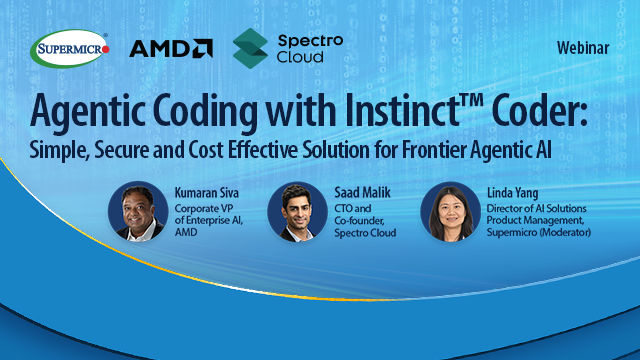
Agentic Coding with Instinct™ Coder: Simple, Secure and Cost Effective Solution for Frontier Agentic AI
Coding agents can generate millions of tokens a day as they read, reason, generate, test and retry. Supermicro, AMD and Spectro Cloud partner together to deliver the AMD Instinct Coder solution designed to moves suitable inference onto infrastructure the customer controls, while preserving frontier access for the hardest tasks. Learn how Supermicro AI servers with AMD Instinct™ GPUs and Spectro Cloud's PaletteAI Inference Launchpad deliver a more cost effective, pre-integrated, ready-to-deploy appliance for enterprise agentic coding. Presenters: - Kumaran Siva is the Corporate Vice President of Enterprise AI at AMD, where he drives strategic business development and product management for AI solutions. A seasoned technology executive, Kumaran has a deep background in processors, networking, and hyperscale environments. He previously led AMD's Cloud Business group and held leadership roles at Inphi, Broadcom, ARM, and PMC-Sierra. Kumaran holds an undergraduate degree in Electrical Engineering from the University of Waterloo and a master's degree from Harvard University. - Saad Malik, CTO and Co-founder at Spectro Cloud, leads technology strategy and innovation across modern infrastructure, Kubernetes, distributed systems, and enterprise AI. He is one of the core architects behind Spectro Cloud's PaletteAI platform and the Inference Launchpad, helping enterprises run and govern complex workloads across cloud, data center, edge, and regulated environments. - Linda Yang is a technology leader with over 20 years of experience spanning software engineering, networking, and AI infrastructure. From Cisco to PayPal and ServiceNow, she has led innovations in intelligent infrastructure and enterprise AI platforms. Today, as Director of Product Management, AI Solutions at Supermicro, she focuses on accelerating enterprise AI adoption, transforming cutting-edge technologies into scalable solutions, and delivering measurable business outcomes.
Kumaran Siva, Corporate Vice President of Enterprise AI (AMD); Saad Malik, CTO and Co-founder (Spectro Cloud); Linda Yang, Director of AI Solutions Product Management (Supermicro - Moderator)
-
ON-DEMAND 62 mins
Incident Management Has Outgrown Its Playbook: How IT Leaders Are Adapting for the AI Era
Modern incidents rarely stay contained. As cloud platforms, automation, third-party services, and AI systems become increasingly interconnected, traditional incident management approaches are falling behind. Join experienced IT leaders for a practical discussion on modernizing incident response, balancing AI with governance, and building resilient operations prepared for what's next.
Andrew Keating, Vice President, Product & Solutions Marketing, LogicMonitor; Julie Mohr, Principal Analyst, Forrester
-
ON-DEMAND 61 mins
96% of Companies Run AI Agents. Only 21% Can Control Them
96% of companies are running AI agents in production. Only 21% can actually control them. Gari Singh has watched this movie before. Three times. XML middleware, enterprise blockchain, and now AI infrastructure at Google Cloud, and every wave has the same opening act: teams rush to deploy before the platform team is even in the room. In this episode of [Dev]olution, Nicky Pike, and Gari break down what the outer loop actually costs you when agents go ungoverned, why "Ninja IT" is the new shadow IT, and what platform engineers need to do this Monday to stop building on a foundation that's already cracking. If you're still treating agent governance as a roadmap item, this episode is the reason to move it to the top of the list. In this episode, you’ll learn: - Why automating bad processes with AI just makes bad things happen faster - The three things every platform engineer should do this week, according to Gari - Why MCP servers are the new SOAP and will disappear in five years
Gari Singh, Product Manager, Google Cloud at Google | Nicky Pike, Field CTO at Coder
-
ON-DEMAND 20 mins
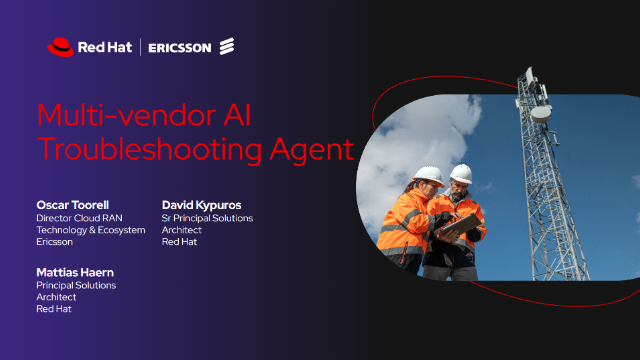
Multi-vendor AI Troubleshooting Agent
Discover how Ericsson, Red Hat, and Intel are using agentic AI to automate cross-vendor Cloud RAN fault diagnosis. In this webinar you will see a live demo exploring how secure AI agents identify PTP timing faults across RAN, platform, and hardware layers. Learn how to resolve remediation conflicts, and enable faster, more reliable autonomous operations. Live event not at the best time for you? In order to support our global partner ecosystem, all webinars are available on-demand after the live event. Register and you will receive an email reminder for on-demand viewing. *Red Hat collects your personal data when you submit information as a part of the registration process within BrightTalk. By registering for any of our webinars, you agree that Red Hat may contact you via email in regards to the webinars. If additional email opt-in is required for Red Hat to notify you about products, services and events that may be of interest to you other than these webinars, Red Hat will confirm opt-in via email. You may opt out of Red Hat’s marketing emails at any time via our Preference Center: https://www.redhat.com/en/preferences. For more information on each party’s privacy practices, please see: Red Hat’s Privacy Statement (https://www.redhat.com/en/about/privacy-policy).
Oscar Toorell, Director Cloud RAN Technology & Ecosystem Ericsson - David Kypuros, Sr Principal Solutions Architect, Red Hat - Mattias Haern, Principal Solutions Architect, Red Hat
-
ON-DEMAND 21 mins
SCC Simplify Episode 14 - AI and Cyber Resilience
AI has lowered the bar for attackers and raised the speed of every attack. Phil Atkin, Practice Director for SCC's cybersecurity practice, explains why the answer is cyber resilience rather than more prevention. In 20 minutes, Phil covers what has changed in the past 12 months, why boards now ask how quickly the business could recover rather than whether an attack was contained, and where to start if you're building resilience from the ground up. He makes the case for knowing what you're defending before you buy anything and for treating training as the cheapest control you have. He is also clear that the worst time to rehearse a breach is during one. Also covered: how AI cuts security triage from an hour to minutes while keeping a person in the loop, why certifications such as ISO and Cyber Essentials are moving towards continuous proof, and the data a CISO needs to answer "are we secure?" with something better than "maybe". For CIOs, CISOs, IT directors and risk leaders in enterprise and public sector organisations.
Kate Auchterlonie, Content Manager, SCC Digital hosts Phil Atkin, Practice Director for SCC's Cybersecurity Practice