Webinars
Stay current with the latest webinars on information strategy. Explore more related webinars on TechTarget's BrightTALK platform.
-
Awareness Alone Fails: Transform Security Habits Across SaaS Environments
Attackers exploit established routines and workflows, making traditional training ineffective. Human error is magnified in hybrid environments. The SaaS footprint keeps expanding, access paths keep shifting, and oversight becomes uneven. This drives up fraud losses, data exposure, operational downtime, and regulatory risk. Ultimately, customer trust, employee confidence and your security team's credibility are on the line. Leaders need to make the secure path the path of least resistance by embedding clear guidance and guardrails into daily workflows and tools. This session examines how organizations can move past compliance-focused training and implement a human-centered security strategy by identifying risky behaviors, reducing security friction, and building controls that employees naturally embrace. Fatema Fardan, Cybersecurity Digital Data Lead at a leading international bank, draws on lessons from banking, fraud prevention, and cybersecurity operations to show practical ways to measure behavior change, design effective security nudges and balance user experience with risk in today’s hybrid workplace. Topics for discussion include: - Pinpoint why awareness programs fall short and map risky behaviors across your environment. - Design controls employees actually use, from adaptive MFA to real-time guidance at critical decision points. - Counter phishing and fraud by integrating training, simulations, and behavioral nudges linked to identity signals. - Track what drives impact: reporting rates, time-to-report, reduction in repeat clicks, control adoption, and measurable ROI. - Establish a cross-functional operating model using pilots, A/B testing and leadership dashboards.
 Fatema Fardan, Cybersecurity Digital Data Lead | Leading International Bank
-
Weakest Link: How Security Gaps and Bad AI Hygiene Can Kill a Business
AI is already in your business, whether you rolled it out or not. Someone on your team pasted a contract into a chatbot this week, connected an AI assistant to their inbox, or signed up for a new tool with a work email, and every one of those moves opened a new door into your environment. In this session, John Hansman, CEO of Truit, a managed IT, cybersecurity and AI consulting firm, walks leaders through the security gaps and bad AI habits he sees most often in real organizations: free tools that keep or train on what employees type, shared and orphaned logins, sensitive data pasted into public AI, and AI agents wired into business systems with no owner and no oversight. He'll show how these small gaps chain together into a business-ending incident, and why adopting AI without a plan means adopting risk without a plan. Attendees will leave with: - A vendor-neutral, three-step framework (see it, secure it, strategize it) for finding the AI already in use. - Setting guardrails such as a short-written AI policy, an approved-tools list and clear data-handling rules. - Building a prioritized roadmap with an owner for every use case, so AI becomes an advantage instead of the weakest link. Meet the Speaker John Hansman is CEO of Truit, a family-owned managed IT, cybersecurity, and AI consulting company with offices in Tumwater and Spokane, Washington. He spent the first 20 years of his career in the electronic security industry, rising from entry-level technician to Central Station Manager and later IT Project Manager for a major corporation. He now helps organizations strengthen their cybersecurity, protect their data, and put AI to work safely. A frequent speaker for chambers of commerce and industry groups, including the Thurston County Chamber and the Washington Trucking Association, John turns complex cybersecurity and AI topics into practical steps business leaders can act on immediately.
John Hansman, CEO | Truit
-
Preparing for the 2027 Threatscape: A New Strategy for Operational Resilience
The speed of geopolitical risk continues to increase, not least in the differing approaches to the development of Artificial Intelligence (AI). Governments are now warning that it is "likely, if not inevitable" that national cyber defenses will at some point be breached. Among this growing spread of challenges, any new strategy must take account of the current level of operational risk. So ask yourself this question: do you do nothing, or do you move your organizational strategy towards planning for the worst? Join Steve Yates, Chairman of the Resilience Association and Liveryman of the Worshipful Company of Information Technologists, to explore lessons learned from past events and how you should position your organization to be sufficiently prepared for "business-as-unusual". Key Takeaways: - Identify 2027 threat landscape challenges. - Review the changing direction of operational risk. - Update operational readiness and response strategy. - Change leadership thinking about operational resilience. - Establish a joined-up way of thinking with internal and external partners.
Steve Yates, Chairman | Resilience Association
-
Open Source + AI: Where Attackers Move Next in 2027
Supply chain and AI security failures share a common thread. Adversaries identify structural gaps, assess potential impact, and act before defenders can respond. In 2026, this approach drove major incidents across open source, AI tooling, build pipelines, and interconnected vendor environments. However, attackers do not rely on static tactics. Their methods adapt faster than most organizations can adjust their defenses. Industy thought leader Yesenia Yser moves the conversation from retrospective analysis to forward-looking action. Using threat patterns, attacker behaviors, and governance breakdowns from 2026, she argues for anticipatory defense. The goal? To understand adversary strategy deeply enough to close architectural gaps before attackers exploit them, not after the damage is done. For 2027, Yesenia will identify the threat vectors set to define risk across open-source software, AI systems, and supply chains. The session will turn the hard lessons of 2026 into actionable foresight. Expect clear guidance on where advanced attackers are likely to strike next, which structural weaknesses enable those moves, and what defensive architectures can close the most critical gaps.
Yesenia Yser, Founder | Yes2Tech- Software Security Engineering Consulting
-

What to expect from COP31
Join LSEG's upcoming webinar as we explore the key themes, priorities and developments expected to shape discussions at COP31 in November. Bringing together experts from across finance and sustainability, we’ll discuss the themes likely to influence discussions in November and their relevance for organisations and investors. Topics are expected to include: • The key themes likely to shape discussions at COP31 • How organisations and investors are approaching climate transition • The latest research and insights on climate transition pathways Speakers will include: • Rachel Kyte, UK Special Representative for Climate • Jane Goodland, Group Head of Sustainability, LSEG • David Harris, Head of Sustainable Finance Strategic Initiatives, LSEG • Mustafa Adil, Head of Islamic Finance, MENA • Claire Dorrian, Head of Sustainable Finance, Capital Markets & Post Trade • Stephanie Maier, Head of Sustainable, FTSE Russell • Jaakko Kooroshy, Global Head of Sustainable Investment Research, LSEG • Paula Vanlaningham, Director, Carbon Research, LSEG Data & Analytics, LSEG
LSEG
-

Jupiter Merlin Monthly Webcast - October
Please join the Jupiter Merlin team for their latest update on the Jupiter Merlin Portfolios. The team will cover the recent market backdrop, fund performance, portfolio activity and the rationale for current positioning, as well as providing their outlook for the market and the strategy. A more detailed schedule of topics to be covered on the call will be made available in due course.
Merlin Team
-
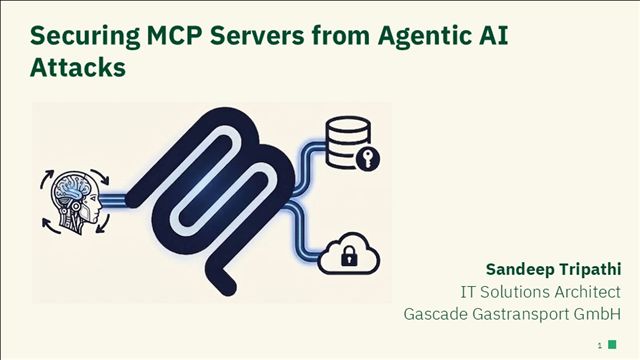
Securing MCP Servers from Agentic AI Attacks
Agentic AI is rapidly integrating into enterprise systems through the Model Context Protocol (MCP.) This introduces new and significant risks. Recent assessments reveal that 43% of tested servers are vulnerable to command injection, 82% use file operations susceptible to path traversal, and 33% contain critical vulnerabilities. Once a single server in a chain is compromised, the risk cascades to 72% of connected systems. Sandeep Tripathi will examine real-world incidents including tool poisoning, rug pulls, indirect prompt injection, and supply chain remote code execution. He will outline a practical defense strategy: establish clear trust boundaries, categorize tools by risk level, require human-in-the-loop approval for state-changing actions, sandbox runtime environments, and enforce strict schema and parameter validation. Sandeep will also introduce an MCP gateway designed for risk scoring, authorization, validation, approvals, and rate and result limits, along with AWS and Azure guardrails supported by continuous monitoring. Key takeaways: - Quantify MCP risk with hard signals and real attack paths. - Apply tiered policies: automatically approve read operations, and require human-in-the-loop approval for destructive or critical actions. - Contain the blast radius by enforcing isolation and using least-privilege scopes with just-in-time tokens. - Follow five essential rules: trust nothing by default, treat every server as a potential attack surface, authorize and audit each tool, minimize permissions, and require gating or reversal for material actions.
Sandeep Tripathi, IT Solutions Architect- Cloud | Gacade
-
ON-DEMAND 60 mins
DigiCert's Certificate Lifecycle Management: What We Learned Modernizing Our PKI with Trust Lifecycle Manager
If you’re planning to modernise your PKI, it helps to hear from someone who has already been through it. DigiCert implemented Trust Lifecycle Manager in production. With a complex certificate environment and very little room for error, it was critical for us to get this right. Hear from Jeremy Rowley, Senior VP, Strategy and former CISO at DigiCert, as he shares what the implementation actually involved: where we started, the challenges we ran into, what we changed along the way and what we would do differently knowing what we know now. You’ll learn about: - What DigiCert’s certificate environment looked like before Trust Lifecycle Manager - The practical challenges we encountered during implementation, and who to involve when - The operational changes required to improve visibility and automate certificate management - Lessons that could help make your own implementation quicker, easier and less risky - How the project reduced manual work and the annual dollar value delivered in addition to the priceless risk reduction for our brand
Jeremy Rowly, SVP, DigiCert | Bellinda Charleson, Director, DigiCert
-
ON-DEMAND 29 mins
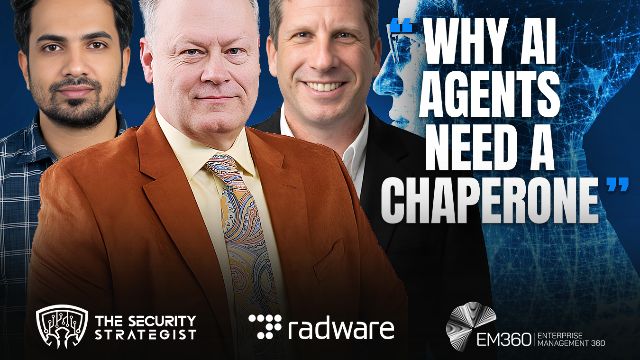
Can Runtime Security Keep Autonomous AI Under Control?
“Autonomous AI agents could take an entire task & run it from start to stop without intervention, without any directives, making agentic AI attacks far more vicious than what the industry is accustomed to in traditional applications.” The one key thing that could aid enterprise success in the agentic AI cybersecurity space today is its ability to understand agents' intent. It’s easy to state but hard to convert into an actionable security strategy. This is why in the recent episode of The Security Strategist podcast, host John Tolbert, Director of Research and Principal Analyst at KuppingerCole Analysis, is joined by Dror Zelber, VP Product Marketing at Radware and Dhanesh Ramachandran, Product Marketing Manager at Radware. They got together to discuss the emerging challenges of agentic AI security and how to tackle it realistically.
John Tolbert, Director of Research and Principal Analyst, KuppingerCole Analysis | Dror Zelber, VP Product Marketing, Radware | Dhanesh Ramachandran, Product Marketing Manager, Radware