Webinars
Stay current with the latest webinars on data analytics and operations. Explore more related webinars on TechTarget's BrightTALK platform.
-
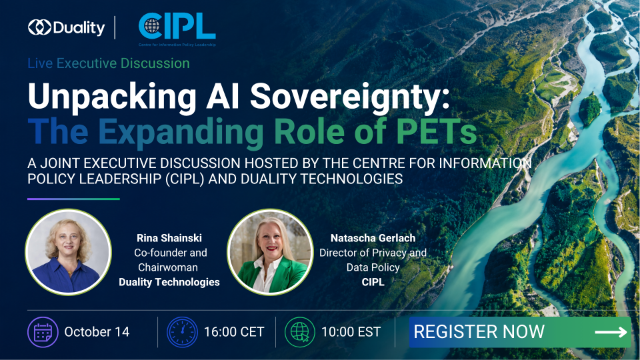
Unpacking AI Sovereignty: The Expanding Role of PETs - CIPL + Duality Live Discussion
Sovereignty discussions often centre on three questions: where data is stored, who operates the infrastructure, and which jurisdiction has authority over it. As AI workloads move onto cloud infrastructure and across organisational and jurisdictional boundaries, the more consequential questions concern control rather than location. Who controls access to the data and to the models? And who controls the environment in which they are executed? These questions can increasingly be answered through deployment of Privacy-Enhancing Technologies (PETs). (PETs) originally developed primarily to protect sensitive data and privacy during computation, are excellent tools for enabling digital sovereignty. By protecting data, models, and workloads while in use, PETs enable organisations to retain control over sensitive assets even when workloads run on infrastructure operated by others. PETs such as Trusted Execution Environments (TEEs), cryptographic key management and attestation, fully homomorphic encryption and secure multi-party computation allow an organisation to enforce access control to its most sensitive assets, irrespective of who operates the underlying infrastructure. These technologies are deployed and operating today. Legal, certification, and procurement frameworks, however, continue in some instances to place greater weight on legal and contractual safeguards than on demonstrable technical ones. The discussion will focus on that relationship between technical and legal means of achieving sovereignty objectives: what controlled environments can and cannot deliver; whether the operation of infrastructure and control over a workload can be meaningfully separated; how the analysis of laws such as the CLOUD Act changes when the question moves from what a provider may be compelled to disclose to what it is technically able to access; and how regulators should evaluate controls that are cryptographically enforced and independently verifiable.
 • Rina Shainski, Co-founder and Chairwoman, Duality Technologies • Natascha Gerlach, Director of Privacy and Data Policy, CIPL
-
Ransomware at AI Speed: Targeted Containment in a Layered Defense
Ransomware showed up in 48% of breaches in the Verizon 2026 Data Breach Investigations Report, yet 69% of victims didn't pay. Less profitable hasn't meant slower. CrowdStrike puts average breakout time at 29 minutes, and Sophos found 88% of payloads land outside business hours. Human-paced response can't keep up. What happens when ransomware gets past your defenses? Join Netrix and BullWall to explore the latest shifts in cyber threats, from AI-powered attacks and data exfiltration to destructive ransomware campaigns targeting organizations of every size. Our experts will share real-world insights into today's threat landscape and discuss how layered cybersecurity strategies help organizations detect threats earlier, respond faster, and contain attacks before they become business disruptions. As part of the session, we'll stop a ransomware attack live and show you exactly how BullWall's containment technology works. You'll see how BullWall interacts with the broader security stack, generating intelligence, integrating with MDR and security operations workflows, and helping organizations prevent large-scale data destruction when every second counts. Whether you're a CISO, IT leader, or security practitioner, you'll walk away with practical strategies for building a more resilient defense against modern ransomware threats.
Adam Berger, CISO at Netrix Global, and Christian Have, CTO of BullWall
-
ON-DEMAND 46 mins
AI & UK GDPR: What Leaders Get Wrong About Data Protection and AI Risk
Is your AI deployment actually a GDPR problem — or are you solving the wrong issue? Most leaders either over-panic about AI and data protection, or ignore it entirely. Craig Clark, Director of Clark and Company Information Governance Services and a practising CISO, cuts through the noise: AI only becomes a UK GDPR issue when personal data is involved — but when it is, the risks are serious and often misunderstood. Speakers: Craig Clark, Director at Clark and Company Information Governance Services; Stewart Tinson, Projecgt Director, AI-360. You'll learn: - Why AI is not automatically a GDPR issue — and the one question that determines whether it is - Why consent is not the most important lawful basis, and which lawful basis actually fits AI use cases - Why a global firm's AI agent hallucinated its entire sales strategy throughout 2026 — and what human oversight would have prevented it - How to approach DPIAs as a design tool, not a compliance tick-box - Why facial recognition bias disproportionately harms people who are not middle-aged white men - What to actually ask AI vendors regarding data usage and sharing Key topics: UK GDPR & AI • Lawful basis for AI • Special category data • DPIAs • Transparency obligations • Human in the loop • AI supplier due diligence • Facial recognition bias • Data minimisation • Security non-negotiables Essential viewing for CISOs, CIOs, legal, and compliance leaders deploying AI in data-sensitive environments.
Craig Clark, Director at Clark and Company Information Governance Services; Stewart Tinson, Projecgt Director, AI-360
-
ON-DEMAND 59 mins
DBTA Roundtable – Trusted Context for AI: Semantic Layers and Data Products
As AI moves from pilot into production, many organizations discover that access to data alone is not enough. Inconsistent business definitions, disconnected assets, and fragmented institutional knowledge quietly undermine the reliability of analytics, AI applications, and agentic systems. In this DBTA roundtable, industry experts examine how semantic layers and data products create the shared, governed context AI needs to operate with consistency and trust. They discuss practical approaches for aligning business meaning across the enterprise so analytics and AI initiatives can scale without sacrificing accuracy or accountability. In this session, you’ll learn how to: • Create consistent business definitions that analytics and AI systems can trust • Build reusable data products that support scalable AI initiatives • Improve governance while reducing fragmentation across data ecosystems • Provide AI applications and agents with trusted business context Whether you lead data strategy, governance, analytics, or AI initiatives, you'll gain practical guidance for creating trusted business context that improves the reliability and scalability of AI and analytics. Roundtable Participants: • Andreas Blumauer: Co-founder | SVP Growth, Graphwise • Ashwin Warrier: Vice President, Product, Incorta • Shawhin Mosadeghzad: Director, Agentic Intelligence, Simba • Susan Laine: Chief Data Technologist, Quest Software • Stephen Faig: Research Director, Unisphere Research and DBTA (Moderator)
Andreas Blumauer, Graphwise; Ashwin Warrier, Incorta; Shawhin Mosadeghzad, Simba; Susan Laine, Quest Software; Stephen Faig, Unisphere Research and DBTA (Moderator)
-
ON-DEMAND 36 mins
Rethinking HCI Economics: Nutanix and Dell Private Cloud
Hyperconverged infrastructure changed the data center. Now, a smarter approach can help organizations scale more efficiently. Watch this on-demand session featuring experts from Dell Technologies and Nutanix to discover how Dell Private Cloud brings a disaggregated three-tier architecture to Nutanix. By separating compute and storage, organizations can reduce costs, increase flexibility, and give IT decision-makers and business leaders more choice in how workloads are deployed. Building on a 15-year partnership and more than 20,000 nodes deployed, the session explores why typical HCI environments average only 26% CPU utilization and 41% memory utilization—and how to put that stranded capacity to work. You’ll also learn how organizations can: • Scale compute and storage independently, without adding full nodes simply to increase capacity • Reduce infrastructure costs by up to 65%, based on independent analysis • Connect Dell PowerStore and PowerFlex to Nutanix while retaining replication capabilities and the familiar Prism experience • Deploy and update clusters faster with the Dell Automation Platform and full-stack lifecycle management • Choose HCI or three-tier architecture for each workload, with one vendor for support The session concludes with a live demonstration of Dell Private Cloud running inside Prism.
Christopher Willis , Modern Data Center Team, Dell technologies & Darren Wollard, Principle Systems Engineer, Nutanix
-
ON-DEMAND 45 mins
Building an AI-Ready Data Foundation: How Cribl and AWS Turn Telemetry into Action
AI is reshaping how organizations operate, innovate, and compete, but success on the AI frontier depends on more than models alone. It starts with data. For most teams, exploding telemetry volumes, fragmented tools, and rising storage and observability costs make it difficult to get the right data to the right place at the right time, let alone put it in front of AI agents you can trust. Cribl and AWS discuss how a unified data strategy turns telemetry from a growing cost center into a strategic advantage. We'll show how Cribl serves as the control plane for AWS-native services like CloudWatch and S3 by filtering, enriching, and routing data in real time so IT, security, and operations teams (and their AI agents) can access clean, governed telemetry without costly rehydration or re-indexing. In this session, you'll learn how to: -Cut telemetry and observability costs by routing, filtering, and tiering data before it reaches expensive hot storage and monitoring tools. -Accelerate investigations and incident response by searching data in place across CloudWatch, S3, and other existing environments. -Strengthen governance by masking sensitive data and normalizing telemetry while keeping long-term data cost-effective and searchable. -Lay the groundwork for agentic operations, using AWS-native services and Cribl together to enable faster root-cause analysis and automated remediation. Whether you're modernizing your SOC, managing rising CloudWatch spend, or preparing your infrastructure for AI-driven operations, this session will show you how Cribl and AWS help you build a practical, cost-effective path to an AI-ready operations foundation.
Kam Amir, Cribl; Kishore Vinjam, AWS; Gabriel Costa, AWS
-
ON-DEMAND 59 mins
AI-driven telemetry is up 10x. This is how to scale visibility to match it.
AI-driven and agentic SRE workloads are driving an exponential increase in telemetry volume, putting Platform Engineering and SRE teams under more pressure to maintain visibility, control costs, and investigate issues faster. When data is fragmented across tools, teams, and storage tiers, both SRE teams and developer teams are left piecing visibility together across disconnected systems. The result is slower incident response, more administrative toil, and less access to the context needed to resolve issues quickly. Watch this practical session on how modern Platform Engineering teams are building a more scalable telemetry strategy for the AI era. We’ll explore how to centralize control over telemetry collection, routing, governance, and access so teams can support AI and agentic SRE workflows, reduce blind spots, improve efficiency, and give developers the right data in the tools they prefer. In this session, you’ll learn how to: -Scale visibility as AI-driven and agentic SRE telemetry volumes grow -Reduce operational toil with a more centralized, flexible telemetry model -Complement centralized telemetry models by giving developers choice and visibility to their telemetry - from search to AI-driven investigations Balance cost, governance, and team autonomy without slowing the business down See how Platform Engineering can deliver more control, better visibility, and faster answers for AI and agentic SRE in the modern operating environment.
Bill Emmett: Sr Dir Technical Product Mktg at Cribl and James Conway: Field CTO at Cribl
-
ON-DEMAND 45 mins
Ask Me Anything: DataSecAI 2026
DatasecAI 2026 is the biggest gathering of AI security leaders, bringing security, data, identity, and AI together in Dallas to tackle the questions shaping how AI gets secured. In this on-demand AMA, Shane Coleman, Chief Data Security Evangelist, and Michael Ferguson, Principal Data Security Services Architect, answer questions about datasecAI and securing data in the AI era. They cover the agenda, speakers, tracks, certifications, agentic AI, data and identity, and the security challenges teams are working through right now. Still deciding on datasecAI? Watch to plan your schedule before you arrive. Certification seats are limited and popular breakouts fill up early, so hear which ones to sign up for first. Get a preview of the conversations: why data and identity have to be governed together, and what the CISOs pulling ahead are doing differently. Hear where the agenda is going before everyone else does, then bring your hardest problem to the conversation in Dallas. Already registered? See what’s actually planned for Dallas: the Executive, Product, and hands-on tracks, the certification courses, the speakers, and what last year’s attendees took home. Find out whether the event is built for you, with guidance on which tracks and sessions were designed for CISOs, architects, data leaders, and AI builders. You’ll also get ideas for making the case to your boss, including what to put in your justification.
Marie Reyes, Head of Global Events & Executive Programs, Cyera | Michael Ferguson, Principal Data Security Services Architect, Cyera |Shane Coleman, Chief Data Security Evangelist, Cyera
-
ON-DEMAND 44 mins
Govern the Data Powering AI with Cyera and Snowflake
AI has moved from pilot to production across the enterprise, but scaling it safely is proving harder than most teams expected. The biggest blockers aren’t the models or the compute. They’re fragmented data, limited visibility, and weak access controls that undermine trust and compliance. Snowflake accelerates AI by centralizing data and enabling scalable access. But as sensitive data proliferates across environments, that same speed introduces new risk. Join Gal Pollak, Senior Product Manager at Cyera, and Navnit Shukla, Principal AI Architect at Snowflake, as they show how Cyera, an AI-native security platform, delivers full visibility, automated classification, risk prioritization, and policy enforcement across Snowflake environments, including Cortex AI, so organizations can scale AI on trusted, governed data. In this webinar, you will learn: • How Cyera secures Snowflake environments, including Cortex AI, with full visibility, automated classification, risk prioritization, and policy enforcement • The latest Cyera and Snowflake innovations • Where the two companies are headed together on securing AI • Real customer success stories
Navnit Shukla, Principal AI Architect, Snowflake | Gal Pollak, Senior Product Manager, Cyera | Michelle Zhang, Director of Product Marketing - Technology Alliances, Cyera
-
ON-DEMAND 4 mins
The Urgency for Data Security to Support AI Adoption
AI adoption is only as strong as the data behind it. And that data is becoming a bigger security risk. Omdia’s latest research on strategies for risk management to enable AI adoption highlights a clear concern. Data management is the top risk challenge, data privacy violations are the leading AI-related threat, and data loss is the top impact of AI-related cybersecurity incidents. As AI exposes previously “dark” data and gives employees and AI agents new ways to access it, organizations need to rethink how they protect, manage and recover their data. That means looking beyond traditional data loss prevention to areas such as data security posture management, data protection and data resilience. And there’s a bigger shift happening. AI: Rebalancing from investment to monetization is one of the four forces Omdia has identified as shaping 2027. As AI moves from experimentation toward a business imperative, security needs to help organizations accelerate adoption, not slow it down. As Todd Thiemann puts it: “It’s not like I can be part of team No saying, ‘Hey, slow down.’ The business, this is a business imperative. You need to help the business accelerate.” Secure the data. Enable the AI. Accelerate the business. Watch the latest Omdia Trend Watch with Melinda Marks and Todd Thiemann.
Melinda Marks, Practice Director and Todd Thiemann, Principal Analyst