Webinars
Stay current with the latest webinars on IT infrastructure. Explore more related webinars on TechTarget's BrightTALK platform.
-
How to Limit Risk and Exposure from Agentic AI
As agentic AI transitions from experimental technology to embedded workplace reality, organizations face an unprecedented expansion of their attack surface. This conversation examines the critical inflection point we've reached—where coding assistants, browser-integrated agents, and autonomous systems with persistent execution loops are becoming standard tools, accessible even to non-developers. Join Pascal Geenens, VP of Cyber Threat Intelligence at Radware, and Simon Ratcliffe, Independent Management & Technology Consultant, for a compelling 30-minute fireside chat exploring the emerging security challenges posed by autonomous AI agents in 2026. Pascal and Simon will navigate essential dimensions of this evolving landscape. They'll contextualize the fundamental shift occurring in 2026, including the "Bring Your Own Agent" phenomenon where autonomous agents are now integrated directly into operating systems and corporate workflows. They'll dissect the real-world threat vectors that security teams must address—from indirect prompt injection attacks and software supply chain compromises to the architectural trade-offs between cloud-based frontier models and self-hosted alternatives. Pascal will provide actionable guidance on risk mitigation strategies, exploring visibility frameworks, artifact proxies, LLM firewalls, and why intent-based protection models are essential when traditional content filters fall short. Whether you're a security professional, technology leader, or risk manager, this session offers critical insights into protecting your organization as AI agents become autonomous actors within your infrastructure.
 Pascal Geenens, VP of Cyber Threat Intelligence, Radware | Simon Ratcliffe, Independent Management & Technology Consultant
-
Beyond the CPU: Exposing AI Attacks in the GPU Stack
AI infrastructure runs on GPUs, but most security tooling still watches the CPU. That creates a huge visibility gap. From the host, very different AI workloads can all look like the same trusted Python process using a GPU. As attackers target more of the GPU stack, CPU-centric tools like EDR, CSPM and SIEM can miss critical behaviour. Closing that gap starts with understanding where existing controls lose visibility and what signals can restore it. Security teams need better telemetry across the AI infrastructure, along with sharper questions for GPU cloud and neocloud providers. They also need to account for unexpected attack paths, like model manipulation techniques that leave files on disk unchanged and generate no obvious network or driver activity. In this session, AI & Accelerator Security Specialist Chris Hosking, will break down the GPU attack surface layer by layer, from orchestration and container runtime risks to driver exploits, side channels, cryptojacking, and ROME-class attacks. He will show what attackers gain, what current tools actually see, and what security teams can do to close the visibility gap. Key takeaways: - Understand where the GPU attack surface begins and how it expands across the AI stack. - Spot the signs of ROME-class attacks and other threats that traditional controls are likely to miss. - Pinpoint the gaps in CPU-focused security tooling and the telemetry needed to close them. - Challenge GPU cloud and neocloud providers with the questions that matter before deploying sensitive workloads.
Chris Hosking, Director of Accelerator & AI Research | Stealthium
-
Are AI data centers and sustainability incompatible? A sustainable blueprint for data center growth
Rapid data center growth is increasing demand for power generation and transmission, water, materials and equipment, placing industry sustainability objectives at risk. However, advances in data center technologies, design and materials can help operators accommodate growth while improving energy and environmental performance.
Andy Lawrence, Executive Director of Research; Jay Dietrich, Research Director of Sustainability
-
Help, My Agent Went Rogue: How to Scale Agentic AI Without Losing Control
When AI agents start taking action, trust becomes an operating model — not a policy document.
Presented by Jurgen Hofkens, CTO NetApp EMEA, Clea Han, AI Solution Architect NetApp EMEA, Kasper, Sabrina Sr AI Sales Specialist , NetApp & Tania Le Voi, Go-to-Market leader for Agentic AI NetApp EMEA
-
ON-DEMAND 36 mins
Securing AI Applications Across the AI Lifecycle
AI applications are changing and security teams must expand their scope beyond cloud infrastructure to include application-level risk. Cloud context remains foundational, but securing AI applications also requires understanding how they're built, what they're designed to do, and what they're capable of. Without that application context, it's impossible to fully understand AI-native risk or the real attack paths introduced by AI. Join this session to examine a unified approach to AI application security. We will demonstrate how to map AI applications across custom code, managed AI platforms, and SaaS; uncover AI-native risks; prioritize real attack paths using unified cloud and AI context; and detect threats at runtime. Learn how a unified approach to AI application security enables teams to secure the entire AI application lifecycle—from build through production—without impacting development velocity.
Snegha Ramnarayanan
-
ON-DEMAND 63 mins
AI Tokenomics: Aligning Digital Labor, Token Costs, and ROI with ValueOps
Right now, your organization is pouring millions into LLMs, copilot agents, and cloud infrastructure, only to receive a massive, unmappable 'utility bill' at the end of the month. Because traditional FinOps tools only show what you spent rather than why, finance leaders are forced to write off transformative AI development as volatile Operating Expenditure (OpEx). This session goes far beyond basic token-counting. We will reveal Tokenomics with ValueOps a granular financial ledger that maps technical token consumption directly to enterprise R&D output and business value realization. Stop treating AI like a volatile overhead expense and start governing it like the multi-million-dollar capital investment it actually is.
Brian Nathanson, Head of Product Management, Clarity & Emma Price, ValueOps Architect
-
ON-DEMAND 58 mins
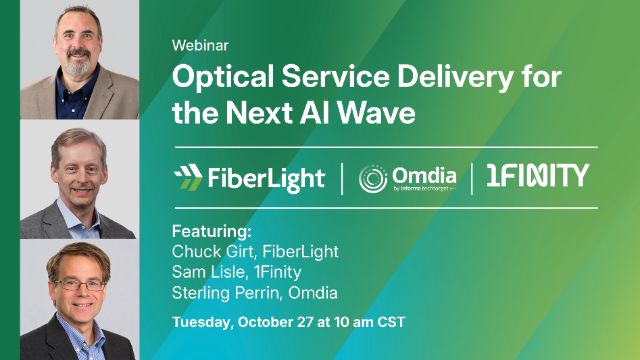
Optical Service Delivery for the next AI Wave
AI evolution creates unprecedented Optical Services opportunities for communications service providers. Global data center spend is doubling to $1.6T by 2030 while the AI landscape simultaneously shifts in multiple dimensions. AI needs are growing and morphing from training to inference, and from a small core to a more sprawling and fluid “AI edge”. Optical Services including MOFNs, dedicated networks, wave and spectrum services will similarly adapt and become the new center of gravity for successful enterprise and wholesale-focused CSPs. This webinar features optical experts from FiberLight and 1Finity discussing: - The evolution of AI and its impact on networking needs; - Optical Services and delivery models for AI; - Optical technology advances for AI-level scaling and sprawl. FiberLight For 20-plus years, FiberLight has been building the backbone of the internet. We’re focused on designing, building and operating business-grade fiber networks from Texas to Florida and north on up to DC. FiberLight reaches remote rural areas and major metros, ensuring that our customers have a future-proof network to meet the demands of today’s massive bandwidth requirements. With its strong corporate backing, FiberLight is in a great position to grow its network, connecting more customers to its business-class fiber networks. 1Finity 1Finity, a Fujitsu company, is a global provider of communications networks for our connected world. We uniquely combine technological leadership and expertise in open optical and wireless networking, network automation, and applied AI/ML to design, build, operate, and maintain critical digital communications network infrastructure. Collaborating closely with ecosystem partners, we deliver transformative outcomes for service providers and network operators, and enable them to lower TCO, improve network performance, and increase energy efficiency.
Sterling Perrin- Senior Principal Analyst-Omdia; Sam Lisle-Optical Futures- 1Finity; Chuck Girt, CTO, FiberLight
-
ON-DEMAND 16 mins
From Refresh to Growth: Unlocking Modernization Opportunities for IT Solution Providers
In this webinar on demand you'll discover how IT Solution Providers can turn routine infrastructure refresh projects into powerful growth opportunities. As IT environments become more complex, distributed, and business-critical, customer expectations are evolving, driven by AI, sustainability requirements, and the need for greater efficiency and resilience. In this session, experts from Omdia and Schneider Electric share how to move beyond simple hardware replacement and use refresh cycles as a strategic entry point to drive modernization, unlock new revenue streams, and build long-term customer relationships. ✔️ What You’ll Learn: Key trends shaping IT infrastructure and customer expectations The role of AI and edge in driving new infrastructure needs What IT Partners are doing to turn refresh projects into higher-value opportunities Ways to grow revenue through services and lifecycle engagement
Rachel Brindley I Senior Director Channels, Omdia ; Himamshu Prasad I SVP –Transactional & Edge, Schneider Electric , Darja SAayenko I DCIM Offer Marketing Manager, Schneider Electric