Getty Images/iStockphoto
EmTech Future 2026: Quantum sensing is here, more to come
Quantum technology feels like it's just within our reach. Advancements in quantum sensing show that we're much closer than we might think. But there's still progress to be made.

CAMBRIDGE, Mass. -- After AI, quantum could be the next technological breakthrough that revolutionizes everything. Experts have shared several different timelines for when they believe quantum will achieve commercial utility, but in some cases, it's already here.
Quantum is quickly becoming a new buzzword in the tech industry. In its most basic sense, quantum computing is the use of quantum mechanics in computing. While classical computers use bits that are either 0 or 1, quantum computers can harness quantum properties such as superposition and entanglement to achieve states between 0 and 1. These are called qubits, and they enable computations that are faster and more optimized, can run complex simulations and can solve complex problems faster than traditional computers.
At MIT's EmTech Future last week, industry leaders in the quantum space talked about the progress they have made in the field and what they think will come next. One of those topics was the strides made in quantum sensing: using quantum capabilities to enhance sensors, like GPS. Speakers also shared that we need to continue developing quantum algorithms to sustain advances in the technology and offered their thoughts on what the future might hold for quantum capabilities.
Quantum sensing is here
During his session "Quantum Sensing," Michael Biercuk, CEO and co-founder of Q-CTRL, a company that develops infrastructure software to make quantum computers viable and practical, talked about his company's work creating redundancy for commercial pilots' GPS using quantum technology.
"We receive radio frequency signals from satellites, and based on the timing of when those signals arrive, we can determine where we are," Biercuk said during his session. "There are lots of ways that you can interfere with this. Now, this has become a weapon of strategic and economic influence."
In the U.S., a short-term GPS outage is estimated to cost approximately $1 billion per day, and it's becoming a regular occurrence, Biercuk said. To combat this issue, Q-CTRL created a quantum sensor that can see "bumps and wiggles" in the Earth's magnetic field, enabling more precise navigation. He likened this functionality to how birds navigate during migration, using a molecule called a chromophore in their eyes that responds to magnetic fields and helps them travel accurately.
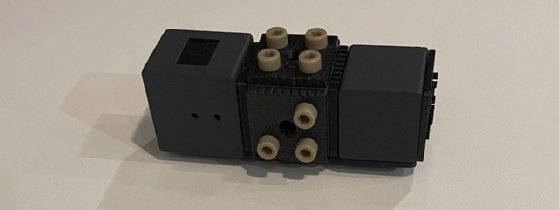
He then showed the audience a demonstration comparing two flights: one using Q-CTRL's quantum sensor and the other using an inertial navigation system, an alternative to GPS. Over the course of these flights, the one using the inertial navigation system strayed from its intended position, while the one using a quantum sensor stayed right on track.
Navigation isn't the only use case for quantum sensors. Danna Freedman, professor and director of MIT's QMIT quantum initiative, gave the audience an example of how quantum sensors can measure battery discharge during her session, "The Practical Quantum Moment."
"Quantum computing is coming, it's accelerating and user demand is growing," Biercuk told TechTarget. "All of those things are great, but we still don't have the … clear end use where everybody is saying 'Give me 1,000 of these.' In quantum sensing and navigation, we do."
Biercuk said that quantum sensing is the "big, near-term winner" in the quantum field, citing his company's customer base, which is purchasing thousands of these quantum systems. According to him, this success is "a critical bridge for the overall quantum sector."
We need quantum algorithms
While quantum sensing might be the bridge for the quantum sector, quantum computing won't be a viable tool without quantum algorithms to direct it.
"A quantum computer can solve a problem that has a quantum algorithm," Freedman said during her session. "This sounds simplistic, but part of that … shows to what extent we're relying on our algorithm writers in this area."
She used the example of Shor's algorithm, created by mathematician Peter Shor in 1994. The algorithm demonstrates how to factor numbers using a quantum algorithm and has been implemented on many quantum computers. Shor's algorithm, famous for its impact on current encryption methods, is often cited as a threat to public-key cryptosystems like RSA and is a driver of post-quantum cryptographic security.
"The future of quantum computing is largely going to be in the algorithms that we haven't determined yet," Freedman said. "This is a very open field, and why would anyone write an algorithm if they don't know why somebody would care?"
Jerry Chow, CTO of quantum-centric supercomputing at IBM, also talked about how quantum algorithms are key to harnessing the full potential of quantum computing in his session, "Quantum Convergence."
"There are really exciting problems that quantum computers have the opportunity to help us unlock and solve beyond what classical computers can do," he said. "And it all comes down to the kinds of algorithms that you can build around this kind of technology."
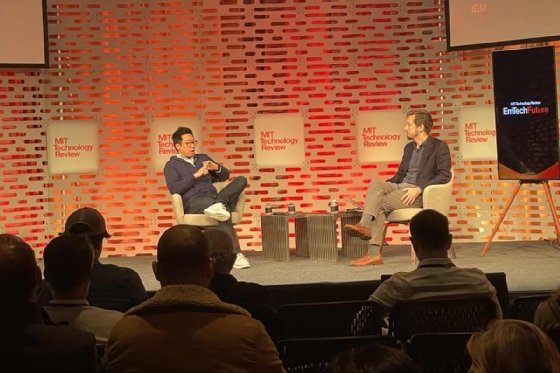
He gave some examples of the problems quantum computers could help solve, including better understanding molecular structures, which could help develop new materials and better batteries, optimize drugs and better understand energy processes. To create and understand the quantum algorithms that we will need to complete new kinds of work, IBM created Qiskit, an open source SDK for quantum algorithm research.
More enterprise-grade services are becoming available in this space, Biercuk told TechTarget. These tools are creating a class of end users who can benefit from these algorithms, even if they have no skills in the quantum-algorithm arena. These enterprise tools and open-source SDKs like Qiskit are enabling users of different skill levels to test and research quantum algorithms, pushing the space forward and exposing more people to quantum.
"There's a lot of work to be done in terms of the algorithm discovery, and we're trying to bring these tools to bear for users to push," Chow said.
Our quantum future
While quantum algorithm discovery is still a work in progress, recent advancements in the quantum field are making researchers optimistic about the technology's future.
"Industry roadmaps from at least some players have proven right many times," Biercuk told TechTarget. "When IBM announces that they're going to have a system with this size on this timeline, they very broadly met those milestones. And every time they release a new processor, it's better, and we can do more with it."
Beyond timelines, experts are looking forward to what, specifically, quantum will improve. One possible improvement that both Biercuk and Chow mentioned was the future impact of quantum on AI.
While quantum might not help in every facet of AI technology, there are certain areas it could prove beneficial, Biercuk said. "It stands to reason that the richness of quantum representation could give benefits in inference or in the model descriptions of reality, but there's much more that needs to be done before we really know."
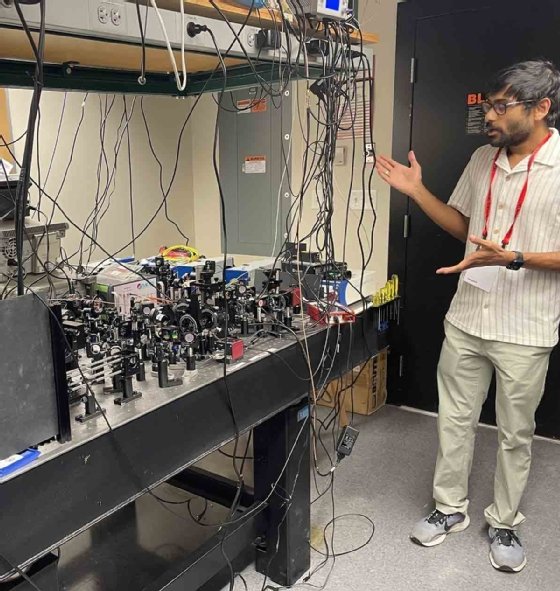
During a tour of the quantum labs at MIT, Atanu Ghosh, a postdoctoral associate at MIT, shared his hopes for the future of the quantum space.
"I think the quantum sensor has a huge potential for medical care, because it's going to revolutionize a couple of great things," he told TechTarget. "One example I give is MRI technology. Can you develop … a small sensor that has these tiny molecules that can go either inside your body or you can wear it and get the same information [as an MRI]? I think that's fascinating, and possible."
Everett Bishop is an associate site editor for TechTarget's AI & Emerging Tech group, covering AI, quantum computing and other emerging technologies.
Dig Deeper on Emerging Tech
-
![]()
The quantum technologies that will transform enterprise IT
By: Kerry Doyle
-
![]()
Quantum computing technology pushes for IT advantage
By: John Moore
-
![]()
What is a quantum circuit? Quantum vs. classical circuit
By: Leah Zitter, Ph.D.
-
![]()
What is quantum technology? Use cases and future implications
By: Kinza Yasar