The data center industry has done a bad job communicating with communities about new AI data centers, operators and advisors admit. Is it already too late to recover?
By
Beth Pariseau, Lead Editor, IT Infrastructure News
Published: 07 Oct 2026
LAS VEGAS – An industry used to obscurity has found itself thrown into the national political spotlight amid battles about AI data center expansion in communities across the U.S.
Residents of towns and cities where data centers are set to be expanded, or new facilities built, have expressed concerns about those facilities' water use, pollution from backup generators, noise and carbon footprint. They also worry about potential energy price increases and doubt whether new data centers will yield long-term local jobs.
Proponents of new AI data center construction argue that the facilities bring much-needed tax revenue to communities, and they warn that the U.S. risks falling behind China and other international rivals in developing AI. However, community pressure to block or restrict new data center construction has only grown.
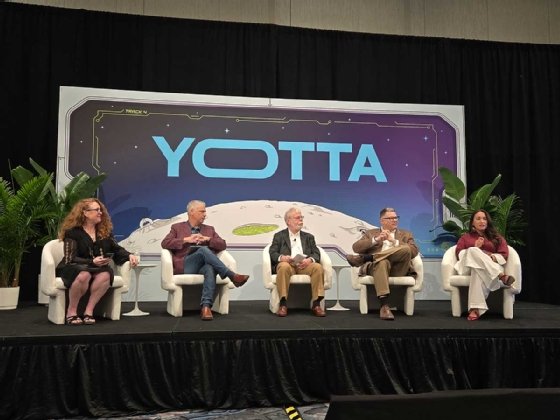
"The constraint on AI infrastructure is no longer just about power, land, capital, and equipment," said Ilissa Miller, founder and CEO at iMiller Public Relations, as she introduced a panel session she moderated during the recent Yotta 2026 conference about winning community trust. "It is permission, and the industry is treating permission as something to obtain rather than something to earn."
'Shame on you'
All four panelists in Miller's session agreed that the data center industry overall has not conducted proper community outreach.
"If we're going to get out of the hole, we're not going to get out of it alone, doing the same things. We're going to get out of it because we bring [communities] into the discussion with us," said Cyre Mercedes Quiñones, CEO at Infrastructure Masons (iMasons), a nonprofit digital infrastructure industry association that published a data center sustainability framework in 2021 and established the iMasons Climate Accord for digital infrastructure in 2022.
"We're not just trying to convince [communities] of all these great things that our industry is doing, but that we're really taking that time to listen with intention … to listen to understand with humility … and then defining what that mutually beneficial path forward is going to be, [rather than] the industry just trying to shove that down people's throats," Quiñones said during the panel discussion.
Moreover, some data center builders actively make matters worse when they operate without transparency and even in secrecy as they look to build in new locations, said Daniel Golding, CTO and managing partner at Appleby Strategy Group, an advisory firm to data center infrastructure providers and private equity funds.
Golding cited companies that compel local leaders to sign non-disclosure agreements (NDAs) as particularly egregious.
"If you were making local officials sign NDAs, I have no time for you because you're screwing up this entire industry," Golding said during the panel session. "You know for a fact that those NDAs are not enforceable, and yet you do it anyway to intimidate local officials and to make it look like we're all working in a smoke-filled room. Shame on you."
'A cloud of misinformation'
Community leaders should consider the potential benefits of data centers before bowing to public pressure to restrict or block projects, panelists said, adding that some projects are blocked due to misinformation. .
There are more than a few people throughout the county who think data centers don't pay taxes.
Fletcher Mangum,CEO and founder, Mangum Economics
"To a great extent, it's a communication issue that we need to overcome this cloud of misinformation that's out there," said panelist Fletcher Mangum, CEO and founder of Mangum Economics, an economic analysis firm in Richmond, Va. "There are more than a few people throughout the county who think data centers don't pay taxes."
On the contrary, he said, "data centers are a goldmine for localities … the major source of revenue for localities in the United States is property tax."
In Northern Virginia, the data center industry generated $1.3 billion in local tax revenue in 2025, Mangum said. Mangum and other panelists cited communities such as Richland Parish, La., whose teachers each received a $50,000 bonus earlier this year based on increased tax receipts linked to a Meta data center project. Mecklenburg County in Southern Virginia saw similar benefits from a Microsoft data center project, Mangum said.
Data center operators must also more clearly communicate – and directly deliver – the economic benefits of building data centers to community leaders and residents, Mangum said.
"You have this cloud of anti-data center agitprop, and we lose track of the fact that the reality is that data centers, and the AI buildout in particular, are one of the major drivers of gross domestic product right now," he said.
In interviews following the panel session at Yotta, Mangum and Golding further disputed the notion that all data centers hog energy and waste water.
"Data centers spend about half their budgets on electricity," Mangum said. "Use a lot of electricity, then you're in a position to want to economize, and [operators] have been at the forefront of those efficiency initiatives. And the same thing is true of water."
Golding also challenged claims from some communities that pollution from data centers has caused health issues nearby.
"Gas turbines are actually not significantly polluting," he said. "Much less so than a car or a truck. They're actually very clean. … There is some environmental propaganda about PFAS chemicals being emitted from data centers. None of that is true.
"There is absolutely zero data showing any negative health impacts where those studies haven't been directly commissioned by environmental pressure groups," Golding added.
Multiple government and academic institutions have called for more research on these issues, including the National Institutes of Health and the state of Colorado. Some industry research, such as a 2023 study by IEEE, found that data centers had a $6 billion public health impact in 2023, and estimated that growing infrastructure demands from AI would come with a $20 billion price tag in public health costs by 2028.
As for water and power usage, a 2025 study by Lawrence Livermore National Labs found wide disparities in water usage across facilities and concluded that "there is no single recipe for minimizing water use" by data centers. And a Global Energy Perspective report from McKinsey & Co. published Sept. 30 estimated that data centers will consume 10-15% of global power by 2030, and are the fastest-growing power segment in OECD countries. Beyond 2030, the McKinsey report states that growth trajectory could change if AI helps optimize energy systems for better efficiency.
Data center experts discussed winning community trust during a Yotta 2026 panel session. L-R: Ilissa Miller, iMiller Public Relations; Jeff Bladen, Verrus; Fletcher Mangum, Mangum Economics; Dan Golding, ASG; Cyre Mercedes Quiñones, iMasons
'We're paying our way'
Neocloud vendor Lambda is among the signatories to this year's White House Ratepayer Protection Pledge, which calls on AI companies to "build, bring, or buy all of the energy needed for building and operating data centers, paying the full cost of their energy and infrastructure."
The company is paying its own way for utility costs and grid upgrades in communities where it is building new data centers, such as Chouteau, Okla.
"We're bringing our own power," said Stephen Balaban, CTO and co-founder at Lambda, during a separate Yotta mainstage session. "We're making huge deposits to these utilities to both construct new transmission and construct new substations, as well as to basically underwrite new generation capacity on the grid."
The industry also needs to call balls and strikes on itself to get some credibility back.
Jeff Bladen, Head of energy and policy, Verrus
For every case of pollution-law violation, such as Data One in Vineland, N.J., which was hit with a million-dollar fine this year for operating non-permitted generators, there's a case like Janesville, Wis., said panelist Jeff Bladen, head of energy and policy at Verrus, a data center builder in Mountain View, Calif.
"You've got this developer willing to remediate a toxic waste site that used to be an automobile plant, which nobody was willing to remediate for 20 years," Bladen said. "The industry also needs to call balls and strikes on itself to get some credibility back. Say, if I'm a good actor, I actually tell you, 'This is what not good looks like, and so you can actually tell the difference.'"
Job creation is another benefit to communities, Mangum said. Mangum Economics performs a data center impact analysis for the Northern Virginia Technology Council every two years, and the most recent analysis in early 2026 showed that data centers directly and indirectly support 55,000 jobs in Virginia.
"The question is not whether we're going to have data centers, it's where, and there are communities that it's just not a good deal for, for one reason or another," Mangum said. "So, I think that we, as a community, need to get together, have an adult conversation … and decide how we move forward responsibly."
TechTarget's Beth Pariseau interviews Stephen Balaban, CTO and co-founder of Lambda, during a Yotta 2026 mainstage session on Sept. 29, 2026.
A failure to communicate
Still, some of the environmental and energy-use tradeoffs that come with certain technical practices are not easy to communicate to a broader audience, Balaban said.
"The real sad part, actually, about the water usage debate is that it actually increases the PUE [power usage effectiveness] pretty dramatically, going from an evaporative cooling system to a dry cooler system or a closed loop water chiller system," he said. "Go try to explain PUE in a 30-second spot on a local news station. You're going to fail pretty miserably."
Ultimately, the responsibility for communicating clearly about the pros and cons of data centers with a community rests with local political leaders, panelists agreed. But when public opposition is already so strong that officials who do champion the industry's perspective might just be seen as "captured" by it, Bladen said.
Take, for example, the case of Hazle Township, Pa., where a proposed $10,000 dividend to every resident from a proposed data center development project was seen by some as a "bribe," according to a Wall Street Journalreport.
"While lots of folks are too young to have lived this, the community memory still exists -- and is strong," wrote Matt Kimball, an analyst at Moor Insights & Strategy, in an email. "As we look at data center development, it's the same folks coming into city council meetings, putting up charts and telling us not to worry. … Rather than listening to concerns and working to be transparent, with safeguards and appropriate governance, we get spreadsheets, charts, and promises of jobs that are of shorter duration."
Given how fraught these issues have already become, it might already be too late for community outreach to be effective, Golding said.
"This should have been a panel two years ago, but we were so late in combating [the controversy] that we've almost pretty much blown it at this point," he said. "I'm not sure if this is a survivable scenario -- I guess we have to see."
Beth Pariseau, Lead Editor for IT Infrastructure News at Informa TechTarget, is an award-winning veteran of IT journalism. Have a tip? Email her or connect on LinkedIn.