How distributed computing drives revenue and resilience in cloud
Now is the time to align infrastructure decisions with the speed and expectations of your customers. See how distributed computing can create value and what to expect.
Distributed computing is not just an infrastructure concern -- it is a driver of revenue, resilience and experience, making it critical to an organization's technology strategy.
Distributed architecture is a system design approach in which computing, data processing and services are deployed across multiple locations -- core, edge and cloud -- to optimize performance, resilience and proximity to users or data, rather than relying on a single centralized environment.
Centralized resources, such as those found in standard cloud deployments, have significant limitations for real-time, data-intensive or location-sensitive use cases. This article helps IT leaders determine where distributed computing creates value, how to manage distributed infrastructure and what governance practices are necessary.
Where distributed computing creates value
Distributed architecture makes sense when performance, resilience and real-time outcomes matter most. Common design triggers include:
Ultra-low latency requirements such as real-time analytics and automation.
Data gravity and locality such as regulatory, sovereignty or performance constraints.
Bandwidth cost and efficiency considerations.
Not all data requires a distributed infrastructure. In many cases, standard cloud platforms are sufficient. Centralized cloud still wins in areas such as batch processing and AI model training.
To identify where distributed computing creates value, begin by mapping use cases to outcomes such as revenue growth, cost optimization and customer experience differentiation. Use a decision matrix to select among centralized, hybrid or distributed architectures.
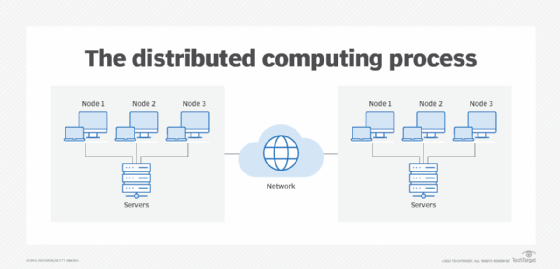
An example showing how networks, servers and computers are structured in distributed computing.
Manage infrastructure across core, cloud and edge
Use the following approaches to translate strategy into operational reality.
Investment prioritization
Investment decisions must be driven by clearly defined business outcomes, not just aspirations to modernize architecture. Prioritize distributed deployments that directly support revenue-generating digital services, latency-sensitive operations or regulatory mandates. Evaluate each investment against its expected business impact to ensure resources are allocated effectively. Follow these four steps;
Align investments with high-value use cases first.
Plan for incremental distributed deployments.
Avoid broad rollouts and over-distribution, such as ungoverned edge sprawl without ROI.
Balance Capex and Opex across environments.
Select investments for high impact and scalability, balancing capital-intensive edge infrastructure with flexible cloud services.
Select investments for high impact and scalability, balancing capital-intensive edge infrastructure with flexible cloud services.
Architectural patterns
Distributed architecture needs intentional workload placement and modern design patterns. Aligning use cases creates a cohesive system rather than a fragmented infrastructure. Several common architectural patterns fit specific use cases, which can include:
Hybrid and multi-cloud integration enable flexibility.
Containerization and orchestration help standardize deployments across core, edge and cloud environments.
Place latency-sensitive processing closer to the edge.
Place aggregation and analytics in centralized environments.
Operational implications
Distributed architectures add significant complexity compared to centralized models. Teams must manage diverse infrastructure, differing connectivity capabilities and geographically dispersed assets. Manual operations do not scale in distributed environments, so plan accordingly.
Expect increased operational complexity over centralized models.
Unify observability, orchestration and remote lifecycle management.
Centralized control planes and automation provides reliability, as well as enforces consistency and performance across all sites.
Governance in distributed environments
Effective governance addresses risks, maintains control and ensures consistency at scale.
Lifecycle management. Manage provisioning, updating and retiring distributed assets.
Security enforcement.Implement zero-trust models across environments and recognize the expanded attack surface at the edge.
Data consistency. Resolve synchronization challenges across nodes to balance consistency, availability and latency.
Regulatory and compliance. Maintain data sovereignty obligations and auditability.
Talent and organizational readiness
Shifting to a distributed architecture is an organizational long-term change rather than a technical deployment project. Success depends on teams designing, operating and optimizing systems that span core, cloud and edge environments. This requires new skill sets across engineering, data streaming, security and operations. These talents are often scarce, requiring development within existing talent pools.
Traditional silos between infrastructure, applications and operations teams impede distributed environments. Many organizations use platform-based models, where centralized teams provide standardized tooling, automation and guardrails, while product teams retain the necessary flexibility in how they deploy and run workloads. DevOps and site reliability engineering are critical to managing complexity at scale.
Failure to account for these challenges means the distributed architecture could become fragmented, costly and difficult to sustain.
Linking architecture to business outcomes
Distributed architectures do not address every operational requirement, nor do they support every workload. The essential element is determining whether distribution offers a measurable impact on essential business processes.
Distributed computing is a continuous capability that scales with evolving business needs, not a one-time project. It enables:
New digital innovations and products.
Real-time decision-making.
Enhanced customer experiences.
Centralized designs have become a constraint -- reevaluate where the organization runs, not just what it runs. If the architecture can't support real-time or location-aware experiences, a competitor's will.