A primer on modernization strategies for legacy systems
Legacy systems are more than just a drag on efficiency or merely older programs; they are strategic inhibitors that prevent resilience, innovation and growth.
The last thing modern organizations need is to impede agility or interfere with essential daily functions. Legacy systems do exactly that. However, they are more than merely outdated. Common legacy system issues include:
Constrains agility, decision-making and speed to market.
Increases operational risk and fragility.
Prevents businesses from maximizing investment returns on other systems.
Locks organizations into inflexible processes and technologies.
Prevents businesses from introducing cutting-edge products.
Legacy systems include older applications, platforms or technologies that remain in use despite being based on outdated architectures, infrastructure or programming languages. They often underpin critical business operations, making them difficult to replace. They may be characterized by high maintenance costs, limited scalability, poor integration with other tools, security vulnerabilities and reliance on specialized or older skill sets.
System modernization is the process of updating, transforming or replacing IT systems to better support current business needs, technology standards and future growth. It typically involves rethinking architecture, workflows and integration, targeting performance, integration, security and scalability.
When approached strategically, system modernization is a critical enabler of innovation and long-term resilience. Failing to address modernization opportunities represents a significant and broad organizational risk.
The business case for modernization
Positioning system modernization as a strategic investment means enhancing resilience, reducing costs and enabling the organization to pioneer new opportunities. Modernization is more than just a technical upgrade; it's a chance to reexamine what works and what doesn't.
Modernization is more than just a technical upgrade; it's a chance to reexamine what works and what doesn't.
Boost resilience
Legacy systems are often brittle because they rely on tightly coupled components, single points of failure and manual recovery processes. Furthermore, they lack upgrade opportunities that address these concerns. System modernization enhances the resilience of existing business workflows.
Modernized systems, by contrast, are designed to handle failure. Workloads on cloud-native platforms, modular architectures and automated recovery mechanisms can scale dynamically and recover quickly from incidents. Modernization strengthens business continuity and enhances customer trust by reducing downtime, limiting the blast radius of failures and enabling quicker incident responses.
Reduce long-term costs
Modernization requires upfront investments in resources, time and effort, but it significantly lowers costs over time. Legacy systems may demand expensive maintenance, specialized support skills and inefficient workarounds to keep them operational. Modern platforms reduce technical debt, simplify operations, enable automation and lower infrastructure costs via cloud consumption models. Focus on the benefits of modernization from a total cost of ownership perspective.
Enable innovation
Perhaps the most strategic benefit of modernization is its ability to unlock innovation and enhance agility. Legacy systems impede experimentation due to their rigidity and lack of integration. This friction discourages new ideas and limits responsiveness to market opportunities.
Modernized systems act as a flexible foundation for innovation and experimentation. Modular services, APIs and data accessibility lend themselves to building, testing and deploying new capabilities rapidly and with minimal cost in time and effort. Today's emerging technologies -- AI, automation and advanced analytics – are more easily adopted without extensive reworking of existing systems. Modern systems transform IT from a constraint to a catalyst for growth.
The challenges of legacy system modernization
Modernizing legacy systems is complex and risky. Many initiatives fail or struggle because they underestimate these challenges. Identifying and planning for these obstacles is essential to a successful modernization strategy. Common challenges include risks to business continuity, architectural complexity, data management and cultural resistance. Addressing these risks involves effective governance.
Risk to business continuity
Legacy systems frequently support mission-critical operations, making any change inherently risky. Organizations are often reluctant to touch functional systems for fear of downtime, performance degradation or functional regressions that impact customers and revenue. Modernization efforts must be carefully staged, with robust testing, rollback mechanisms and parallel operations where possible.
Architecture complexity
Many legacy systems evolved over time, with ad hoc layers of enhancements, hidden dependencies, workarounds and patches. They may be tightly coupled with other systems, lack documentation and be based on a monolithic design incompatible with today's architecture.
This complexity makes it challenging to isolate functionality, introduce new technologies and migrate components incrementally without unintended consequences. Such complexity further underscores the need for careful testing and rollback planning, along with effective documentation.
Data integrity, compatibility and compliance
Legacy systems may rely on outdated data models, inconsistent or incompatible formats, or tightly bound application logic. Migrating or synchronizing this data without loss, corruption or duplication is often a significant challenge. However, data is one of the most valuable -- and vulnerable -- business assets. Ensuring compliance with regulatory requirements for privacy, security and retention is critical. Failure to maintain data integrity or adhere to compliance standards may result in legal or financial penalties.
Cultural resistance
System modernization is as much a cultural challenge as it is a technical one. IT teams that have maintained legacy systems for years may resist changes due to familiarity, fear of job displacement or concerns about learning new technologies. Skills gaps, unclear ownership and a lack of shared vision can further slow progress.
Users may also resist change for their own reasons. They are intimately familiar with how the legacy systems work, and their job requires using them successfully. Any disruption threatens their productivity and performance. These users may also resist the growing pains associated with relearning new processes and software.
Without strong leadership, clear communication and investment in upskilling, cultural resistance can undermine even the most well-designed modernization plans.
Proven modernization patterns
There's no need to reinvent the wheel with system modernization. Established patterns and repeatable approaches exist that allow controlled, low-risk system modernization projects. These patterns emphasize business continuity with incremental changes, enabling IT leaders to manage complexity, reduce risk and deliver value progressively.
Three common modernization approaches are the strangler fig pattern, replatforming and domain decomposition.
Pattern 1: Strangler fig pattern
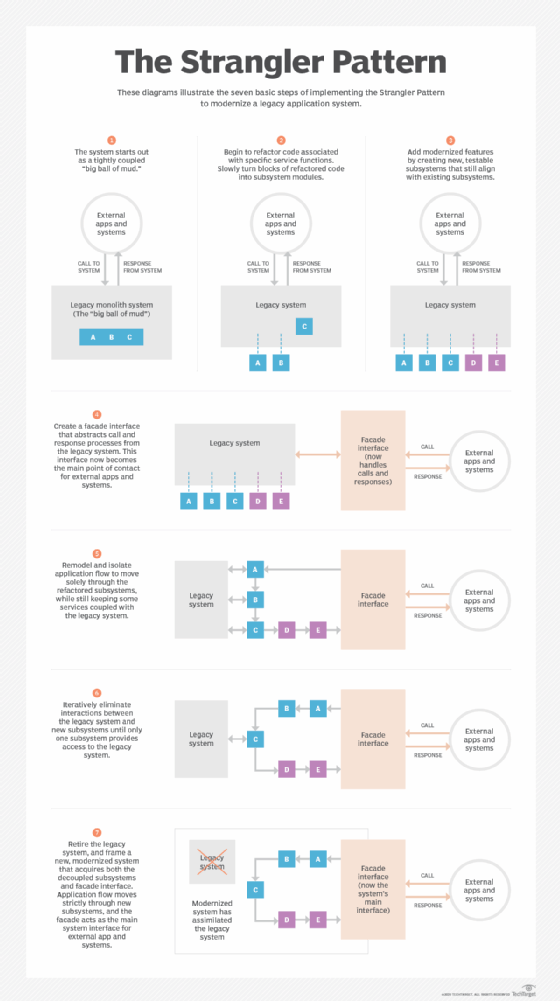
This strangler fig pattern is an incremental modernization approach that builds new functionality alongside legacy systems and gradually replaces them over time. Instead of rewriting an entire application at once, it implements specific features as modern components. The pattern gets its name from gradually "strangling" the legacy system.
Benefits include:
Reduced risk to business continuity and functionality.
Continuous validation.
Effective rollback processes if required.
To be successful, the strangler fig pattern requires strong architectural oversight, clear interfaces and close collaboration between development and operations teams. Many organizations can implement this pattern in-house.
Pattern 2: Replatforming
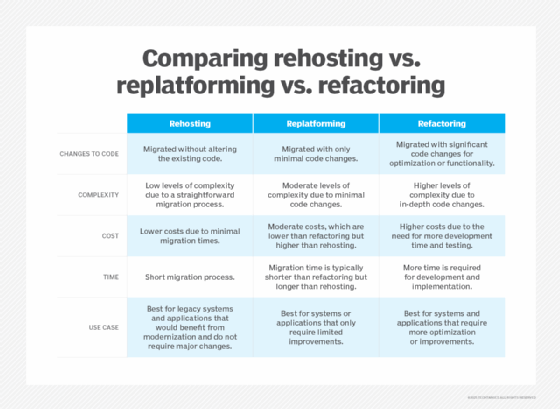
Replatforming focuses on moving applications from legacy infrastructure to modern platforms, such as cloud environments. Changes to the application's code are minimal, making the pattern faster than other approaches. This pattern seeks to improve scalability, performance, reliability and cost efficiency quickly without requiring a complete rewrite or refactoring of the application.
Replatforming is often a practical first step in system modernization. While it can be done in-house, many organizations find it more efficient to leverage the expertise of external partners to accelerate migration and reduce risk. The pattern requires expertise in cloud architecture, infrastructure automation and platform services.
Pattern 3: Domain decomposition
Domain decomposition involves breaking down large, monolithic systems into small, domain-aligned services. These domains represent distinct business capabilities, enabling clearer ownership, independent development and improved scalability.
However, the domain-driven pattern can be complex and resource-intensive. It is best suited to organizations that already structure modern components using domain-driven design principles, microservices and modular architectures. These organizations typically already have the necessary deep understanding of business processes, experienced architects and strong collaboration between business and technical teams. Combining in-house expertise with external partners helps ensure successful execution.
Damon Garn owns Cogspinner Coaction and provides freelance IT writing and editing services. He has written multiple CompTIA study guides, including the Linux+, Cloud Essentials+ and Server+ guides, and contributes extensively to TechTarget Editorial, The New Stack and CompTIA Blogs.