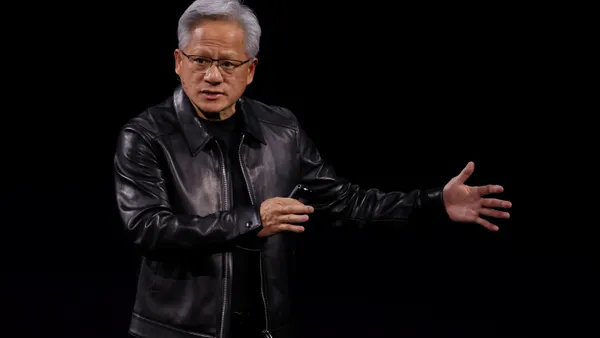


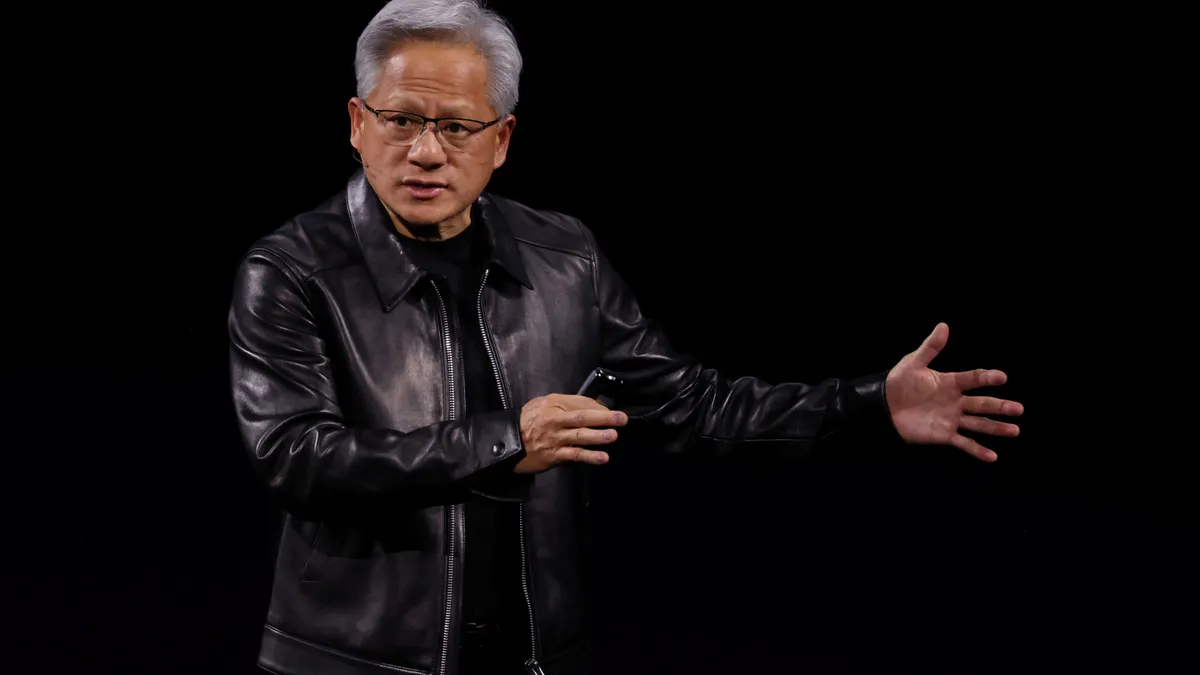
While the possible ouster of Nvidia CEO Jensen Huang after reports of extramarital affairs with a suspected Chinese spy and a member of his top staff likely won’t affect Nvidia’s position as the leading producer of AI chips, the prospect of his departure exposes structural risks in AI spending and valuations.
The uncertainty could give skeptical enterprises another reason to start to back away from AI.
On Wednesday, The Wall Street Journal reported that Nvidia's board was preparing to meet to determine Huang’s future. The new development comes after reports indicate that Jensen Huang began a relationship with Alice Huang, a former executive at the Singapore-based AI data center company MegaSpeed International, in 2023 and 2024.
Over that period, MegaSpeed and companies connected to it acquired billions of dollars of equipment containing Nvidia AI chips. U.S. intelligence officials also briefed President Donald Trump in October 2025 about concerns that Alice Huang was a spy for China’s Ministry of State Security.
Jensen Huang is not related to Alice Huang. He is the charismatic face of AI, and his potential fall comes at a rocky time for the AI business. After the November 3 U.S. midterm elections, Nvidia’s stock and that of other AI data center-related companies declined. Since then, those shares have rebounded. However, the recent debacle that is rapidly enveloping Nvidia is raising doubts about what will happen to the GPU giant – which became the world’s most valuable company during the AI boom.
Nvidia funds the top AI model makers, such as Anthropic and OpenAI, as well as the biggest neocloud vendors, such as CoreWeave.
The effect on Nvidia
Although Huang might face serious problems with the U.S. government because of his relationship with Alice Huang, Nvidia will likely be fine, maintained R “Ray” Wang, founder of Constellation Research.
“They’ve got a product roadmap,” Wang said. “They’ve got products that are going to come out, and so they have to execute on the roadmap.”
Wang also said he thinks that, given the situation, investors realize they don’t necessarily need Nvidia to do well in the markets, because while Nvidia’s stock is plummeting, the rest of the AI trade is still on the upswing.
For Wang, a veteran tech and AI analyst, Nvidia’s troubles aren’t likely to sway enterprises much. However, it could give them some new options to avoid vendor lock-in, he suggested.
“It’s not going to affect what they do as enterprises in the sense that they still need chips; they still need compute. Nvidia is still the leader in the space,” Wang said. “It gives people the freedom to go choose someone else if they have the product.”
A shaky industry
David Nicholson, an analyst at Futurum Group, said the tumult at Nvidia doesn’t change the company’s role as a major investor in a slew of AI vendors, cloud providers and neocloud companies. Still, it exposes a risk tin how the industry is financed.
The AI business is locked in an “intertwined and incestuous” circle, with Nvidia at the center point, Nicholson said.
The Silicon Valley company is building the preferred hardware for generative AI, especially as hyperscalers and cloud providers continue to buy Nvidia’s GPUs.
Nvidia has also been providing financial backing to infrastructure companies, including CoreWeave and the 49-year-old tech giant Oracle. Those companies in turn use that support to buy Nvidia’s hardware and rent it out to the AI market. The data centers these infrastructure companies have built are filled with Nvidia equipment, and top AI model providers such as Anthropic and OpenAI have committed to buying access to it.
The problem is that the cycle works only as long as AI users are willing to keep buying into AI technology, Nicholson said.
“It all hinges upon whether the end users, enterprise customers … are going to continue to do so,” he said.
The current market situation, especially with the new lower-than-expected valuation of Anthropic’s IPO expected next week by most accounts, suggests a pullback. As enterprises seek a return on their AI spending, they are finding it hard to justify the investment. Anthropic and OpenAI are also engaged in a price war to attract enterprises, putting pressure on expectations for both Anthropic’s IPO and OpenAI’s, which is expected next year.
Therefore, Nvidia’s situation could be the catalyst prompting some enterprise customers to retreat further, Nicholson said.
“A lot of people are going to point to what’s going on with Nvidia right now as being the primary mover of Nvidia’s valuation, and I would just say that’s nonsense,” he said.
Skepticism about AI technology has been building for some time, with enterprises unsure about quick ROI from staggeringly expensive AI technology. Also, it’s become apparent that open source AI models, particularly from China, but also, increasingly, from the West, can be cheaper for enterprises than the powerful proprietary models from Anthropic, OpenAI, Google and others.
Perhaps ironically, Jensen Huang and the company he co-founded in 1993 and has led since, with no clear successor, have been ardent advocates of open source as a more democratic and transparent approach to AI technology.
Esther Shittu is a TechTarget AI reporter, podcast host and producer.