sdecoret - stock.adobe.com
Human augmentation is closer than we think, experts say
Researchers at EmTech Future shared current progress in robotics and human augmentation, as well as their vision for human-AI symbiosis and the growing potential of humanity.

CAMBRIDGE, Mass. -- Augmenting humans with technology could push us into the next stage of evolution, curing and preventing disease with nanotechnology, improving physical feats with exoskeletons and maybe even making us unrecognizable.
Earlier this week, speakers at EmTech Future 2026 hosted sessions that centered on the theme of convergence, exploring topic areas that depend on the intersections of different technologies. One of the convergences the conference highlighted exists at the intersection of AI, biology and robotics: human augmentation.
Human augmentation includes all technologies that enhance or repair human capabilities, either to their optimal states or exceeding them. While the conversations began grounded in human health, researchers' predictions for the future verged on science fiction as they teased theories of human-AI symbiosis and bodily modifications that merge human and animal forms.
Hugh Herr, professor of media arts and sciences and co-lead of the Yang Center for bionics at MIT, said during his session, "The Bionic Body," that humans could be unrecognizable in 100 years. While we can't be certain what the next century of human development will hold, EmTech Future displayed the progress we have seen thus far in human augmentation.
Advances in nanotechnology
In several years, invasive brain surgery to cure brain diseases could be a thing of the past.
During her session, "Merging Brain and AI at the Nanoscale," Deblina Sarkar, an associate professor at MIT and founder of Cahira Technologies, a company developing autonomous, surgery-free brain–computer interfaces, explained how current medical practice involves giving patients drugs to treat diseases like Alzheimer's, Parkinson's and depression. However, these drugs are "mostly ineffective or have side effects," she said during her session. More advanced neural procedures, like brain implants, are also out of reach for most, only going to 1% of patients, she said, and run risks of infection, morbidity and mortality.
"What if we could place tiny, electronic chips inside our brains?" Sarkar asked. "This could create unprecedented opportunities for treating devastating neurological conditions."
Sarkar introduced the audience to the concept of circulatronics: injectable, wireless nanoelectronic devices that are a billion times smaller than a grain of rice. These devices travel through the bloodstream, cross the blood-brain barrier and self-implant in their target region. Once implanted, these devices provide precise electrical stimulation to their target, enabling surgery-free brain-computer symbiosis.
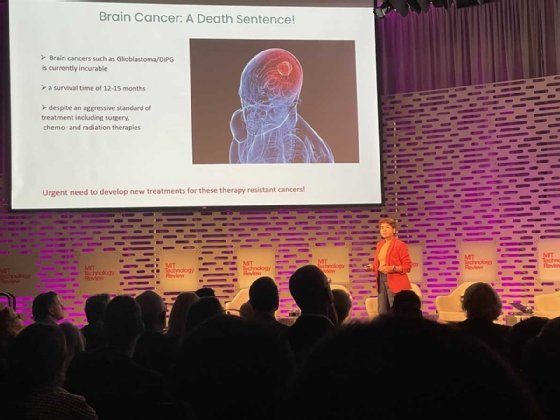
"If we define augmenting as transcending humans beyond diseases … yeah, I think it can help," Sarkar told TechTarget. "What our circulatronics enable is the distribution of millions of billions of nanoelectronic chips inside the brain, so that will help us to precisely control neural activity."
Once they can achieve this, Sarkar said the next step is to introduce AI to predict a patient's optimal brain state and activate each of these circulatronics as necessary to stimulate specific parts of the brain to maintain that state.
"Going beyond that, the optimal brain state also defines our intelligence," she said.
A longer-term goal for this project would be to use circulatronics to enhance human memory and provide humans with access to artificial synthetic neurons, enabling us to access more than the 100 billion neurons we already have, Sarkar said.
Sarkar is hoping to begin clinical trials of her circulatronic technology in three years.
Commercial exoskeletons and assistive robotics
Exoskeletons are entering commercial markets, and assistive robotics could advance to enable users to feel sensations through robotic limbs.
Hugh Herr, professor at MIT and co-founder of wearable robotics and exoskeleton company Dephy, hosted a session titled "The Bionic Body," where he showed audience members recent advancements in the field of wearable robotics and exoskeletons, as well as his vision for the future of the field.
"These connections between the nervous system and electronics are establishing new bodies," Herr said during the session. "We're going into this new era of embodiment where the technology is so fully integrated with human physiology…when you ask the human what is their body, they include the design construct."
Herr showed the audience examples of people using robotic limbs that responded to controls from the users' brains, artificial sensing that enables users to feel what their robotic limbs feel and even technology that can digitally control muscles by expressing a light-sensitive protein in nerves.
Herr has also been working to release various exoskeletons for commercial markets. His company Dephy released the Sidekick, a device that attaches to a person's foot to provide them with additional support to make walking easier. Dephy also partnered with Nike to release another powered footwear system that helps runners and walkers achieve similar support during their activities and move "faster and farther," according to the Nike website.
Herr went on to discuss other ideas he has for embodiment, including blending human and animal morphologies, like attaching a robotic octopus tentacle to the human body.
"We're building a robotic octopus, and we're going to be connecting this to the skeleton, into the nervous system of humans," he said. "We're asking the scientific neural science question, 'Can you view something like an octopus limb as you view your hand, that it's you?'"
But not all assistive robotics for human augmentation will attach to the human body. During his session, "When Machines Move In," Roman Shtylman, co-founder and CTO of the physical AI agentic data platform Foxglove, discussed some of the robotics he sees emerging from the companies he works with. These robots center more on augmenting everyday life than on augmenting the physical body.
"A lot of companies that we work with and the robot systems they create are in these spaces where people are, but nevertheless, they're not on the people," he said during a Q&A period at the end of the session. "But some of them you could still define as human augmentation. A common example is housework, where you might have a robot or cart that is somewhat automated that the person can push or guide, but then the robot will do the bulk of the work."
The goal: Human-AI symbiosis
One theme that recurred across many EmTech sessions was human-AI symbiosis. For example, Sarkar noted in her session that circulatronics has the potential to facilitate unprecedented brain-AI symbiosis. The concept involves cooperation between humans and AI to achieve new cognitive abilities that neither could achieve by themselves.
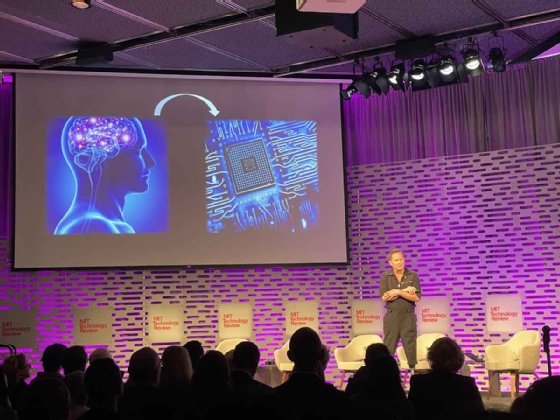
"Imagine human-AI symbiosis where you have this telepresence capability," Herr said in his session. "Humans can embody hardware anywhere in the world, or even across different planets."
This symbiosis could provide AI with human traits like empathy, capacity for love and extreme creativity, while also augmenting humans in terms of computation, memory and physicality, Herr said. This is the next frontier in physical AI and bionics, he postulated.
But all new technologies come with risks and complications. Some of the risks associated with human-AI symbiosis could include cognitive offloading, where humans rely more on enhancement tools. Another complication is ensuring that any data collected by robotic components remains secure and owned by the user.
To mitigate some of the risks of human-AI symbiosis, humans must be able to start these systems when they want, stop them when they want, decide what they will do and revert the systems as they wish, Sarkar told TechTarget. Maintaining human agency is paramount, she added.
To see the benefits that human augmentation can truly offer, Sarkar also said that this technology needs to be accessible above all else.
"Human augmentation technologies should not be only for the rich to access," she said. "Technologies should be designed to be equitable and accessible."
Everett Bishop is an associate site editor for TechTarget's AI & Emerging Tech group, covering AI, quantum computing and other emerging technologies.