


Executive summary
- AI spending has increased 18-fold in two years, with Gartner forecasting global IT spend to reach $7.35 trillion by 2027 as AI drives costs higher across the board.
- Model subscriptions, token usage and underestimated adoption rates are the primary cost drivers, with CIOs often lacking the budget or board support to fund AI initiatives properly.
- IT leaders are countering rising costs through usage controls, cost-per-run tracking, clear governance policies and tying AI projects to measurable ROI before scaling adoption.
AI spending continues to increase as companies face larger bills and try to keep up with rapid adoption.
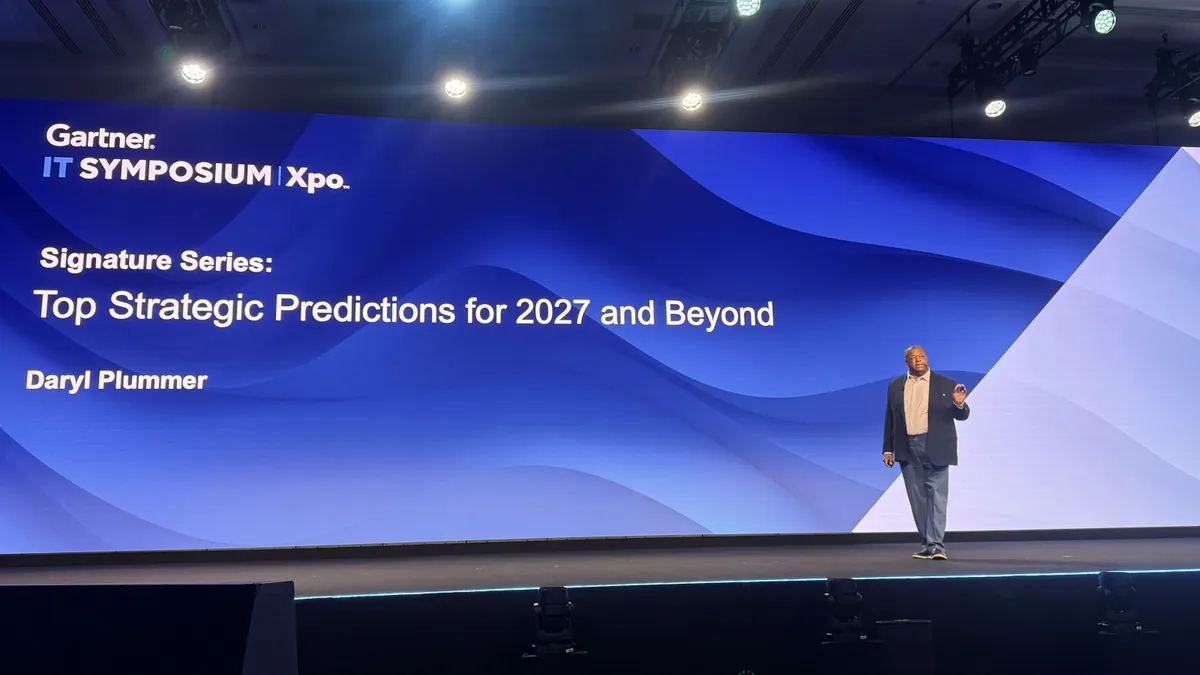
In the opening keynote remarks at Gartner's IT Symposium in Orlando, Fla., Daryl Plummer, distinguished vice president analyst at Gartner, said IT executives are spending 18 times more on AI than they did just two years ago.
"We are in a period of AI inflation during a trust recession. We don't trust AI, and token costs are falling rapidly," Plummer said.
Plummer went on to say that AI is inflating the cost of everything else, and demand is also skyrocketing with spending. In fact, Gartner forecasts that global IT spending will grow by nearly 15%, reaching $7.35 trillion in 2027. AI is a major contributor to this increase, and CIOs are facing the challenge of reducing costs with AI while also spending more to achieve these savings.
In the Gartner CIO survey released at the IT Symposium, 58% of CIOs reported increased pressure to reduce costs by using AI. However, 51% of CIOs expect AI to increase technology’s total costs.
"The interesting thing that we're seeing with that is that boards today are expecting their IT leaders to adopt AI, and they're not giving them a business problem to solve," Eric Helmer, global CTO at Rimini Street, told TechTarget. "At the same time, with their expectation to use AI, they're not giving them any money to do it. So not only do these CIOs have to figure out which business problems are AI-relevant, but they've got to self-fund it."
With mounting pressure for AI adoption and ROI, rising costs are top of mind for IT leaders, especially when funding is not always readily available.
What is driving the AI spend change
Model subscriptions, tokens and infrastructure are three of the main drivers increasing AI spend.
"People usually sign up for a subscription. They start using it as soon as it starts going to other groups, or other groups aren't paying attention to their actual token spend," Chris Carreiro, CTO at Park Place Technologies, said about increasing AI costs to TechTarget. "It's almost like the model isn't designed properly to roll out, and then everyone starts attaching to it."
Adoption is also happening on a massive scale in the industry. Rajesh Arora, chief data and analytics officer at Principal Financial Group, said he budgets for a set number of licenses for a tool, but those estimates aren't accurate because adoption costs have increased immensely. "So, for example, for a particular AI tool, we budgeted for 2,000 out of 20,000 people, but that usage is 10,000 now," he said. "So, how do you budget for exponential growth in adoption? We got surprised by that a little bit."
There is more to costs than just the hardware; implementation needs resources and review -- which also has costs. Janelle Milodragovich, vice president of AI market strategy at Smartsheet, said that organizations often underestimate the cost of this coordination -- getting information from team to team. She added that when companies implement agents and AI, they lose these relationships that aren't typically documented, such as approvals.
"If we think about the way in which we document handoffs between stages at work, unless you're in a production system, oftentimes, it's underinvested, and so it takes more time upfront to be able to scope what's happening and to sort through," she told TechTarget.
Deciding which AI initiatives deserve funding
With all the increase in spending, IT leaders need to ensure they are funding initiatives that deliver value. Gartner reported that 44% of CEOs struggle to demonstrate the value of AI-driven products to their stakeholders, making it even more imperative to monitor costs.
"We look at a lot of the projects being rolled back because leaders lacked the evidence that shows what was the ROI for that investment. So, I think organizations need to think more about the projects adopting AI that make sense," Henrique Teixeira, senior vice president of strategy at Saviynt, told TechTarget. "Not everything will be better with AI. And I think a lot of people, or many leaders, are thinking they have to use AI, but in a very general sense, without thinking there might be situations where AI is not applicable."
He added that many leaders struggle to demonstrate ROI on their investments because AI is not needed for everything.
Shanea Leven, co-founder and CEO of Empromptu AI, told TechTarget that business goals must be established before deciding on funding.
"Most business goals are ultimately tied to some kind of revenue or some type of time savings or cost savings, but you can work your way backward from those numbers to find intermediate goals that help you to lead up to the ultimate goal," she said.
Controls to prevent unexpected AI bills
Controls such as user-based usage limits can be critical in keeping costs down.
“The ownership and control should be with the people intimately familiar with that process to ensure that this agent is doing what it's supposed to do and nothing more than what it's supposed to.”

Eric Helmer
Global CTO at Rimini Street
"Think about your AI agent assistant; we can set those limits. We do that as a precaution, but because we want people to use it, they can generally request an increase from their manager," Amy Farrow, CIO at Celigo, told TechTarget. "We just want the checks in there so that something erroneous can't wreak havoc, and to kind of force a light conversation between a manager and a fleet."
She added that managers can see what employees are doing, and how it can help the department.
Healthy conversations about AI usage and production-ready flows are also necessary to identify potential risks.
Keeping track of usage and the cost of running AI is also necessary to determine whether the outcome was worth the cost.
"We, for our own platform, run a lot of agentic workflows, and we have basically cost per run, so we capture all of that, log it into our data warehouse, so that we can see, on an execution-by-execution basis, what the cost is," Farrow said.
Another way to keep costs down and maintain control is through leadership and corporate governance. Helmer said that having clear communication on policy, accountability, approved tools, and the right data to work with these tools is a way to monitor these costs.
"But we don't want it to be too restrictive because we want people to use it. We have to make sure that we're controlling it," said Helmer.
Helmer added that the person who owns the output of AI tools should also own their effectiveness and controls.
"The ownership and control should be with the people intimately familiar with that process to ensure that this agent is doing what it's supposed to do and nothing more than what it's supposed to," he said.
Leven said she thinks many teams are training on AI -- but they should train with AI experts to help build systems. Choosing the wrong person can steer companies in the wrong direction, defeating the purpose. With proper training, Leven said that helping people can get over mental hurdles and use AI correctly.
"[AI experts] are more likely to think about systems holistically, and that will save you money at the end of the day," she added.
Choosing the right model for the right task is another factor that helps reduce costs. Aron Semle, CTO of HighByte, told TechTarget. He said that employees should not throw trivial problems at these top-tier models that are meant for heavy development or architecture.
"I still think most of the industry is probably behind in thinking about multiple models and which ones are good for which," he said. "With the introduction of new models, it's hard to keep track at this rapid pace."
Amanda Hetler is senior editor and writer within the Reader Engagement and Outreach team of Informa TechTarget.