


Executive summary
- Low ROI: Only 13% of CIOs report significant AI value, despite growing use cases.
- High failure rate: More than 50% of generative AI projects were abandoned post-POC in 2025 due to bad data, weak controls or unclear value.
- Root causes: Incomplete legacy data integration, weak processes, wrong-fit use cases, poor training, and no clear AI strategy.
- Fix: Scale only with proven value, fail fast and build AI strategy incrementally.
Businesses are struggling to see ROI on AI projects.
This was a big takeaway from the 2026 Gartner IT Symposium in Orlando, Fla., from Oct. 19-22.
"I think a lot of customers are starting to struggle with this frustration of, why is it not translating into something real?" said Kabir Nagrecha, CEO at Tessera Labs, an AI platform for business transformation. "It feels like we've thrown everything at it -- everything but the barn door -- and it's not translating into actual numbers and incremental lift."
In fact, only 13% of CIOs reported their enterprise has realized significant or transformational value from AI so far, according to Gartner's 2027 CIO and Technology Executive Agenda survey. While AI use cases have increased in the past two years, use case success remains one in five.
You don't have to spend weeks or months doing something. You can prove it's working or not within a couple of days. Take the learnings, then move on.

Murali Swaminathan
CTO at Freshworks
"The biggest drag on AI momentum is using AI when it isn't needed," said Kristin Moyer, Gartner vice president and analyst, during a keynote at the conference.
Organizations should scale AI investment only if a measurable business value is demonstrated, Moyer said during the keynote.
Murali Swaminathan, CTO at Freshworks, said failing fast is something his team constantly thinks about.
"You don't have to spend weeks or months doing something," Swaminathan said. "You can prove it's working or not within a couple of days. Take the learnings, then move on."
Reasons for failed AI projects
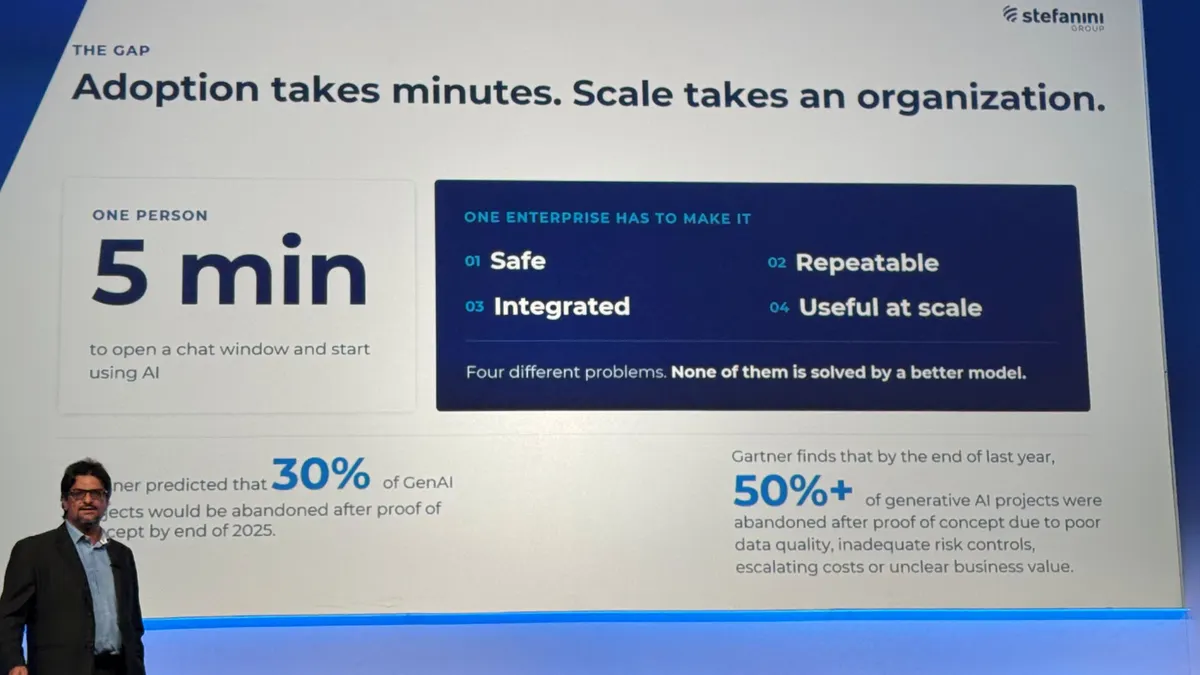
Gartner research shows that by the end of 2025, more than 50% of generative AI projects were abandoned after proof of concept due to poor data quality, inadequate risk controls, escalating costs or unclear business value.
While there are many reasons for failed AI projects, here's what some IT leaders and experts have to say on the matter.
Incomplete ontology
Nagrecha defined ontology as understanding of truth or reality in a customer's environment.
In fact, he said many early AI project failures stemmed from not correctly constructing the ontology and overlooking how to connect to and pull data from legacy systems. But over time, Tessera Labs built expertise connecting to and extracting information from these legacy and mainframe systems.
"Early on, coming out of Silicon Valley as a new start-up, you don't think about mainframes," Nagrecha said. "You don't think about these ancient machines that are still actually running the majority of Fortune 500s in many ways in different parts of their businesses. Without connecting to those legacy systems, that ontology layer was incomplete."
Lack of processes
If something cannot be proven with humans and with current processes, doing it with AI is not going to make it better, Swaminathan said.
"It's easy to pick up something that's working and figure out it takes me 10 people and five days to get something done. Now with AI, can I do it with fewer people and faster?" Swaminathan said. "That's why I think people pick up problems that are totally out of the zone, and then they try to make it work. But not every problem has a solution because their operation processes are weak."
The key is to take a project in small pieces: buy it, prove it, win the trust and then go, Swaminathan said.
Technology isn't the right solution
The fundamentals of finding the right solution to problems still matter, said Ryan Downing, CIO at Principal Financial Group.
"One of the traps I see organizations fall into is, 'Oh, I can apply AI to this!' Sure, but if it's a solution that requires a very deterministic answer -- an if X then Y type of answer -- AI is probably not right," Downing said. "I've seen some of those come through as pilots, and we say, 'Is that really the right solution?'"
Lack of training
In some instances, tool adoption within companies lags after the initial pilot. A tool may work as intended, but employees aren't trained in how to use it or why it's beneficial.
"As long as you still have a human somewhere in the loop or in the lead, you still need them to adopt it into their workflow," said Ben Schein, vice president of AI and business transformation for Progress Software. "You need to walk the walk and show people how it can work."
Schein said if someone asks him a question, he uses the agent -- even if he usually uses a dashboard and is the only person who knows how to use the dashboard to get it to do what he wants.
"I need to start modeling that behavior for someone to say this is worth it," he said.
Adoption takes minutes, said Fabio Caversan, CTO of Stefanini Group, a global tech consulting company, during a session at the conference.
"Adoption of one person is quick and easy," Caversan said. "But to scale this in an organization is a challenge that a lot of us are fighting right now. Despite the hype and what most of Silicon Valley wants to tell us, you're not going to solve this by just creating new models."
No AI strategy
An AI strategy dictates how you're going to use AI, readiness, implementation, training, mindset and then what humans will do, said Robert Kramer, analyst and managing partner at KramerERP.
"All that has to be done before you just start going from zero to 100," Kramer said. "You need to go zero to maybe five or 10 first."
Sarah Amsler is lead editor for editorial's Reader Engagement and Outreach team at TechTarget.