

Zendesk last week doubled down on service outcomes, adding platform capabilities alongside more detailed pricing policies.
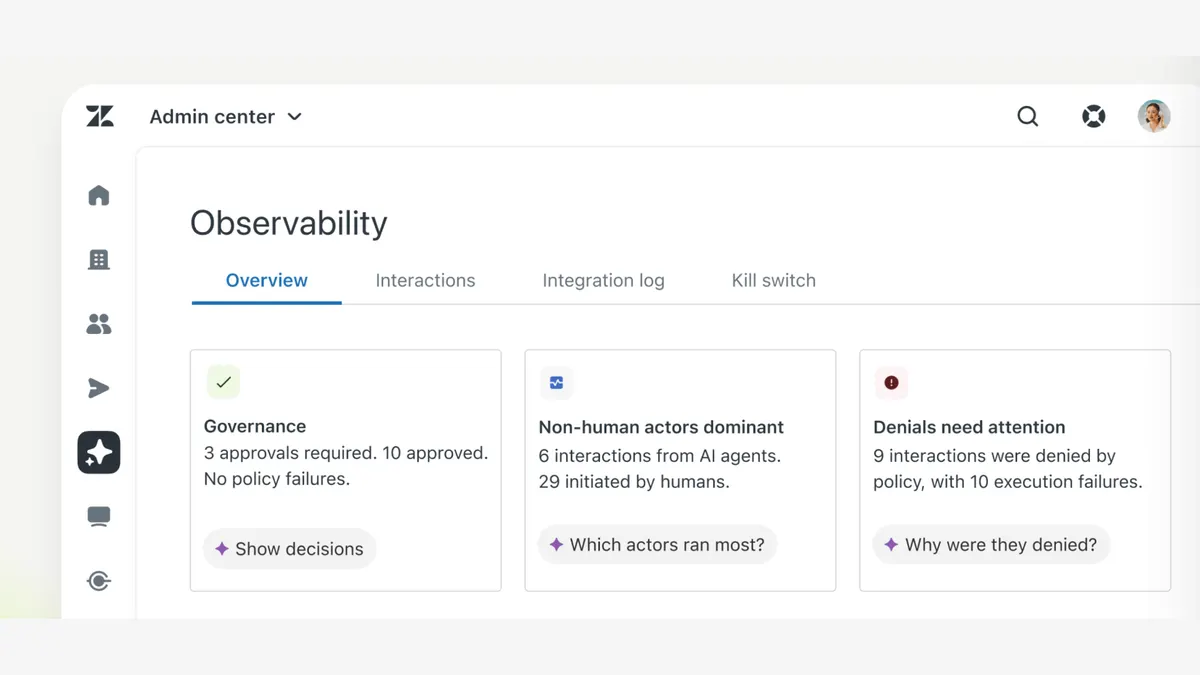
On the tech side, Zendesk outlined plans for its Open Service Directory, which is intended to help personal AI assistants find businesses' verified customer support channels. Zendesk Bridge, now in early access, lets AI assistants and agents use approved Zendesk service workflows and actions through tools such as Claude, ChatGPT and Microsoft Copilot, while administrators control permissions and monitor activity.
In 2027, Zendesk plans to roll out industry-specific agents beyond commerce, adding support for healthcare and financial services verticals.
On the pricing side, Zendesk is testing plans that eliminate per-seat licenses in favor of a flexible "outcome budget" for eligible customer issues resolved and business work completed. The new plans, available through an early-access program, include unlimited user seats and access to Zendesk AI capabilities, with features and platform fees varying by tier.
Zendesk's latest outcomes-based model aims to distinguish between a "resolution" — which can be good or bad, and may require follow-up — and the outcome the customer is looking for. The company lists certain events that aren't billed as resolutions, as well as situations that don't incur an additional voice charge. Examples include tickets created as verified test or training data; when a customer hangs up on hold; or when calls are routed as overflow to an external call center or external voice AI agent.
"Just because something has been resolved — or addressed — doesn't mean the customer's happy. It doesn't mean they've actually got what they wanted."

Simon Harrison
Analyst, Actionary
"There's quite a big difference between a resolved interaction and a positive outcome from that interaction," said Jim Davies, analyst at Actionary. "Being able to tease that out as two different things and focus on the latter — because what you want is that positive outcome — has got to be a good thing."
His colleague, analyst Simon Harrison, added that most customer service vendors are adding similar AI tools to their platforms. Many of them are building platforms that are "the perfect vehicle to take no responsibility, whatever" for customers' needs. Zendesk's B2B pedigree helps users keep better in sync with their customers as they build AI-driven experiences.
"Just because something has been resolved — or addressed — doesn't mean the customer's happy. It doesn't mean they've actually got what they wanted. It typically means the business has got what they wanted," he said. "Zendesk tends to be a little bit more in tune with what it is that really matters to people."
Vendors race to define outcomes
Outcomes-based pricing is a hot topic right now in enterprise software — especially in customer service. Even though contact centers have developed well-grooved metrics such as time-to-answer and first-call resolution to measure success, AI introduces some complications. One of those is getting the vendor and customer to agree on exactly what constitutes a "resolution" of a helpdesk ticket or a customer case, because that's the point at which AI billing happens.
In most cases, Zendesk customers have the right data to determine how and when service issues are solved, said Shashi Upadhyay, Zendesk president of products, engineering and AI. The platform's 80,000 customers are still transitioning toward greater AI adoption. Some 20,000 of them use AI in one form or another and, of those, 5,000 use outcomes-based billing.
Upadhyay thinks more will adopt outcomes billing. Currently, some user AI training data is collected by having humans tell the system that an issue was resolved. If AI eventually resolves 60% to 80% of service cases, "what constitutes an outcome" will become clearer and more precise. Furthermore, in customer service, some work definitions — such as what comprises the automation of a customer return — are agreed upon by Zendesk and a user "95% of the time," he added.
"We are finding that — especially in the support domain — the unit of work is very well defined. The unit of work is: 'Somebody has a problem, and you solve that problem,'" Upadhyay said. "It lends itself really well to outcome-based pricing. Once people understand that they can define what the unit of work, success and failure means — and I pay the vendor for success — it's a much easier conversation, and that's why I think they've been [adopting the model]."
Don Fluckinger is a seasoned B2B technology journalist with over 30 years of experience specializing in enterprise IT, digital experience and content management. As a senior news writer at Informa TechTarget, he delivers award-winning analysis that helps IT and business leaders navigate complex technologies to enhance customer and employee experiences. Got a tip? Email him.