Outcomes-based AI pricing works in theory -- but in practice?
Outcomes-based AI pricing sounds great at a macro level, but CIOs must define results, settle disputes and meet procurement requirements before it works in practice.
On the surface, it's hard to argue with the idea of outcomes-based AI pricing: An agent performs a real task that both saves human labor and achieves a business outcome -- and then, the technology vendor meters it.
As CIOs count the costs of agentic implementations beyond AI token consumption, outcomes appear to be an interesting new metric upon which to base their value. Taking a closer look, though, some IT leaders see it as more of a red herring than a viable model, for several reasons.
That's because, before reaching outcomes utopia, customers must navigate a swamp of contract language that defines "outcomes" and how they're measured, in black and white -- and the vendors have set the terms. At Dreamforce and elsewhere, interviewees said CIOs should approach this fledgling enterprise IT pricing model with caution.
While vendors might hold up early adopters of outcomes-based pricing as examples of its potential, many customers are not yet familiar with the idea. Salesforce customer Designed Conveyor Systems (DCS) hasn't yet considered it, said Gabe Rybicki, senior director of the project management office at the company.
DCS uses Agentforce Operations, which is typically priced on a blended seat and consumption model; DCS uses its own sanctioned AI model, so consumption isn't part of its particular equation. Users on different tiers within the company have different token allotments depending on whether they are building with AI or using it to accomplish work.
"We're trying to regulate that token cost on the back end by structuring our environment," Rybicki said.
DCS's Salesforce integrator OSF Digital is, however, seeing outcomes-based pricing emerge in contract negotiations, said Sean Catlin, EVP and global head of strategy. In fact, OSF is working on its own outcomes-based contract with a financial services customer that plans to increase the automation of account opening, account onboarding, claims and payments processes.
"It's part of our strategy to move in that way," Catlin said. "How you move in a relationship with a customer to where you share risk and reward -- and have an outcome -- that will be the evolution, no doubt."
Salesforce head: 'Customer's choice'
Among the four pillars of CX, customer service appears to be well ahead of marketing, sales and e-commerce in adopting outcomes-based pricing. Contact centers rely on well-established KPIs such as first-call resolution, time-to-resolution and customer satisfaction ratings, which have standard measurement mechanisms.
Those would seem like obvious metrics to convert into outcomes-based technology pricing.
But contact center vendors can't agree on the most basic KPIs, such as what constitutes a resolution, so there's no standardization across vendors, making apples-to-apples comparisons difficult during the RFP process. Faced with pressure on seat-license revenue as AI agents take on more customer service work -- and pushback from customers wary of possible surprise consumption bills and AI implementation costs -- some vendors are pushing on with outcomes-based pricing.
Among CX vendors, HubSpot was an early mover, introducing outcomes-based pricing in April for Breeze Customer Agent and Breeze Prospecting Agent. During its analyst day on Sept. 17, CEO Yamini Rangan said outcomes-based pricing is the future of SaaS and presented it as part of HubSpot's answer to the SaaSpocalypse fears that shook Wall Street earlier this year.
"We're not just selling software, we are proving value and we are earning the right to expand and compound adoption from there," Rangan said. "In terms of pricing, it's not about charging for access; it is clearly aligning to how customers get value and outcomes from HubSpot."
Salesforce offers outcomes-based pricing for Agentforce Help Agent, part of Agentforce Service (formerly Service Cloud). Most other Agentforce offerings use consumption-based or per-user pricing. CEO Marc Benioff has repeatedly discussed the idea of "agentic work units" to explain how much work AI agents are performing during quarterly earnings calls.
But when asked at Dreamforce whether agentic work units will ever be tied to outcomes, Benioff said they are a good measure for illustrating the use of Agentforce across the Salesforce platform, but that pricing is a whole different animal.
"As you go all over the world, different-sized customers all want different types of pricing," Benioff said in a media Q&A. "Some still want pure user pricing; it's predictable. They understand it. Some want agent pricing. Some want usage-based pricing. Some want consumption. Some want transaction outcomes; they're willing to pay for that. And some want business outcomes.
"We've had to throw away our price book, basically, and come up with a whole new pricing mechanism [so] that we deliver the right pricing for the right customer, at the right time. So we're not fixed to any one particular pricing model. We let that customer have whatever they need."
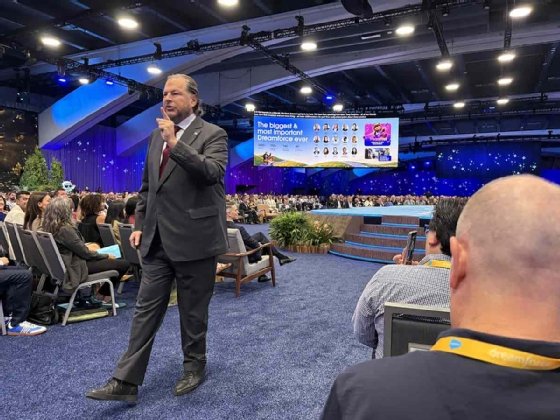
Salesforce CEO Marc Benioff, shown here delivering his Dreamforce keynote, discussed outcomes-based pricing with reporters.
Procurement pushback
Many customers remain skeptical of outcomes-based pricing, said Mark Polly, vice president of strategy and design for global technology and consulting firm Perficient. Some have tried it in the past, prior to the advent of agentic AI, and the outcomes never came; others aren't ready for it; and still others don't believe outcomes can actually be measured.
Even when IT leaders are open to it, internal approval can still be difficult.
"There's this little organization called procurement, and they're also looking for an outcome," said Kevin Lee, field CTO and key pursuits leader at NiCE. Its desired outcome can be "diametrically opposed" to sharing an unpredictable upside, he added. "Procurement and finance want certainty. They want to be able to forecast against it. They want to know that the ROI and returns math out."
Procurement and finance want certainty. They want to be able to forecast against it. They want to know that the ROI and returns math out.
Kevin Leefield CTO and key pursuits leader, NICE
Lee isn't the only one observing this. Polly's colleague, chief partner officer Santhosh Nair, said Perficient runs into that, too.
"In my [customer] interactions, most business sponsors who own a solution are pro outcomes-based, but we do get constant pushback from procurement," Nair said. He added that procurement teams often feel that tech vendors weigh the value of "AI labor" too heavily and will charge too much.
"Business sponsors look at it in terms of making a stock investment. If I can buy it for X and I can get Y, why would I not do that? Just let the vendor worry about all the hiccups. I'm only going to pay them when they meet my objectives."
For now, outcomes-based pricing remains difficult for many enterprise IT leaders to implement, given the corporate hurdles. Even the idea of sharing savings with a technology company is anathema to the typical CFO, said Brent Leary, co-founder of consultancy and research firm CRM Essentials.
The biggest hurdles might be the unknowns: Is the pricing model workable? Who controls the measurements? How will disputes be resolved? Can the economics work for both sides?
To Leary, there's one obvious way for CIOs to protect themselves from bad deals as vendors figure out how to compete -- and standardize -- their pricing schemes, which, for some, are evolving month-to-month, even week-to-week.
"I think it's wise not to get roped into anything longer than six to 12 months," Leary said. "They might dangle some price incentives, but what does that mean today? Six months from now? A year from now? You've got to think very short term -- let all the dust settle and see what it actually looks like at the end of the year. Then you can really start putting some meat on the bone."
Don Fluckinger is a seasoned B2B technology journalist with more than 30 years of experience specializing in enterprise IT, digital experience and content management. As a senior news writer at Informa TechTarget, he delivers award-winning analysis that helps IT and business leaders navigate complex technologies to enhance customer and employee experiences. Got a tip?Email him.