Negotiating AI licensing and costs: A step-by-step guide for CIOs
CIOs must balance access to innovation with cost control as AI becomes standard. The goal: to avoid paying a premium for features that should be included.
AI is rapidly becoming a standard feature across enterprise software, but vendors often spike prices as if it were an optional add-on. Capabilities once offered as optional add-ons are now routinely embedded in productivity suites, ERP systems, CRM platforms, cybersecurity tools and other core applications with little to no means of opting out.
"Vendors are increasingly bundling various AI features into broader subscriptions or introducing their own proprietary currencies, such as vendor bucks or token credits, making it highly difficult for organizations to parse out the exact cost of individual AI features from their broader software subscriptions," said Dippu Kumar Singh, senior director of solution architecture at Fujitsu.
The new AI features come ready-packed into automated updates or upgrades, usually with additional costs in tow using new licenses, consumption fees or premium tiers.
That puts CIOs in a difficult negotiating position. They must preserve access to useful innovation without repeatedly paying for overlapping and increasingly commonplace capabilities. Doing so requires a new procurement strategy -- one that determines which AI features deliver measurable value, which should be included in existing contracts and which costs can be challenged before today's premium becomes tomorrow's permanent baseline.
CIOs can use the following steps to ensure they make better purchasing decisions and avoid unexpected costs.
Step 1: Separate standard-issue from premium features
Evaluating all the added AI features across software can feel a bit like stepping into an arcade and trying to group specific sounds within the overall cacophony into categories by ear alone. To work past the noise and confusion and begin the process, start with a simple test. Sort AI features in one of two buckets: those that improve the software's core function and those that provide a genuinely new capability.
"Basic automation, predictive text, automated tagging and standard workflow enhancements that replace or slightly improve legacy functionality should be included in the base software fee. Vendors should not charge extra for features that maintain or slightly modernize the baseline value of the software," said Michael Kimball, principal at The Innovation Attorney.
Examples of AI feature add-ons worth an additional price or a premium for a tier upgrade include "advanced, resource-intensive capabilities such as autonomous agents, proprietary industry-specific large language models, complex multi-step reasoning or deep generative content creation," Kimball added.
Watch out for AI washing or agent washing tactics, too. Premium pricing should be reserved for additional premium value and not applied to ordinary software modernization re-labeled as AI.
Step 2: Find hidden costs
"Unlike predictable per-seat software licensing, AI consumption is driven by user behavior, automated background agents and data query complexity. A sudden surge in automated workflows can exhaust annual budgets in weeks," warns Kimball.
Negotiating AI licensing and costs requires a keen eye on a frequently moving target. AI pricing varies, sometimes within the same product, said Kuber Sharma, senior director of product marketing at UiPath, a business orchestration and automation platform. That makes it harder for CIOs to spot hidden costs within vendor contracts.
"A vendor might include a basic AI feature in the seat price and put more capable features in a higher tier. In another contract, the bill moves with usage, so a seat-based forecast misses the actual cost," said Sharma.
CIOs should look for usage charges tied to tokens, queries, agents, API calls, storage, data movement, model training and premium support. Costs might also rise when employees exceed usage allowances or when a pilot expands across departments. The price computations for any of these are often complicated and based on unclear metrics. To get better control over these costs, according to Singh, implement clear, near-real-time anomaly detection; set up automated alerts based on historical usage baselines; use industry benchmarking and peer discussions; and demand clear metric definitions from your vendor account managers.
"It is crucial to enforce cross-company accountability by using a showback or chargeback model, routing the cost data directly back to the specific engineering or business managers driving the usage," said Singh.
Look for related costs as well. For example, integration, security reviews, data preparation, governance, monitoring and employee training add expenses that vendors might exclude from initial estimates.
The bigger bill is usually not the AI license; it's the work needed to get your data into a shape the model can use.
Kuber SharmaSenior director of product marketing, UiPath
"The bigger bill is usually not the AI license; it's the work needed to get your data into a shape the model can use. In my experience, that integration work consistently runs higher than buyers expect. In one deal I saw, the AI license was $200,000, and the data integration work was $800,000," said Sharma.
Integration isn't the only cost that can swallow your entire AI budget in one or two big gulps. A prime example is the cost of telemetry and logging: "Testing an AI feature or running a new algorithm can inadvertently trigger massive logging spikes, leading to exorbitant, unexpected daily charges," Singh warned.
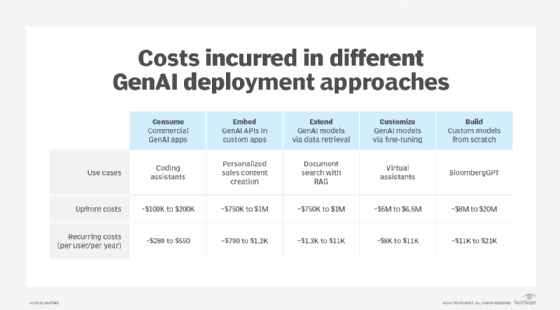
The estimated upfront and recurring costs of generative AI applications can vary dramatically based on the deployment approach.
Step 3: Develop a strategy for negotiating AI licensing and costs
Start by making this a group effort. Build a strong, collaborative partnership internally with your legal, procurement, finance and engineering teams, said Singh. "The key role is to facilitate these relationships, not to act as the sole owner of the contract." Take their total input into account in building the overall negotiating strategy.
Singh also suggests using the following checklist to assess which features are useful and perhaps worth paying a premium:
Gather details and use case. Identify exactly who needs the tool, how it will be used and its criticality to the business.
Architecture review. Have engineering leadership evaluate the tool to ensure it naturally fits into the company's current and future technology stack.
Proof of concept. Run a trial period. Because the ROI is unproven, strongly request that the vendor provide free credits or waive fees for the duration of the proof of concept.
Compliance and security review. Route the tool through legal and security departments to ensure it meets data processing, privacy and single sign-on requirements.
Centralized documentation. Record the contract details, the internal point of contact and the vendor terms in a centralized document repository before scaling.
Furthermore, to prevent undue and unexpected cost exposure and to protect the company contractually once it decides to proceed, Singh suggests you consider the following protective actions in the negotiation process and before committing to scaled usage:
At-will termination. Negotiate an out-clause, such as with 30, 60 or 90 days written notice, so you aren't locked into a long-term contract if the AI tool fails to deliver business value.
Discounted overages. Ensure the contract stipulates that any overages are billed at your negotiated discount rate, rather than reverting to standard list pricing.
Modeled ramps. Avoid committing to peak usage upfront. Structure the contract with a usage ramp that mirrors your expected gradual adoption.
Marketplace scrutiny. If purchasing through a cloud marketplace, ensure the legal department reviews the end-user license agreement, as click-through agreements often bypass standard corporate protections.
Next, do a mental walkthrough on what it takes and what it costs to onboard and offboard data from the vendor. Be aware that vendors might charge separately for data ingestion, high-speed vector database storage and egress fees, Kimball said.
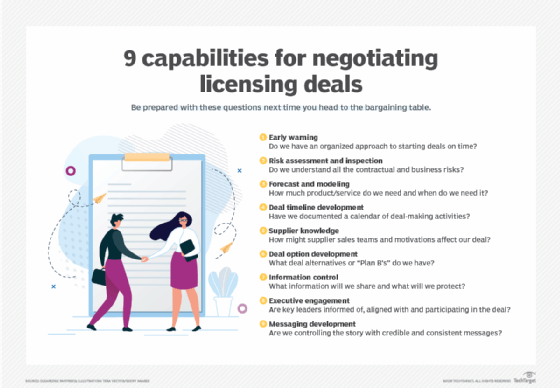
In addition to assessing business risk, leaders should evaluate how much of the product or service under consideration is truly needed and by when.
One question most buyers skip: "Ask specifically what triggers a billable AI call in this product, and what doesn't. If the answer is vague, you don't have enough information to model the cost at scale," said Sharma.
"Do not let vendors dictate rushed timelines, artificial end-of-quarter deadlines or pressure you into renewing at current usage rates if those rates are unoptimized," said Singh.
The goal is not to reject new AI capabilities, but to determine which features deliver measurable value, which belong in the base product and what they will cost at scale. Clear pricing, realistic usage estimates, strong contract terms and ongoing cost monitoring can preserve access to innovation without allowing AI spending to outrun its business value.
Pam Baker is a freelance journalist and the author of books including ChatGPT For Dummies and Generative AI For Dummies. Baker is also an instructor on AI topics for LinkedIn Learning and a member of the National Press Club, the Society of Professional Journalists and the Internet Press Guild.