
your123 - stock.adobe.com
All agentic AI data access, orchestration hinges on these two standards
A vibe check on the state of the two foundational generative AI standards.

Agentic AI has begun its takeover of customer experience, human resources, cybersecurity, developer toolboxes and other provinces of enterprise IT. Vibe coding, software planning, testing and deployment, customer service automations, one-to-one marketing, and hiring and firing all can be accelerated with the help of agents.
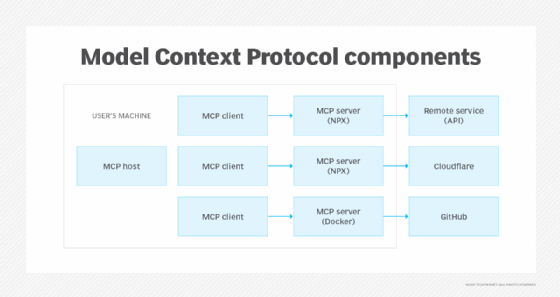
But without two open standards -- Model Context Protocol (MCP) for data access, and Agent2Agent (A2A) for agent orchestration -- none of that could happen. There would be no way for agents to tap enterprise data repositories with governance or for agents to work together.
Even as these standards are available and can, in theory, support infinitely complex enterprise IT configurations, users are still grappling with how to integrate simple task-based agents into their organizations, said Julie Linn Teigland, global vice chair for alliances and ecosystems at professional services firm EY.
One thorny issue is the sequencing of work across departments. Take the example of enterprise sales data: Companies must determine which agents get priority when a salesperson updates a CRM record, a process that triggers finance department commissions and billing, updates sales forecasts and might involve HR agents depending on how employee productivity and compensation are tracked. When cross-vendor, cross-department work is handed off to AI agents, things quickly get complex.
"There's a lot of talk about orchestration, but is orchestration control?" Teigland asked. "Is it accountability? Is it governance, or is it just transparency? I can have transparency, but do I have control? And have I established the prioritization within a company for how that works?"
The Linux Foundation now manages both MCP and A2A. MCP started as a project at Anthropic before it was open-sourced; A2A was launched by Google with input from Salesforce, SAP, ServiceNow, UKG and Workday. As is typical with generative AI, the rollout of these standards has been quick. MCP and AI were released in late 2024 and early 2025, respectively. Today, the tech world is building seemingly everything on top of these fledgling yet foundational ideas.
"I was amazed how quickly the industry aligned around these two protocols as a mechanism," said Gary Lerhaupt, Agentforce vice president of product architecture at Salesforce. "[The AI and SaaS vendors said,] 'Let's all standardize on these things and not create 15 variants of the same type of job to be done.'"
But because MCP and A2A are new -- and because data and interoperability standards typically evolve in complexity with time as emerging real-world use cases reveal their limitations -- there is room for improvement.
Living the A2A dream
Vendors such as Salesforce and Nvidia, early AI startups such as Cofounder and the backers of open source standards such as Paperclip may try to advance the idea that a team of role-based AI agents could, in theory, run whole companies autonomously.
Users, however, "are not yet really in the alpha generation" of agentic AI, said Mohamed Khalfallah, partner at global AI consultancy Emerton Data. They are still building single-task agents specialized to aggregate documents, perform basic computations or both.
"All the data vendors will provide, kind of, the average agent," Khalfallah said. "If you want to keep your uniqueness in terms of company and your progress, you need to add your unique processes and your unique data to keep your leverage and keep competitive. This is the part where the market is not there yet."
For its clients, Emerton focuses on automating one process at a time, paring each process back to its data needs and then setting up a platform, data quality rules and other elements to fulfill that task. As such, the company is a heavy consumer of MCP, but not so much A2A. Yet.
"We don't have the approach where we're going to come and transform the whole business -- that's not the idea," Khalfallah said. "It's more like, 'Let's start with a very small scope of data' and then we start increasing."
A2A's day will come soon, Khalfallah believes, as customers automate more processes with more agents and start taking tentative steps to combine the operations of multiple agents into a single action.
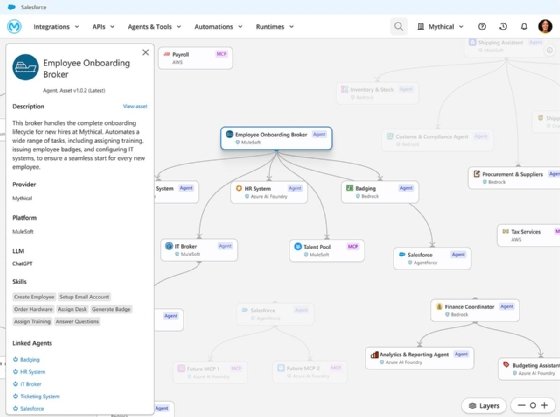
Salesforce is working to support several types of agent environments: those with single Agentforce agents; those with multiple Agentforce agents working together; and those combined with agents from other vendors that Salesforce users commonly deploy, such as Google or Workday.
On top of all that, imagine the above coordinated across multiple Salesforce instances, a common situation for many of the company's large customers.
"Our customers have the situation where there are lots of Salesforce instances, and those shouldn't be siloed away from each other," Lerhaupt said. "So how do we connect what we call 'multiple orgs' together using the same underlying runtime, the same underlying orchestration and planning?"
A2A and MCP's blind spots
There's a lot more to be built into the MCP and A2A standards. While they are open standards, many CX vendors are joining the projects to increase functionality, enable regulatory compliance, add governance to help agentic AI scale, and build in more data safeguards.
Salesforce contributes to both MCP and A2A standards development to help its users personalize their customer experiences with "super agents" that orchestrate task-based agents to deploy the right customer data to the right channels, said Madhav Thattai, Agentforce executive vice president and general manager at Salesforce.
Working groups are still ironing out many aspects of the standards. One is how agents retain data -- or not -- to execute personalized recommendations in the moment, at runtime, to keep experiences personalized as they unfold. Moreover, users want their agents to understand customer data in the long term as well, so they can build on past actions and advance the customer relationship.
"This is not a simple API call," Thattai said. "We can make this a lot more powerful with shared context, so that there is a very seamless handoff. Shared context is memory … these protocols play a super important role in that."
MCP and A2A are crucial to optimizing software development, delivery and runtime, said Matthias Zieger, field CTO international for Digital.ai, which hosts an AI-powered DevOps platform.
A part of A2A that is lacking -- and that working groups are building -- is cross-vendor agent authentication, or "portable agent identity," a concept coined by Forrester Research. That is an even more important issue to solve than agent orchestration as far as Zieger is concerned.
For instance, a DevOps team might have a planning agent, a testing agent and a security agent, possibly from multiple vendors, working together. As they operate together, each agent will have to understand its role in the company, what it is allowed to do and -- more importantly -- what it is not allowed to do, such as publishing to production.
"If you cross the boundaries of a single vendor or single tool, the portable agent identity problem is not solved," Zieger said. "It's one of the biggest problems. If I give an agent a task, and then this agent uses the A2A protocol to talk to other agents, and then one of those agents is touching my production system, you have to have a lot of trust."
That said, if the adoption curve of AI is analogous to the widespread adoption of the internet in the 1990s, we are in the "Netscape era" of agentic AI, Zieger said.
In other words, he believes there's plenty of runway for growth as MCP and A2A become more sophisticated. Rapid advancements in MCP and A2A will make agentic AI more capable of performing sequences of automated work.
"Vendors, of course, are talking about [AI orchestration] because they want to set the future," Zieger said. "The reality is that the big enterprises are still in the very early phases, looking for singular use cases … that's what we see."
Don Fluckinger is a seasoned B2B technology journalist with more than 30 years of experience specializing in enterprise IT, digital experience and content management. As a senior news writer at Informa TechTarget, he delivers award-winning analysis that helps IT and business leaders navigate complex technologies to enhance customer and employee experiences. Got a tip? Email him.
Dig Deeper on Customer Experience
-
![]()
Salesforce broadens headless offering for agentic AI access
By: Don Fluckinger
-
![]()
The AI handshake: More MCP interoperability for Salesforce's Slackbot
By: Don Fluckinger
-
![]()
Adobe releases Coworker marketing orchestration 'super agent'
By: Don Fluckinger
-
![]()
Salesforce releases Agentforce dev tools, updates Agent Fabric
By: Don Fluckinger