
Getty Images/iStockphoto
Tips for the governance of AI-generated and synthetic data
CIOs need a lifecycle policy for AI generated and synthetic data. Learn how to set lifecycle policies and manage the risks of this type of data.

Many organizations remain unprepared for the rapid growth of AI-generated content and synthetic datasets across enterprise environments, leaving them equally unprepared to govern that data effectively and within compliance boundaries.
Governance frameworks are lagging behind AI, even as AI-generated and other algorithmically generated synthetic data permeate across business functions. Governance is now a strategic business issue, not just an IT concern. Executives should establish governance best practices before operational and regulatory complexity increases. IT leaders investing in AI need to construct an AI data lifecycle policy and establish scalable governance.
Why AI-generated and synthetic data require governance
AI-generated data and synthetic data differ fundamentally from traditional data. Traditional data originates from real-world business activities, customer interactions, transactions, sensors or human-created content. It is the data generated by years of doing business.
AI-generated data is produced by machine learning models, including text, images, code, audio or analytics. It is often derived from prompts or existing data. For enterprises, AI-generated data accelerates content creation, software development, customer support and decision-making.
Synthetic data is artificially created to statistically resemble real data without directly representing actual individuals or events. Synthetic data enables a host of practices, such as AI model training, software testing, analytics and data sharing while reducing privacy risks, protecting sensitive information and improving compliance. Together, they expand opportunities for innovation but require stronger governance over provenance, quality, security and lifecycle management.
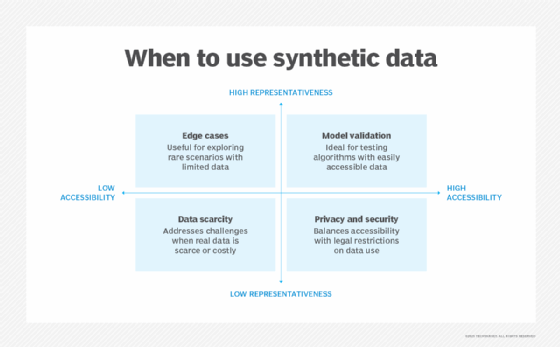
These data sources are increasingly important to business innovation, but they include significant risks for IT leaders to mitigate.
How machine-generated content creates risk
Unmanaged AI-generated content presents operational, legal and compliance risks that cannot be ignored. These risks span the organization, making them a strategic governance imperative.
Specific risk examples include:
- Data provenance and authenticity. Organizations must be able to demonstrate where AI-generated content originated, which model produced it, when it was created and whether it has been modified. Without provenance, trust and auditability suffer.
- Regulatory compliance. AI-generated and synthetic data may still fall under regulations such as GDPR and the EU AI Act if personal information is involved or if AI outputs impact regulated decisions. Governance enables transparency, traceability and accountability.
- Retention and deletion obligations. AI-generated content should follow the same retention, archival and disposal policies as other business records. Unmanaged data increases storage costs and compliance risks.
- Intellectual property. AI outputs may contain copyrighted or proprietary material, creating ownership disputes or licensing concerns.
- Third-party AI vendor risk. External AI platforms can introduce contractual, data residency, security and privacy risks. Organizations should define vendor governance requirements and understand how providers store, use and retain submitted data.
Enterprises face challenges with proving origin and authenticity, yet they must be prepared to undergo audits and prove regulatory compliance. Building an AI lifecycle policy and governing data deliberately helps ensure these obligations are met.
Building an AI data lifecycle policy
A practical AI data lifecycle policy should establish governance from the moment AI-generated or synthetic data is created until it is securely disposed of. All aspects of the data's lifecycle require management to ensure privacy, compliance and auditability.
Specific lifecycle events include:
- Inventory AI-generated data. Identify where AI-generated and synthetic data is created, processed, shared and stored across enterprise applications, cloud platforms and third-party AI services. Maintain an up-to-date inventory to reduce shadow IT.
- Classify data by risk and business value. Categorize data using a risk-based approach that accounts for sensitivity, intended use, regulatory requirements and business impact. Different AI-generated data requires differing levels of governance.
- Capture provenance and metadata. Record the generating model, prompts or source inputs, creation data, version history, ownership and any subsequent modifications to datasets. The goal is to support transparency, reproducibility and audits.
- Define retention and disposal policies. Determine how long different classifications of AI-generated data should be retained, archived or deleted to meet legal, operational and storage requirements.
- Control access and usage. Apply role-based access controls, encryption, monitoring and usage policies to prevent unauthorized access or misuse.
- Review, adapt and refine governance. Regularly assess governance policies as AI models, business processes and regulations evolve. Monitor compliance through periodic audits, governance metrics and policy reviews to ensure the framework remains effective and aligned with organizational risk tolerance.
Data governance improves capabilities
Strong governance of AI-generated and synthetic data accelerates innovation rather than restricting it. It also avoids operational and compliance issues that distract the organization from its business objectives.
Examples of how data governance speeds up innovation include:
- Enabling faster software testing and AI-assisted development.
- Reducing privacy risks by limiting the use of production data.
- Implementing governance-by-design rather than governance after deployment.
- Using AI governance tools to automate lineage, policy enforcement and monitoring.
Measure success with governance KPIs such as provenance coverage, policy compliance rates, audit results and the percentage of AI-generated data under lifecycle management.
Wrap up: Governance should scale with AI adoption
AI-generated and synthetic data must be managed as strategic enterprise assets with both associated value and risk. Organizations that establish clear ownership, risk-based policies and lifecycle governance now will be better prepared for evolving regulations and future technologies while enabling responsible AI innovation.
Damon Garn owns Cogspinner Coaction and provides freelance IT writing and editing services. He has written multiple CompTIA study guides, including the Linux+, Cloud Essentials+ and Server+ guides, and contributes extensively to TechTarget Editorial, The New Stack and CompTIA Blogs.
Dig Deeper on Storage
-
![]()
Why AI governance and data privacy must be integrated
By: Tom Walat
-
![]()
GenAI and synthetic data: What can go wrong in business?
By: Stephen Bigelow
-
![]()
Improving business forecasting with synthetic data and simulation modeling
By: Kashyap Kompella
-
![]()
What to know about synthetic data as a business advantage
By: Stephen Bigelow