Serious misunderstandings and miscommunications can come from inadvertently using different meanings for the same seemingly simple term, such as the fundamental element of testing--"test case." A tool is provided to reveal the extent of such discrepancies and reach common consensus in your own organization.
What is a test case?
Students in my testing seminars frequently express frustration that different instructors use the same terms to mean different things and vice versa. The problem actually is more complicated, as I discovered while reading a book by a prominent testing authority colleague.
Initial survey
I created a survey as a less confrontational way to address the test case definition question. Without explaining the reason for my questions, I sent the survey to about a dozen fellow testing authors and instructors, including the author who had prompted my question. The survey asked for each recipient's definition of "test case" and several other test terms.
Subsequent survey
I changed the survey as shown below to include a concrete example.
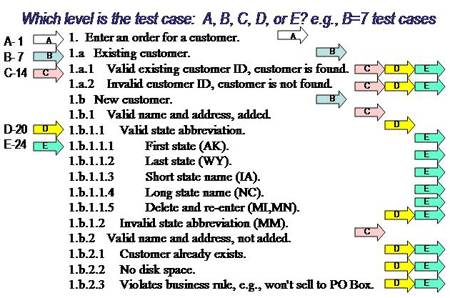
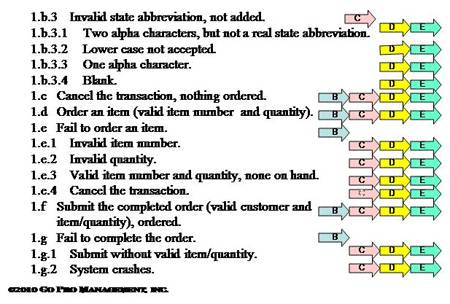
Survey findings
Only a few of the authors/instructors provided the requested one-letter answers. Most who previously had given lengthy verbal definitions declined to give a one-letter answer to this concrete example. Several, including the book author, nonetheless waxed on about various philosophical testing topics unrelated to the example, such as how long should be required to run a test case.
Broader survey results
I acknowledge I haven't been able to total actual A-B-C-D-E counts from the hundreds of testers who have taken the survey example. Most response counts get buried in the bustle of classes. I can say with certainty that each choice has received many votes and none reliably dominates. Each class exhibits variability among the choices, and patterns of responses differ from class to class.
What is a requirement?
The need for such test case interpretation choices often occurs because of the level of detail in which requirements are defined. Testers generally create test cases based on however the requirements are defined. The problem is that requirements very often are defined at only the grossest Level A.
| Robin F. Goldsmith, JD is President of Needham, Mass., consultancy Go Pro Management, Inc. He works directly with and trains business and systems professionals in requirements, quality and testing, metrics, ROI and project and process management. A subject expert and reviewer for IIBA's BABOK, he is author of the Proactive Testing and REAL ROI methodologies and Discovering REAL Business Requirements for Software Project Success. |