

AMD will invest $1 billion in Meta’s equity offering as the companies expand a multi-year partnership spanning AI accelerators, server CPUs, networking and rack-scale systems. Initial AMD Helios systems are installed and undergoing testing at Meta, providing an early milestone for an agreement covering up to 6 gigawatts of AI infrastructure.
The companies have not disclosed how many Helios systems Meta is testing, when broader deployment will begin or how quickly the partnership could reach gigawatt scale.
For data center operators, the announcement offers a view into the work required to bring an alternative AI computing platform into production. Power availability, cooling, memory supply, networking and software support all affect how quickly rack orders become usable computing capacity.
“The $1 billion is the least important part of this announcement,” said Stephen Sopko, practice lead for semiconductor and deep tech at HyperFrame Research. The more consequential development, he said, is confirmation that Helios systems are installed and running at Meta, although they remain in testing.
That represents progress toward converting the companies’ February agreement into operational infrastructure. It does not establish that Meta has deployed Helios at gigawatt scale.
AMD and Meta deepen their financial ties
AMD’s investment adds a financial commitment to a relationship that already involves joint hardware and software development. An earlier agreement gave Meta performance-based warrants in AMD, according to Matt Kimball, an analyst at Moor Insights & Strategy.
“AMD isn’t just a supplier with this kind of engagement. It’s no longer just selling into Meta. It’s putting its own balance sheet behind Meta’s AI buildout,” Kimball said.
The arrangement gives both companies an interest in the partnership’s success, but it also raises questions about execution and the relationship between financing and future business. Kimball compared the dynamic with circular financing concerns seen elsewhere in the AI infrastructure market, where investment and commercial commitments can reinforce one another.
The practical test will be whether deployments and revenue materialize on schedule. AMD has not disclosed customer-level shipment volumes for Helios.
Meta is pursuing a multivendor infrastructure strategy rather than relying on a single supplier. It uses Nvidia hardware alongside AMD processors and accelerators, as well as its own silicon. That approach gives Meta options for matching hardware to workloads and managing supply.
Helios faces a production test
Meta has deployed millions of AMD EPYC processors across multiple generations and uses AMD Instinct GPUs in production for training, ranking and recommendation engines, according to AMD. Meta is a lead customer for AMD’s sixth-generation EPYC CPUs and helped define the MI450 GPU architecture. It plans to deploy a custom Instinct GPU optimized for its workloads.
AMD said its collaboration with Meta also informs future MI500 series GPUs and next-generation rack-scale systems.
Those existing deployments could help Meta integrate Helios. Meta developed PyTorch and operates large internal AI engineering teams, giving it experience with the software stack and the resources to address integration issues.
The hardware specifications suggest AMD is targeting workloads where memory capacity is important. AMD’s published specifications list 432 GB of HBM4 memory per MI455X GPU and 31 TB per Helios rack, which contains 72 GPUs. Nvidia lists 288 GB of HBM4 per Rubin GPU in its Vera Rubin NVL72 system. Across 72 GPUs, that works out to approximately 20.7 TB of GPU memory.
Networking is another test. AMD’s approach uses UALink over Ethernet for connections within a rack and Ethernet-based Pensando networking between racks. Nvidia’s NVLink has a more established track record at scale. AMD must demonstrate that its networking can deliver the latency, communication performance and reliability required for large deployments.
“The question for AMD isn’t whether the silicon competes. It’s whether AMD and its partners can deliver, integrate and support these racks reliably at scale,” Kimball said.
That challenge extends beyond the chip itself. Rack-scale systems require coordination across accelerators, CPUs, networking, power delivery, cooling and software. Operators also need sufficient electrical capacity and completed data center space when equipment arrives.
AMD’s planned Helios deployments with other customers, including Vultr, will provide further opportunities to demonstrate whether the platform can be delivered and supported at scale.
What gigawatt scale requires
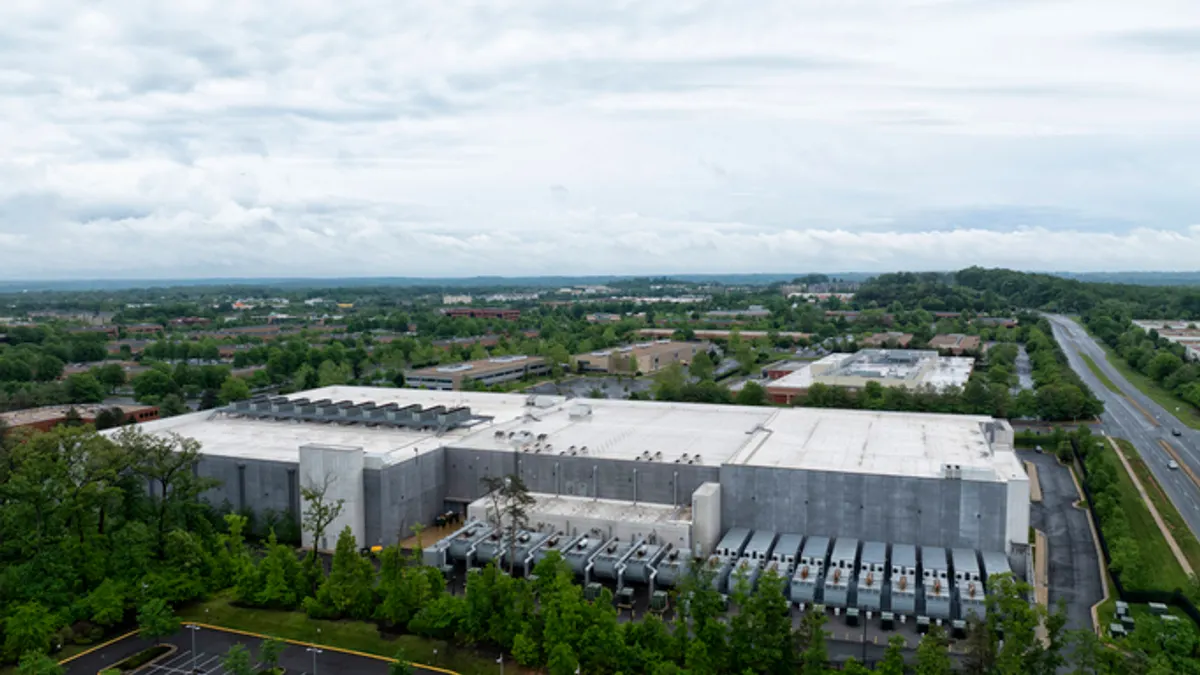
AMD and Meta have described their partnership in terms of gigawatt-scale infrastructure, but that target involves hundreds of thousands of accelerators and substantial facility investment.
Using Nvidia’s reference density of roughly 40,000 GPUs per 100 MW, Sopko estimated that one gigawatt would represent approximately 400,000 accelerators, or more than 5,500 racks containing 72 GPUs each.
Several constraints could affect the pace of deployment, Sopko said, including HBM4 and advanced packaging supply, rack-level reliability, networking performance at scale and the readiness of powered data center sites.
AMD CEO Lisa Su described the partnership as extending beyond current systems.
“Together, we are building and deploying infrastructure at gigawatt scale and shaping future generations of silicon, software and systems to enable Meta’s most ambitious superintelligence models and services,” Su said in the announcement.
The software challenge extends beyond Meta. The company’s experience with PyTorch and AMD accelerators gives it resources that many enterprises and smaller cloud providers lack. Nvidia’s CUDA ecosystem retains an advantage in developer familiarity and tooling, while AMD must show that its ROCm software stack can support a broader range of customers and workloads.
Lessons for enterprise IT leaders
Meta’s multivendor strategy offers a model for reducing dependence on a single AI hardware supplier, the analysts said, but enterprise IT teams should not assume they can reproduce the same approach without comparable engineering resources.
Kimball recommended maintaining portability where practical through standard frameworks, containers and open networking. IT leaders should also evaluate systems against their own workloads rather than relying on peak specifications or vendor comparisons.
For some organizations, the relevant measure may be the cost of completing a task, such as translating a document or generating marketing materials, rather than raw accelerator performance. Utilization, software maturity and reliability all affect the economics of running AI workloads.
Sopko similarly recommended evaluating total cost per successfully completed workload, which captures efficiency and operational performance alongside hardware costs.
Shane Snider is a senior news writer at TechTarget, covering AI infrastructure, hyperscale data centers, cloud platforms, and the power and energy systems driving modern compute expansion. You can reach Shane at [email protected] or on LinkedIn.