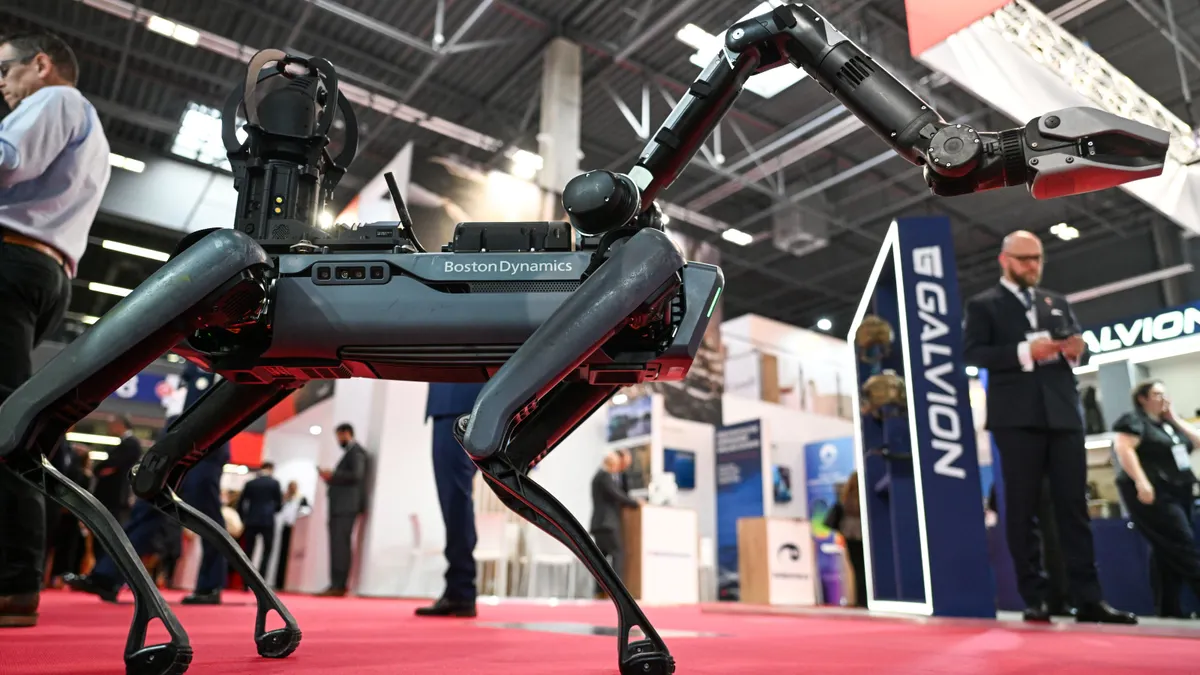
U.S. robot maker Boston Dynamics has partnered with GlobalFoundries to deploy its humanoid Atlas and quadruped Spot at the contract manufacturer's chip fabrication plants.
The deal marks Atlas’ first applications outside the automotive industry, and the first program of its kind for semiconductor manufacturing, according to the partners.
The partners have not disclosed how many Atlas units will be involved, which tasks they will handle first or when testing could transition into routine operations.
Spot, meanwhile, will expand across GF's fabrication plants in New York, Vermont, Germany and Singapore, building on an existing deployment at its Burlington, Vt., facility that has been running for more than four years.
According to the partners, the two Spot robots already working at GF's Singapore site have traveled nearly 560 miles and completed more than 90,000 inspections in sterile chip manufacturing “cleanrooms” since April, achieving a 99% success rate.
The Atlas deal announcement marks a step beyond Boston Dynamics' existing relationship with its owner, Hyundai. GF is the first publicly disclosed manufacturing customer outside that ecosystem, bringing Atlas into a new kind of operating environment and demonstrating its potential applications across a range of industries.
However, the deal looks more like an experiment than a significant shift in manufacturing automation, according to Bill Ray, a Gartner analyst.
“Being owned by Hyundai provides Boston Dynamics with a captive audience for trialing its robots, so this commitment from GlobalFoundries is a step outside that, but the announcement only talks about trials of the [multi-function] Atlas alongside deployment of a few more Spot canine robots,” he said.
Atlas also brings different safety considerations to the factory floor than smaller robots such as Spot, Ray noted. While Spot's size makes it inherently less dangerous in the event of a system failure, Atlas presents greater risks, particularly if safety relies on AI systems whose behavior is not always predictable.
Battery life and the durability of components such as robotic fingertips are other practical problems, Ray said. Hyundai is not expected to start using Atlas in its own factories until 2028, underscoring how much testing remains before the robots become operational at scale.
Effective deployment will ultimately depend on how easily robots can be integrated into existing manufacturing processes and environments, Ray said.
“Success comes by minimizing the disruption of deployment avoiding cages, special infrastructure or workflow reorganization,” he said. “Not only does this make it faster and cheaper to deploy the robots, but it also reduces the risk. The process can be rolled back if the robots fail or rolled forward if a better robot becomes available the latter being increasingly likely in such a fast-moving market.”
Pradip Singh, chief manufacturing officer at GlobalFoundries, said in a joint statement with Boston Dynamics that the project would support the company's roadmap toward AI-enabled manufacturing.
Atlas testing at GF's facilities is due to begin in early 2027, with an initial skills development workshop focused on evaluating potential humanoid use cases, assessing readiness and integration requirements, and training the robots to perform specific tasks.
Scarlett Evans is a freelance writer with a focus on robotics and emerging technologies. Previously, she was assistant editor at IoT World Today, where she specialized in robotics and smart city technologies. She also has a background in the mining and resources sector, with experience at Mine Australia, Mine Technology and Power Technology.