The annual Modern Infrastructure Impact Awards recognize the top cloud technologies and IT infrastructure products. These award-winning tools are the ones that make a difference by helping IT professionals manage vital on-premises and cloud-based environments.
Maybe DevOps is on your organization's planning document? You're going to need to evaluate the tools before you take even the first step toward that goal. The product-selection stakes don't get much higher than when you are making a decision about a converged infrastructure platform. And what about cloud migration or optimization? Plenty of organizations could stand to benefit from the top cloud technologies available in those segments.
As always, the Impact Awards process began with an open invitation for vendors and users to nominate infrastructure tools and cloud computing products across seven categories. Readers were then given the chance to weigh in, voting for their top choices. TechTarget editors and independent experts reviewed submissions, taking into account user comments and readers' votes, before choosing the winner in each of these categories:
- Best Software-Defined Infrastructure Product;
- Best Private/Hybrid Cloud Management Tool;
- Best Public Cloud Migration and Optimization Tool;
- Best DevOps Tool;
- Best Converged and Hyper-Converged Infrastructure Product;
- Best AWS Consultant or Integration Partner; and
- Best Systems Management Tool.
Click through to see all of the winners in the 2018 Modern Infrastructure Impact Awards.

Just the smallest change to your network configuration can have significant repercussions on performance, and even a temporary loss of network connectivity can be detrimental to your bottom line. It's essential that network administrators have the ability to make informed decisions about what changes they plan to make to their environments. Voters chose Forward Networks' Forward Platform as the winner in this year's Impact Award for Best Software-Defined Infrastructure Product because of the software's ability to show administrators how potential changes could affect the network.
Forward Platform collects configuration states from all devices on your network. It then processes this information with a series of algorithms, creating a mathematical model that assesses the current condition of a network and predicts possible future behavior. While other networking tools focus solely on the current state of your infrastructure, this predictive tool's intent-based networking approach appealed to readers.
"Although it's a small company, I think Forward Networks' Forward Platform is pretty great," said Mark May, enterprise infrastructure specialist. "It basically imports your network configurations and lets you treat them like a sort of lab to predict network intent. For me, these guys are the most innovative."
Forward Platform boasts three primary capabilities: Forward Search, Forward Verify and Forward Predict. Forward Search gives the user instant access to the entire end-to-end network behavior and configuration. Forward Verify builds on this search feature by alerting network administrators to policy violations, unexpected behavior and security risks. Forward Predict enables network administrators to test different scenarios in a sandbox environment before they're implemented.
Forward Platform is a "Day Zero offering that brings operational expenditure reduction, compliance and agility to the network," one voter wrote.
"Forward Platform looks at what your change can affect," said Brian Kirsch, an IT architect and instructor at Milwaukee Area Technical College. "Forward Platform gives you that 'what-if' and, that's huge in today's data center."
Readers were also impressed by the level of visibility Forward Platform provides into the network. It performs continuous verification to ensure the network follows the connectivity and security policies that you've defined. As one voter said, it "finally solves the underlay problem."
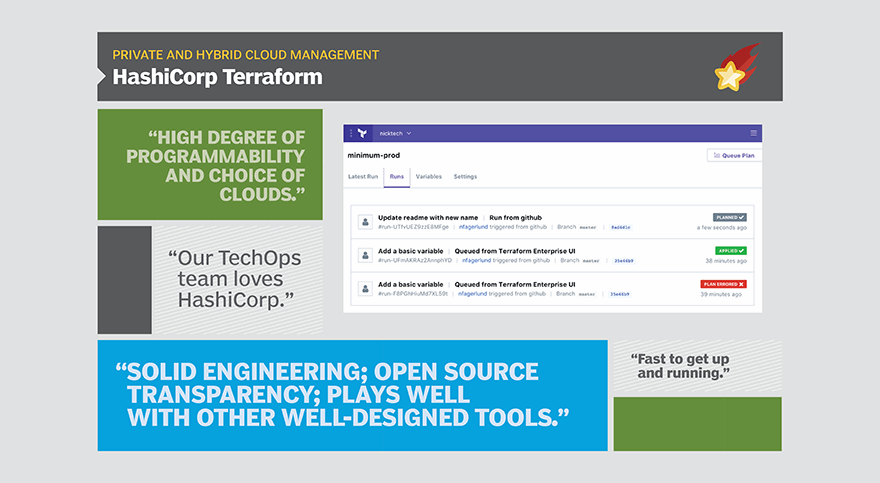
Effective private and hybrid cloud management hinges on a number of tasks, ranging from performance monitoring to cost optimization. But increasingly, it also incorporates infrastructure as code -- at least, that's what 2018 Impact Awards voters seem to suggest.
HashiCorp's infrastructure as code (IaC) software, Terraform, is this year's winner of the Best Private and Hybrid Cloud Management Tool category. And while not all enterprises have adopted IaC for cloud infrastructure management, the technology certainly has its benefits, said Chris Gardner, senior analyst at Forrester Research.
"One of the biggest challenges executing a hybrid cloud management strategy is creating consistent, replicable software-based models of infrastructure," Gardner said. "[IaC] lets infrastructure engineers focus more on overall architecture and less on the nuances of integrating with various cloud providers."
With Terraform, admins can automate provisioning across cloud platforms such as Amazon Web Services, Azure, Google Compute Engine and on-premises private clouds, including those based on OpenStack. The number of platforms that Terraform supports helps set it apart from other IaC tools, Gardner said.
"There are over 70 [targets], many written by the target companies themselves," he said. "These include AWS and Azure, but also old-school VMs, some PaaS and SaaS systems, and even some physical hardware."
To define the infrastructure components they need via Terraform, admins use a command-line interface and configuration files. The tool also provides resource graphs, which help IT teams gain visibility into their cloud resources, the dependencies between them and how a particular change could affect their overall environment.
Voters chose Terraform for a variety of reasons, among them: the fact that it's open source, it supports a long list of cloud platforms and it is highly programmable.
"Terraform provides consistency of approach and an open source model, which is critical for cost containment and extensibility," one voter wrote.
Granted, not every organization -- at least not yet -- will implement IaC as a way to manage private and hybrid clouds. It's still an emerging technology, often coupled with DevOps initiatives, and will come with a learning curve for some IT teams, especially those that support a large number of legacy applications.
Other potential challenges with IaC tools include configuration drift and admins attempting to change configurations outside an IaC tool. To successfully implement the technology, organizations should be sure to document all changes made with IaC and be diligent about version control.
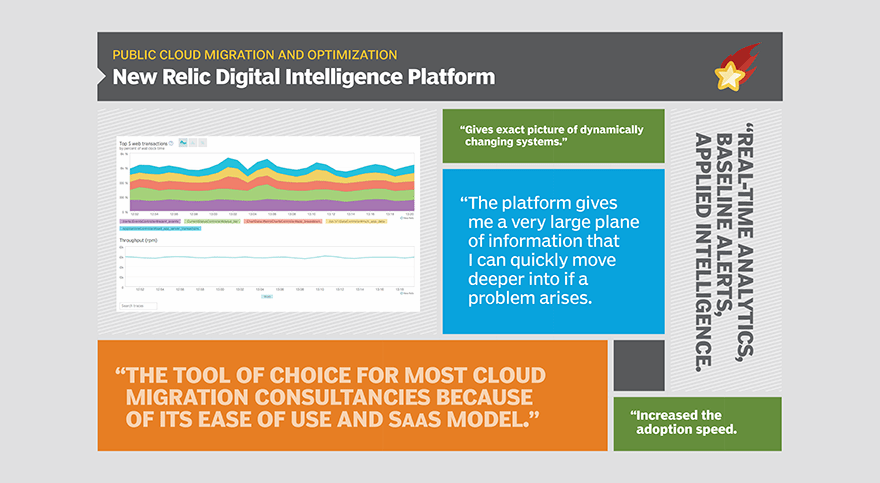
For enterprises accustomed to their private data centers, the shift to the unfamiliar architecture of the public cloud brings a whole new set of challenges. That's why so many third-party tools have sprung up to assist with migrations and optimization. For our readers, there was a clear choice for which company does that best: New Relic.
The New Relic Digital Intelligence Platform is a SaaS-based product that provides real-time analytics and full-stack visibility for workloads running on Amazon Web Services, Microsoft Azure and Pivotal Cloud Foundry. It includes performance metrics, migration assistance, custom plug-ins, dashboards and alerts that can help users navigate these new environments and get the best performance from their applications.
The vast majority of IT workloads remain on premises, but the continuing shift to the cloud means companies need an independent view of their applications' performance, said Federico de Silva Leon, a Gartner analyst. New Relic is among a handful of companies, including AppDynamics, Dynatrace and NetApp, that are doing interesting things in the cloud, he said.
"They're helping clients monitor the performance of applications that are cloud-native but, more importantly, as customers migrate those [on-premises] workloads into the cloud," de Silva Leon said. "So, before, during and after, I think New Relic is doing a great job."
San Francisco-based New Relic was the clear winner among our readers, earning nearly twice as many votes as the next entrant. In casting their votes, readers cited its ability to work across multiple clouds and the user experience, including the dashboard, alerts and analytics tools built into the product.
"The platform gives me a very large plane of information that I can quickly move deeper into if a problem arises," one reader said.
The product isn't without its shortcomings, de Silva Leon said. New Relic is focused on the cloud, so it doesn't have the best support for legacy, on-premises workloads. And a SaaS-only model doesn't meet the needs of the many companies that want an in-house product.
But New Relic does have a simple, powerful tool that is focused on the developer community, which is, after all, the group that is leading the push to the public cloud.
"They're selling to a very tough group of buyers who are developers who like to pay for almost nothing,” de Silva Leon said. "So the fact that they are growing is impressive."

The development of AppDynamics App iQ platform reflects broad trends in enterprise DevOps tools in the past year, from a renewed focus on monitoring IT apps and infrastructure to pushing the envelope of analytics-based automation.
The company kicked off a busy year of tech industry headlines in January when it was acquired for a cool $3.7 billion by Cisco Systems, as AppDynamics stood on the verge of a blockbuster initial public offering.
The company's momentum is based on its popularity among enterprise customers, such as Hallmark, eBay, Expedia, Carhartt, United Airlines, CarMax and others. It also reflects a strong focus on business value within the AppDynamics product line, which correlates technical metrics with business outcomes.
"AppDynamics has helped us shift left on the development side, giving ops and development a common language on our most critical applications," said one of our Impact Awards voters.
The application of advanced analytics with machine learning capabilities to IT operations, known as AIOps, was also a dominant trend in the DevOps world this year. AppDynamics is a longtime proponent of AIOps, and could be the product to beat in 2018 if plans for automated root-cause analysis and predictive analytics features the company previewed at its annual AppDynamics Summit come to fruition. Cisco has big plans to fold AppDynamics App iQ platform in with its network infrastructure and security tools, reflecting the broadening focus of DevOps to include software-defined networks and DevSecOps practices. A further DevOps monitoring acquisition, Perspica, which brings wire-speed analytics into the Cisco fold, will also up the ante for DevOps monitoring in 2018.
"When we look back at 2018, we'll see a separation between the leaders and the laggards in DevOps monitoring," said Stephen Elliot, analyst at IDC. "It isn't just what kind of analytics companies are developing, and whether they have patents to show they're unique -- it will also depend on the breadth and depth of data they can collect."
All this is a sign DevOps in enterprise IT shops has matured beyond test and development environments to take on more critical production workloads, Elliot said. "It's a sign companies are realizing they still need monitoring. There might have been some hope they needed less investment in this area with IT automation, but they actually probably need more," Elliot said. "It's becoming more and more important with multi-cloud adoption to have broader process management and data collection, as well as analytics."

Scalability and simplicity are two main benefits of Nutanix Acropolis that helped the product win Modern Infrastructure's Impact Award for Best Converged and Hyper-Converged Infrastructure Product. Nutanix Acropolis combines software-defined storage with virtualization to create a well-rounded hyper-converged platform on which administrators can run nearly any workload.
Acropolis runs on x86 server nodes across four hardware platform lines.
Nutanix offers the Acropolis software in three tiers. The Starter option is ideal for small deployments, while the Pro tier offers features such as rich data services, resilience and management features. The Ultimate version, which offers the full software suite, is aimed at organizations with advanced security requirements and those with multisite deployments.
Brian Anderson, an IT director at Boston University, has been a Nutanix customer for several years. He recently replaced the IT organization's VMware setup with the Nutanix Acropolis hypervisor.
"It's been a bit of a challenge, as VMware has some features and functionality that are more fleshed out, but I believe Nutanix is more forward-thinking with some of their capabilities," Anderson said. "From a management perspective, the VDI cluster requires little maintenance, and to perform updates is seamless and requires virtually no downtime."
For others Acropolis offers the ability to forgo a proprietary hypervisor -- and the hefty price tag that comes along with it.
"We were able to get tremendous value of savings initially by not having to buy all of the VMware licensing," said Alton Levesque, the IT strategic director of LabCorp, a healthcare research company based in Burlington, N.C. Acropolis can be categorized as a self-healing system because it creates distributed autonomous capabilities among all nodes in a cluster. Built-in fault handling minimizes issues in the event of a failure. But when a problem does inevitably occur, many users praise Nutanix for its excellent customer support.

Amazon Web Services is now focused on landing more enterprise customers, a group that might have reservations about a cloud migration and be less inclined to take the do-it-yourself approach. As a result, a growing network of consultants stands at the ready. Amazon approves technology and consulting vendors through its AWS Partner Network, and with four tiers of consulting partner levels.
Each nominee for the Modern Infrastructure Impact Award for Best AWS Consultant or Integration Partner category earned top-tier status as AWS Premier Consulting Partners, but only one could come away with the award. Flux7, a consultancy based in Austin, Texas, won the award for the second straight year, earning the largest share of votes and the loudest praise of any nominee.
One voter lauded the Flux7 team as "experts in establishing cloud-based CI/CD infrastructure pipeline support."
"We found their work compatible with strategies we had already been exercising. The result was a usable reference implementation, which established some fundamental baseline best practices," one voter wrote.
Another voter and client said, "They were by far the most knowledgeable and efficient team I have ever worked with."
Flux7 works with businesses of all sizes, including Rent-A-Center and Personal Peptides. Flux7 offers four AWS competencies, including demonstrative expertise in DevOps and cloud migrations.
That expertise comes at a time of increased weariness about cloud security and data breaches. In 2017, several AWS customers left data in Amazon Simple Storage Service exposed to the internet, making for bad headlines. And one or two consultancies shouldered blame in that equation.
"If you're AWS savvy and know how to configure security correctly, it's not an issue," said David Linthicum, chief cloud strategy officer at Deloitte Consulting and a TechTarget contributor. "If you're not, then you're exposing data just as you would with any internet-connected server that's not configured correctly."
But even if you know how to configure your security settings, consultancies like Flux7 face a number of challenges. Not only do they need to stand out from the competition and carve out a niche, they need to do so while maintaining a comprehensive knowledge of AWS' dizzying array of services.
"AWS is about 70% of the cloud projects out there, and clients are looking for specific skills and certifications," Linthicum said. "AWS is moving fast, and the new features and functions are just part of the game. The good news [is] you only need to keep up with those features and functions that are relevant to your clients. The bad news is features and functions that are relevant are going to be quickly changing, and thus you must keep up."

In Modern IT, applications are built to be dynamic, rapidly updated and deployed on diverse hosting infrastructures. This means modern IT operations tools must make sense of change at a breakneck pace.
By correlating change with monitoring data, New Relic Infrastructure took first place in the Best Systems Management Tool category for the 2018 Modern Infrastructure Impact Awards. The selection of a real-time monitoring and analysis system for this category demonstrates that systems management has evolved into a method to improve application health, as DevOps, cloud and containers hit the mainstream in enterprise IT.
New Relic Infrastructure monitors cloud and hybrid IT infrastructure deployments in real time. It is intended as a corollary to New Relic's application performance monitoring (APM) technology. With full-stack monitoring from one vendor, the aim is for users to seamlessly detect where configuration changes affect application health and to decrease the time to troubleshoot issues.
"There [are] quite a lot of APM tools out there that don't go into the infrastructure, and vice versa," said Roy Illsley, principal analyst at Ovum. Covering both for a full-stack monitoring experience has become increasingly important, and New Relic is positioned to do so.
New Relic Infrastructure displays change and performance data in customizable dashboards, sends alerts based on tags and other input, provides full search as an alternative to log-based explorations and enables analysis based on the New Relic Insights data platform and analytics engine. The monitoring product works on any combination of cloud or traditional servers, including containerized deployments. CPU, memory, I/O and processes are tracked with a correlated change history.
"New Relic's use of the Insights module enables IT organizations to understand monitoring data in relation to business performance," Illsley said. That capability, offered by New Relic and others, should be a checkbox for organizations selecting new IT monitoring tools.
Illsley noted that New Relic frequently makes the short list for IT organizations in the market for monitoring, in part because the company's products are built for scale and cloud-based deployment, and in part because the company is associated with modern IT, not legacy. Voters chose New Relic Infrastructure as the top systems management tool because it is familiar, offers hashing of configuration state in real time and provides a single source of monitoring information. But others said it provides less detail and less flexibility than other tools available. To stay at its peak, New Relic will have to keep the future of IT in its product roadmaps, Illsley said.
"When New Relic came into existence, they were looking at tomorrow and beyond," Illsley said. They'll have to keep doing that to grow. Deep learning and AI-infused monitoring is bringing increased intelligence to IT monitoring, troubleshooting and optimization, and New Relic must continue its efforts on contextual and precise data analysis. The IT ops pro's user experience is another concern for IT systems management vendors. "You have to think about how the next generation will interact with data," Illsley said. But, many companies see data collection and processing as the differentiators for a product, and the GUI as little more than an afterthought.
New Relic Infrastructure is available in Essentials and Pro product levels. New Relic Infrastructure Essentials includes core infrastructure monitoring functionality with three months of data retention. The Pro level adds the integration capability with other popular technologies, such as Amazon Web Services' Elastic Load Balancing, CloudFront, DynamoDB and others.