

Physical AI is gaining traction across manufacturing, logistics, healthcare and other labor-intensive tasks. A 2026 report from the Capgemini Research Institute, "Physical AI: Taking human-robot collaboration to the next level," found that in a survey of 1,678 senior executives, 79% of organizations already engage with physical AI, indicating strong activity from experimentation to deployment.
However, physical and embodied AI platforms are far from foolproof. Potential safety problems exist everywhere that humans and physical AI interact. The issues can be subtle, such as poor route optimizations, but can easily become life-threatening when a warehouse robot drops a heavy pallet or a surgical robot applies too much pressure during a procedure.
Today's executives must understand the risks and implement well-considered safeguards to keep robots -- and the humans they interact with -- safe.
AI robot types
There are several types of robots, each differing in speed, safety challenges, flexibility and ability to perceive and respond to their environment.
Traditional industrial robots
These robots have been around for decades and operate extensively in manufacturing. They have limited sensor input, follow fixed, repetitive paths and have insignificant computing and decision-making ability.
Traditional robots work within highly controlled safety cages or across dedicated robotic cells. Their focus is high-speed, precise operation and heavy payloads. The fixed locations, repetitive movements and demanding safety requirements have led to extensive safety guidelines and standards.
Physical and embodied AI
Physical AI is an umbrella term referring to any AI system that gathers, processes and uses data in real time and doesn't require a physical presence. An AI traffic control system is a physical AI system, but it isn't embodied into a distinct, independent platform.
All embodied AI platforms are physical AI, but the term "embodied AI" refers to distinct, independent platforms. These include advanced intelligent manufacturing robots, warehouse robots and autonomous vehicles that can navigate chaotic or changing situations in real time. Physical and embodied AI employ advanced sensors to see, predict and avoid obstacles.
The wide range of embodied AI platforms, coupled with their dynamic capabilities and decision-making, has made it difficult to develop and ratify safety standards. Standards are evolving but will likely emerge in the future as sets that users can pick and choose from to assemble a safety environment most appropriate for their use case.
Collaborative robots (cobots)
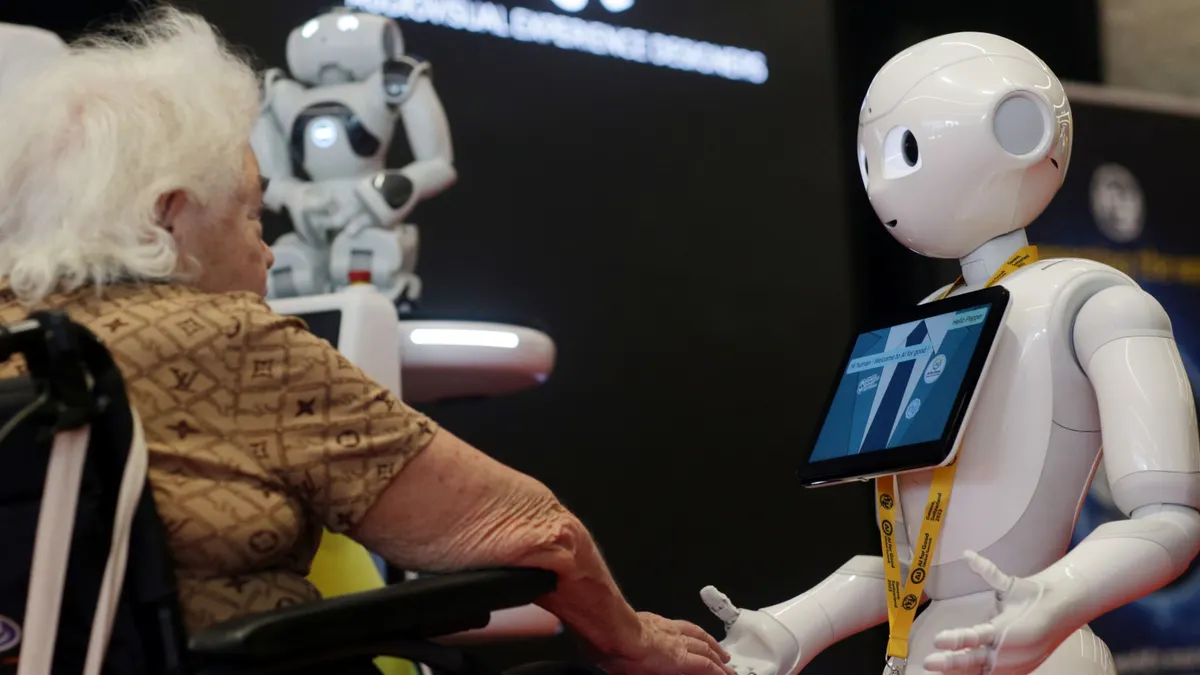
Cobots are a class of embodied AI that work beside humans in shared spaces. These might be small, autonomous vehicles delivering coffee across busy office spaces or medical robots interacting with patients. While embodied AI robots can apply potentially dangerous speed and force for tasks such as manufacturing or transportation, cobots limit human hazards by using low force, low speeds, torque sensing and rounded forms that reduce injuries during human contact. Cobots might include additional conversational capabilities to aid human communication.
Physical AI's safety challenges
The role of physical AI in enterprise operations is growing. AI agents can help optimize building management by sensing people's presence to control lighting and environmental conditions, while cameras can use facial recognition or other biometrics to authorize access or alert security to suspicious behavior.
Other examples of embodied AI include autonomous cars and drones, as well as agricultural robots that detect and remove weeds in fields. Hospitality fields can employ embodied AI to help patrons find and book activities, while healthcare fields might use robots to assist patients and monitor vital signs.
However, autonomous and embodied AI systems operating in proximity to humans face complex safety challenges:
- Unexpected human contact. Embodied AI can unintentionally strike, catch or crush a person in proximity when it miscalculates a trajectory or suffers a sensory blind spot. The consequences can be deadly.
- Stability loss. While wheeled and multi-legged embodied AI often have built-in stability, other designs -- such as bipedal robots -- require continuous power and computing resources to remain upright. Sudden loss of power or failure of inertial control devices might cause the robot to fall and injure nearby humans.
- Sensor disruption. Detecting and responding to physical obstacles requires ultra-low-latency sensor arrays and complex sensor integration. Rapid motion and unexpected environmental problems, such as vibrations, smoke and bright light, can fool sensors.
- Lack of engineering standards. Traditional industrial safety frameworks, such as emergency stop buttons for fixed industrial machinery, don't address physical or embodied AI platforms. Consequently, there is no industry guidance on the design, deployment or management of workplace robots. Newer standards, such as ISO/CD 25785-1, will address the dynamic stability of robots.
- AI vulnerabilities. Developers build physical and embodied AI platforms on well-established foundations of machine learning (ML) models, network connectivity and extensive data collection and processing. Consequently, AI platforms are vulnerable to a wide range of AI-related problems, including flaws in the model and its surrounding software, data quality and bias issues, and cybersecurity exploits that can be harmful to the robot and fatal to nearby humans.
- Human factors. Robots lack nuanced social cues for things like right-of-way, and their presence in established human areas can cause dissent among employees. Further, the extensive data robots collect, including continuous video and audio, raises privacy concerns in public spaces and shared workspaces.
2026 robot safety standards
Robot safety standards have primarily focused on traditional industrial robots with classic safety features such as emergency stop buttons, protective cages and other fundamental precautions for industrial-class machinery.
The emergence of physical and embodied AI has underscored the pressing need for new standards that recognize the independent, dynamic operation of AI-driven robots across use cases. Updated guidelines for traditional robots, intelligent autonomous robots, cobots and related cybersecurity guidance include the following:
- ANSI/A3 R15.06-2025, parts 1 and 2. The U.S. national adoption of the updated ISO 10218 standards.
- ANSI/A3 R15.06-3-2025, part 3. A U.S. document detailing the responsibilities, safe operation, risk assessment and personnel safety requirements for industrial robot cells. This document replaced legacy 2012 guidelines.
- ANSI/A3 R15.08. Covers safety requirements for industrial mobile robots.
- ANSI/B11 Standards, B11.0 and B11.20. Outlines general machinery safety, risk assessment methodology, and integrated manufacturing systems.
- ANSI/UL 1740-2019. A safety standard related to robots and robotic equipment, with both electrical and mechanical criteria.
- ISO 10218-1, 2025 edition, part 1. Stipulates robot safety design requirements, including over 30 testable criteria. It also defines new Class 1 and Class 2 robot classifications and includes rules for functional safety and cybersecurity.
- ISO 10218-2, 2025 edition, part 2. Outlines system integrations and robot applications. It includes the human-robot contact force and pressure limits previously detailed in ISO/TS 15066 directly into the ISO 10218 standard.
- ISO 25785-1. Currently under development, this standard addresses dynamic stability, balance and fall zones for bipedal and humanoid robots.
Establishing robot safety in the workplace
Today, there is no single, universally accepted approach for physical or embodied AI safety in the workplace. There are simply too many potential industries, each with varied needs. The features and capabilities of physical and embodied AI platforms are evolving so rapidly that applying a set of standardized safety rules seems almost archaic. Beyond the emergence of partial standards, there are broader guidelines, including OSHA robotics guidelines and ANSI/RIA frameworks for risk assessment.
Still, comprehensive safety standards remain elusive. Each enterprise must design, implement and maintain robot safety based on general industry and regulatory demands, occupational safety requirements and specialized operational considerations. Business and technology leaders must adopt a structured approach based on extensive risk assessments, consider a broad array of physical and technological guardrails and adopt strict operational policies. The following includes guidance on how to start:
1. Risk assessment
Physical and embodied AI safety starts with initial and ongoing risk assessments that span the entire spectrum of the platform's operational envelope, including initial setup, programming and training, maintenance, testing and troubleshooting -- not just when the platform is operating normally in a production environment.
Risk assessments should include every point where humans enter the platform's operating space. Fortunately, there are several established risk evaluation standards, including ANSI/RIA R15.06-2025 for industrial robots, ANSI/RIA R15.08 for autonomous mobile robots and ISO 10218, which outlines general safety requirements for industrial robots.
2. Engineering guardrails
Consider methods to minimize human presence in machine spaces and better alert humans to potential hazards. High-visibility floor tape, physical barriers and hard stops, cages, gates and other presence-sensing devices can create machine-only zones, ensuring that humans remain outside of the zone unless the robots inside are safely idle.
When robots operate near humans, ensure the designs include deliberate features such as speed and separation monitoring, power and force limiting, hand-guiding and other safety features intended to limit the robot's speed and strength to reduce potential harm. Finally, always perform routine robot maintenance according to the manufacturer's instructions to ensure ongoing performance.
3. Operational policies
Ensuring human safety in physical and embodied AI environments demands careful attention to administrative policies and access control. Restrict access to robot workspaces to specially trained and authorized humans -- even cobots delivering coffee in the office should receive proper consideration from human colleagues trained in robot presence, interactions and limits.
Heavy industrial robotic environments continue to use traditional lockout/tagout protocols for formal control of the environment, as well as buddy systems to ensure that a second worker can access emergency stop or kill-switch mechanisms. Businesses can design and mandate additional safety rules based on the unique needs of the environment, such as use of safety devices, restrictions on loose clothing or jewelry, helmets and eye protection, and other measures to reduce human injury.
4. Monitor robot behavior
Document and review metrics related to physical and embodied AI platform safety. Objective metrics might include factors such as reflex or control latency, dynamic distance control and more established AI metrics such as model accuracy, drift and recall. Metrics are often combined with detailed incident reports documenting workplace accidents involving robots and can help ensure that underlying causes are understood and addressed.
5. Regular maintenance and reviews
Safety is an ongoing practice that requires human oversight. Human safety in robot environments requires regular preventive maintenance checks on safety equipment such as emergency stops, kill switches, sensors and safety interlocks to ensure their continued operation. Review safety protocols and practices and update them periodically as new safety concerns and industry mandates arise, and as new physical or embodied AI platforms enter service.
6. Routine training
Humans require regular safety training to recognize and understand the dangers and limitations of physical and embodied AI platforms. Training includes safe operation, interaction and emergency response procedures. Training should be repeated regularly and updated anytime software, AI platforms or workflows change.
Stephen J. Bigelow, senior technology editor at TechTarget, has more than 30 years of technical writing experience in the PC and technology industry.