

Can businesses operate when email and chat both go down?
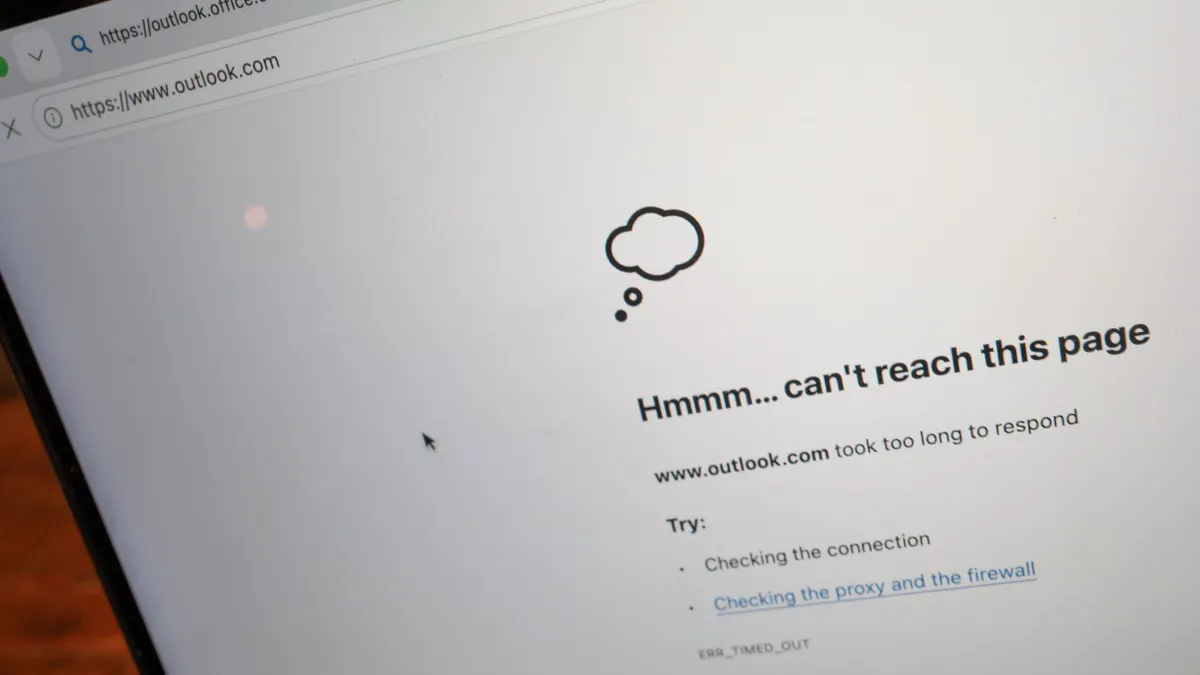
The November Microsoft 365 outage disrupted Outlook and Teams, two tools employees rely on to reach colleagues and clients throughout the workday. For CIOs, the challenge goes beyond finding another messaging app. If the team keeps its contact list in Outlook, who has a copy they can use to make a call? And if the outage plan is in SharePoint, can employees access it when needed?
To find out how organizations are preparing for the next outage, we asked IT leaders and analysts how they’re rethinking business continuity after the Microsoft 365 disruption. Several urged CIOs to identify which work can’t wait and test how teams would stay productive without Microsoft 365.
Here’s what they had to say.
What are you doing after the Microsoft 365 outage to keep employees working through the next one?
Manish Jain, founder and CEO at Strategic Horizon Research, an enterprise AI research firm
The November outage ran for close to 24 hours, and many organizations are still recovering even a week after that. Most CIOs I speak with had a disaster recovery (DR) plan, but almost none had a plan for a weekday without Outlook and Teams. DR runbooks protect data, but they lack processes to protect work.

Last week, I asked a few CIOs, “If Microsoft goes dark again at 10 a.m., which three decisions still must get made by 5 p.m., and how will people make them?” Most don’t have answers yet.
Organizations rely on enterprise collaboration software so much that people don’t even have their colleagues' phone numbers. That human touch needs to come back, at least for organizational resilience.
Ask every individual and team to maintain key contacts offline and keep a second communication channel ready. It could be WhatsApp, Telegram or another phone group. Bring it within the enterprise security perimeter and test it at least once a quarter.
Adam Bowles, CEO and co-founder of ACT360, a managed IT provider in Barrie, Ontario
In light of the outage, we're introducing three measures, internally and for our clients. Firstly, a backup way to contact staff outside of Teams and Outlook — it can be via SMS or a messaging app. Secondly, offline versions of essential files, such as client contact lists and key documents. Thirdly, a one-page guide explaining what to do if Microsoft 365 should go down.
Additionally, we are verifying that administrators can still access their accounts when normal sign-in is unavailable.
Gunter Ollmann, CTO at Cobalt, a cybersecurity company
The November outage was a reminder that business continuity planning for productivity tools is also a security problem.
When email and chat go dark for most of a day, people don’t stop working. They move to personal email, consumer messaging apps and whatever file-sharing tool they can find. They’re also more likely to trust a message that says “click here to restore access.” Attackers know this, and an outage is a ready-made phishing lure.
We’re focusing less on duplicating every service and more on deciding ahead of time which workflows must survive a 24-hour outage. Then we set up a pre-approved fallback channel for each one and clearly tell employees, before anything happens, what IT will and won’t ask them to do while a provider is down. We should test that plan the way we test incident response, not just write it down and hope it works.
Jeremy Roberts, senior director at Infotech, an IT research and advisory firm
Business continuity planning is the answer. This means identifying your key processes and their dependencies, then conducting a tabletop exercise to work through how you’d respond if you couldn’t complete the work as intended.
We advocate for IT as a partner in business continuity planning. Individual business units should have their own business continuity plans, while IT focuses on disaster recovery.
Store important runbooks in redundant systems so you can access key documents even if SharePoint Online is inaccessible. Think about how your teams can contribute to recovery. For example, are they gathering information in a format that will be easy to enter when the system comes back online?
Derek Perry, chief AI and technology officer at Springline Advisory, a business and consulting advisory firm
The outage is a useful reminder that business continuity is about keeping critical work moving, not duplicating every productivity tool. Outlook is a critical communication platform, but it is not where most of our client work is actually performed. The bigger question is whether the applications, data and workflows people need to serve clients remain available.
Communication is also more distributed than it once was. People use email, Teams and other communication channels. There are generational considerations that can create practical alternatives when one channel is down. Some employees may be hesitant to use their phones for voice calls, while others are loath to use less-formal communication media like Teams.
Understand which business processes truly cannot stop, provide an independent way to communicate during an outage and test those plans. Building a redundant version of Microsoft 365 adds more cost and complexity than resilience for long-tail events.
Surya Teja Chayanam, strategic account director at YASH Technologies, leading the account for a Fortune 100 industrial manufacturer
After the latest outage, we are changing how we think about continuity. The lesson is not to buy a second provider, but to decide in advance what keeps running when a major provider goes down — which processes must work offline, who decides whether to switch to manual or local work and how we revert once the service returns.
In our account, we run 56+ bots with 18,000+ executions and 45+ dashboards across 1,200+ assets at 25+ facilities. The plant does not stop when a cloud service does. The question is whether the IT processes around it continue to work, and who decides on the fallback. That fallback plan must be written before the outage, with clear decision rights assigned.
Tim Murphy is a reporter covering IT strategy for Informa TechTarget, with a focus on IT leadership, governance, workforce skills and AI strategy. His enterprise technology coverage has earned multiple Azbee Awards.