

ATLANTA – IBM is the latest enterprise tech vendor to tie agentic security to infrastructure, including an updated version of HashiCorp Vault and Terraform integration with IBM Concert Protect.
IBM's agentic AI security updates this week began with the launch of a new Agent Identity product, which contains an agent registry and performs authentication, auditing and compliance for enterprise agents. Agent identity integrates with identity management providers, including IBM Verify, Microsoft Entra, Okta and Ping, along with Vault Enterprise, to issue and revoke short-lived credentials for agents. The combined systems' agentic identity and access management indicates which human operates each agent, limits agent access privileges with 'ceiling' policies, and revokes agent credentials in the case of suspicious activity.
HashiCorp Vault Enterprise 2.2, released earlier this month, now supports on-premises application startup authentication using a trusted platform module (TPM). This VM provides cryptographic proof that the application possesses a valid encryption key, which Vault can verify before granting its first access, thereby eliminating the need to reuse 'bootstrap' credentials. VMs can also request Secure Production Identity Framework for Everyone (SPIFFE) identities from Vault, which "gives the workload an identity that other systems can verify," according to a HashiCorp blog. A new Security Hub adds centralized management for Vault clusters in the cloud and on premises.
The new features are intended to minimize specific agentic security risks: agents that could be overprivileged when they use the full access credentials associated with their human operator, and the risk that exposed or reused credentials could be exploited by a malicious agent. All of these are hot topics in an industry currently beset by agentic AI security issues, from rogue agents and agent-driven cyberattacks to mass discovery of software vulnerabilities.
With Agent Identity, Verify and Vault, IBM has "essentially, a kill switch – at the point of the problem, it can kill the transaction or kill the agent to prevent it from doing what you would have otherwise found later in logs," said Jim Mercer, an analyst at IDC. "I'm also seeing almost all [identity] providers provide some sort of a policy manager, to the extent there's policy sprawl, which leaves room for gaps. [Agent Identity] provides a veneer on top of that to make sure that, at a higher level, protections are in place."
IBM also beefed up policy guardrails for the HashiCorp Cloud Platform (HCP) Terraform infrastructure as code (IaC) tool. Its new tfpolicy language is based on the same HashiCorp Configuration Language (HCL) used by Terraform itself. This adds a more accessible alternative to HashiCorp's Sentinel tool and Open Policy Agent, which use separate domain-specific languages. Terraform's search feature, introduced last year, can now apply Terraform policies to infrastructure assets before they are moved into Terraform. This lays the groundwork for Terraform code generated by AI agents that's bound by an organization's governance policies – including FinOps policies.
"The new changes in Vault and Terraform are exactly the new features anyone now using agents to control their infrastructure and deployments is going to need," said Rob Lazzurs, CTO at Amach Software, a digital transformation consultancy in Dublin, Ireland. "For one of my clients in the financial sector, the focus has been on how to use Vault and Terraform to give agents controlled access that enables engineers to move quickly and do more in parallel while keeping the systems safe from unintended consequences. I know we will be deploying Vault 2.2 and using these new features as soon as they are available."
Agentic security increasingly rooted in infrastructure
These tools complement existing infrastructure-based security tools in the IBM portfolio, including Verify, which provides identity management and protection, including shadow agent detection, at the network layer. IBM's Fusion AI Factory joined Red Hat, Dell and HPE in signing on to Nvidia's OpenShell Reference Architecture this month. This architecture includes Nvidia Sentry, an agentic security framework that runs outside agent and host software on Nvidia's BlueField-4 DPUs.
"We're the only vendor now that can detect [malicious agent activity in] storage," said Tyler Lynch, outbound CTO for IBM Automation, during an interview here this week. "What we'll show [in a demo] is an agent doing KV-cache poisoning. We catch it at the storage layer, in telemetry, and in real time Agent Identity revokes its credentials and puts it in a sandbox. We are implementing it inside the IBM Fusion hardware."
While Lynch touted IBM's multi-layered agentic storage strategy as unique in the industry, the notion of embedding agentic security mechanisms within infrastructure, outside agents and their orchestration software, is a growing trend. In addition to vendors supporting Nvidia's Sentry, Broadcom also upgraded its VMware hypervisor against agentic threats with HyperArmor this month.
In fact, by 2030, Gartner predicts that 25% of enterprises will merge their network operations center (NOC) and security operations center (SOC), up from 5% in 2026, according to a report released this week by the analyst firm on IT infrastructure and operations (I&O) predictions for 2027.
"As AI becomes increasingly embedded in enterprise infrastructure, operational and cybersecurity risks are becoming more interconnected," according to a Gartner press release. "Shared AI tooling, telemetry and the growing use of AI agents are driving closer collaboration between I&O and security teams to improve resilience, risk management and operational efficiency."
IBM Concert + Terraform = proof of exploitability
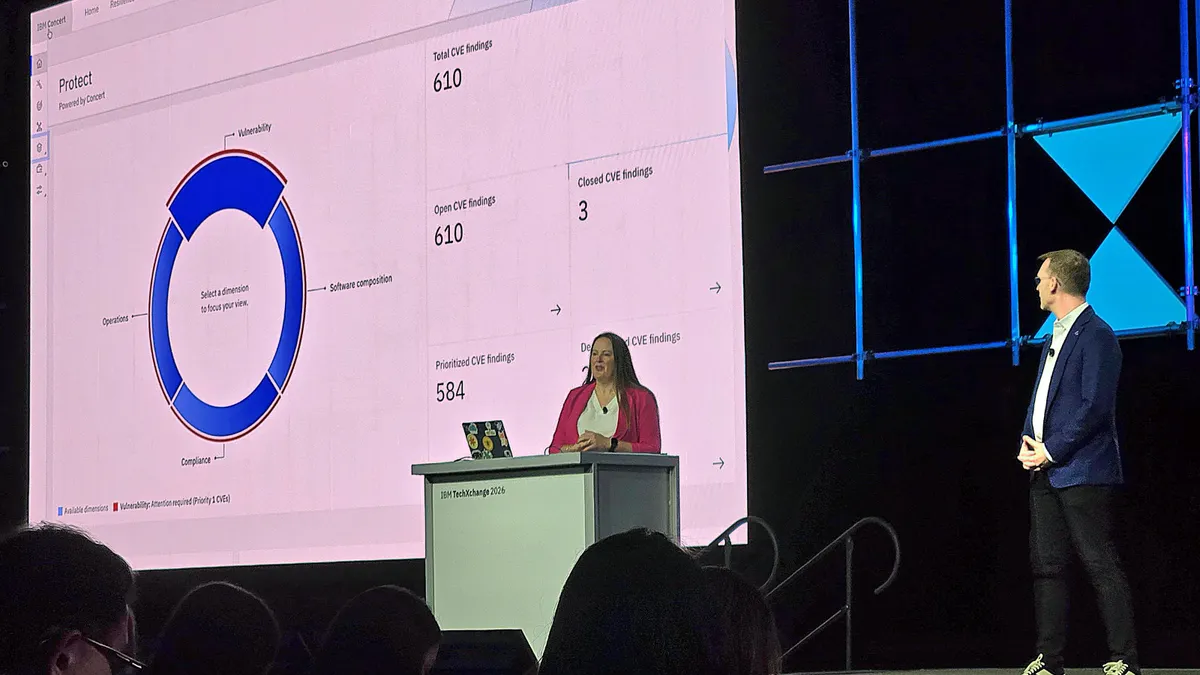
IBM demonstrated more infrastructure-infused agentic security with IBM Concert Protect -- part of the vendor's new AIOps platform shipped as SaaS in June and in a self-hosted version in September. Concert Protect can now link vulnerability management with Terraform infrastructure topology views through the new Infragraph knowledge graph. The demo on the keynote stage here Tuesday showed the blast radius of a security vulnerability mapped to its affected infrastructure, and it kicked off a redeployment of that infrastructure through Terraform to mitigate the vulnerability.
IBM Concert agents could previously kick off Terraform operations, but this new integration offers proof of exploitability, which can help enterprises prioritize which vulnerabilities to patch first, said Vikram Murali, vice president of software development for IBM, during a presentation here this week.
"With Concert Protect specifically having information about your environment, about where the code is, about what actually constitutes that code … instead of [using] a predictive model, we come up with [verifiable] proof of exploitability," Murali said.
Beth Pariseau, Lead Editor, Infrastructure News for Informa TechTarget, is an award-winning veteran of IT journalism. Have a tip? Email her or connect on LinkedIn.