LAS VEGAS -- The word "acquisition" can strike fear into the hearts of IT executives.
When an IT vendor makes an acquisition, customers rightfully wonder what will happen to their services. Will the acquisition drive up costs? Will it be beneficial in the end?
Users at HPE Discover praised the smooth integrations the vendor has made following recent acquisitions.
HPE's integration process has been "genuinely impressive," according to Mike Leone, analyst at Moor Insights & Strategy.
"One thing I respect is that HPE seems to know what not to build itself, leaning on partners for the pieces outside its lane rather than trying to own everything," Leone wrote in an email to TechTarget.
And through all the integrations, upgrades and updates, the importance of communication, experience and expertise is a constant, customers said this week.
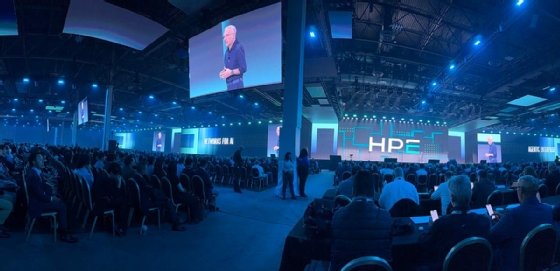
About 13,000 people attended the HPE Discover user conference.
Pickin' up good integrations
Danfoss, a global industrial manufacturing company based in Denmark, has been an HPE customer for about 20 years. The company uses HPE's GreenLake and Private Cloud AI. HPE and Danfoss also collaborate on equipment aiming to improve data center energy efficiency.
HPE does a good job of both acquiring the right companies to complete its portfolio and innovating internally, said Sune Tornbo Baastrup, senior vice president and CIO at Danfoss. For example, HPE's networking has grown dramatically since its acquisitions of Aruba Networks in 2015, Silver Peak in 2020 and Juniper Networks in 2025.
"It has really made them the strongest network player in the market today," Baastrup told TechTarget at Discover.
Baastrup said he was particularly impressed with the speed at which HPE has integrated Aruba and Juniper, "at a pace that I've never seen before in the technology world." He pointed to HPE's experience with acquisitions, customer communication and product execution as reasons why the integrations go well.
HPE is also honest about what isn't going to be in its portfolio, he said.
"Strategically, that's extremely valuable, because then you don't waste time on 'Is this something that is going to be a feature or functionality or is it not?'" Baastrup said. "Honestly, that openness that they have is very seldom [seen] today."
Scott Atchley, CTO of the National Center for Computational Science at the Oak Ridge National Laboratory, was an HPE customer when the vendor acquired supercomputing pioneer Cray in 2019.
The multidisciplinary research facility for the U.S. Department of Energy uses multiple HPE high-performance computing and AI systems, including Frontier. The laboratory issued a request for proposal for Frontier just before HPE purchased Cray.
They really saved the Frontier project for us.
Scott Atchley, CTO, National Center for Computational Science
Frontier, now an HPE Cray supercomputer and the world's first exascale system, went into production in 2022 when the COVID pandemic had left supply chains a mess. Atchley said he was thankful for HPE's ownership of Cray because of its resources available, even at that time.
"They really saved the Frontier project for us," Atchley told TechTarget at Discover.
While Atchley said he sensed some internal frustrations among HPE and Cray employees during the two- to three-year integration process, they didn't affect the customer level.
"It takes time for the cultures and everything else to blend in," Atchley said.
Expertise goes a long way
At the business level, communication is key as well. IT staff at RWJBarnabas Health work closely with their value-added resellers, according to network manager Harold Patino. The collection of healthcare providers in New Jersey has a lot of networking equipment, including 5,000 switches deployed throughout the state.
"They tell us when we should be looking at upgrading that equipment," Patino said at a Discover breakout session on Wednesday. "Without their knowledge, it would be very difficult to try to figure all this out on our own."
It's especially important to be up to date and implement upgrades seamlessly when any downtime is a critical incident, such as in a hospital system.
"It's impossible for me to say, 'Listen, we're just going to take down this floor for about four hours,'" Patino said.
Stressing resiliency and the ability to upgrade without downtime is important when trying to convince management when equipment upgrades are needed.
Patino recalled meeting his CIO and other executives in the office at a time when his organization was discussing moving to HPE Aruba switches.
"We did an upgrade while they were in the meeting, just to prove there was no downtime," Patino said. "So that, for us, pretty much sold it."
Eric Stover, IT transformation leader at building products provider Owens Corning, recommended not getting too swept up in the AI whirlwind. AI can solve a lot, but it doesn't need to do everything, Stover said in the breakout session.
Divide out what agents can take and what they can't, he suggested.
"Definitely start by keeping it simple," Stover said.
Paul Crocetti is editorial director of Informa TechTarget's Infrastructure sites, which include SearchStorage, SearchDataCenter and SearchITOperations. Since starting at then-TechTarget in 2015, he has also served as editor on the SearchStorage, SearchDataBackup and SearchDisasterRecovery sites. You can reach him at [email protected] and on LinkedIn.