Free DownloadWhat is IT/OT convergence? Everything you need to know
The worlds of IT and OT are converging. Advances in technologies, such as the internet of things and big data analytics, are systematically enabling the digital information world to see, understand and influence the physical operational world. When implemented properly, IT/OT convergence can merge business processes, insights and controls into a single uniform environment. Use this guide to learn more about IT/OT convergence, its benefits and challenges, plus industry examples, use cases and more.
6 IT/OT convergence trends IT leaders should watch in 2026
As IT and OT converge, leaders face new opportunities and risks around connected devices, data quality, cybersecurity, team structures and legacy technology.
IT and operational technology have historically operated separately, with most organizations installing an air gap to physically isolate the OT environment from both the internet and the corporate IT network.
However, IT and OT have been melding in recent years, as new-to-market technologies and increasing demands for OT-generated data require connectivity between the two spheres.
The need to bring AI to OT is now also driving more connections between IT and OT.
The convergence of IT and OT is an ongoing process, said Justin Turner, director of security and privacy and global responsivity for OT practice at Protiviti, a global consulting firm.
"Over time, there has been an increased need for data analysis, remote access and monitoring," Turner said, citing those as reasons for the convergence.
IT/OT convergence continues. Here are six IT/OT convergence trends that IT leaders should watch in 2026.
1. More CIOs in more industries will have OT in their remit
For decades, there were only a handful of industries -- manufacturing, energy and utilities, transportation and healthcare -- with operational technology environments, said Dan Albright, global leader for the AdvisoryX business and advisory practice at DXC, a global tech and computer services company.
However, he said the growing number of connected devices has created OT environments in more organizations. Now CIOs in those organizations are tasked with determining whether, how and why to fold those OT components into their IT organizations.
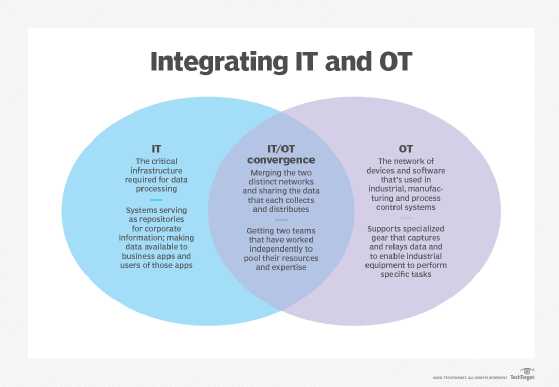
IT/OT convergence involves integrating two distinct networks, sets of data and teams.
Jena Zangs, chief data and AI officer at the University of St. Thomas, has seen an increasing number of OT components -- from weather sensors to smart buildings to connected vending machines -- come into the university. And while facilities had managed those types of components in past years, Zangs said IT is becoming responsible for OT, the data the OT environment generates and the strategy for using that data.
"Bringing in OT data is brand new; everything in the past had been siloed. A lot of the facilities information was stored on spreadsheets, but now we're bringing it into the core data lakehouse and our ERP," Zang said. He added that IT is becoming responsible for technologies such as connected security devices and building controls "that we have never had responsibility for in the past."
2. CIOs must ensure strategic alignment between IT and OT
IT/OT convergence requires alignment between the operations line of business and IT, said Bevin Chau, research director and a member of the Industry practice at Info-Tech Research Group.
Chau explained that as IT and OT environments increasingly interact, what happens on one side influences the other. Having different IT and OT strategic roadmaps is "probably not the way to go in the future," Chau said.
Chau said he's already seeing IT and OT service management converging, particularly in networking and cybersecurity, with IT taking the lead, as it's generally stronger and more skilled in those areas than OT.
"One of the big things I see is centers of excellence where dedicated IT staff and line of business collaborate and help build strategy and adoption of new technology and ongoing lifecycle management of tech," he added.
Despite IT and OT teams collaborating more, Chau and others said IT and OT remain separate teams in most organizations.
3. Demand for OT data grows, but data quality remains a challenge
Zang said the university believes data generated by its operational technology could help to improve university operations and services. For example, she envisions using weather sensor data to aid in planning for and communicating about adverse weather incidents.
Others see the same potential in OT data, said Jonathan Lang, research director for Industry Operations Insights and the IT/OT Convergence Strategies practice at research firm IDC. Lang said organizations see opportunities to use OT data the same way they use data coming from IT systems. In other words, they want to analyze OT data to boost efficiency, productivity, security and service and product offerings, as well as to advance their use of AI.
However, most organizations encounter challenges as they go down that road because data from OT systems often has significant quality issues, Lang said. Data in OT environments was historically intended for local use -- typically for an isolated decision or compliance need. "It wasn't designed to be integrated into large models to analyze and drive [enterprise-level] decision points," Lang explained. "So, IT has to build processes for managing, storing and contextualizing the data in ways that would make it useful for AI."
4. Convergence increases OT security concerns and demands
"To get the maximum benefit from OT technologies, you have to have information pathways that didn't exist before," Turner said.
But those pathways mean greater connectivity between OT and IT environments, eliminating the air gap that was once the principal means of ensuring OT environments remain secure. "If the organization has increased connectivity and information pathways between IT and OT, those could be used by bad actors or nation states," Turner said.
That has CIOs, CISOs and their organizations scrambling to improve the cybersecurity posture of their OT environments and the new networks connected to them.
Chau said IT staffers are lending their expertise to this endeavor, as IT has more experience in securing networks and systems than their OT counterparts. But IT is facing challenges as it does so, as OT environments typically have legacy tech that's no longer supported and can't be patched.
5. Organizations bring IT and OT expertise together
IT/OT convergence requires collaboration between the two teams.
That has CIOs determining how to use the skills from each side to complement the other, as well as how to overcome the cultural differences between the two, Turner said. For example, organizations are asking IT to apply its cybersecurity skills to the OT environment, as IT typically has more knowledge of today's best practices and technologies.
There is an assessment of value that needs to take place.
Jonathan Lang, research director, IDC
On the other side, OT is bringing its knowledge around building highly reliable technology environments and uptime requirements. Meanwhile, organizations are seeking to upskill and cross-skill both teams so they can collaborate more effectively.
Organizations are also focused on bringing IT and OT managers and executives together. "A lot of what we recommend, and have seen be successful, is some sort of committee or working group that has representation from corporate cybersecurity, IT, infrastructure, as well as plant engineering and plant teams," Turner said, adding that some are creating bespoke OT security teams "to help be a bridge between the corporate environment and the OT environment."
6. IT and OT converge, but remain separate
Despite more convergence between the IT and OT environments, Chau said he doesn't see the two departments merging. They might not be as siloed as they were in the past, but Chau expects they'll remain separate. "They will still have different reporting structures, and therefore different priorities," Chau said.
Similarly, organizational leaders will continue to consider the pros and cons of convergence, bringing IT and OT together when there are benefits, but not fully merging the two to help minimize risks, particularly cybersecurity risks on the OT side, where legacy tech and operational requirements exist.
"There is an assessment of value that needs to take place," Lang said. Organizations value the ability to use OT data to optimize processes, improve productivity, gain visibility and monitor the environment -- including cybersecurity threats -- but they're also cognizant of the increased cybersecurity risks that can accompany a connected OT environment.
Still, Lang said convergence will continue. "It's not a question of whether or not to connect OT, but in what ways do we segment or isolate different components of OT to minimize harm while maximizing the ability to get benefits. That's mostly where we have been to date."
Mary K. Pratt is an award-winning freelance journalist with a focus on covering enterprise IT and cybersecurity management.