AI security, VKS boost VCF 9.1 appeal as support deadline looms
Stick, meet carrot: With the clock ticking on VCF 8, recent Broadcom AI security and Kubernetes updates are enticing VMware shops to move forward.
By
Beth Pariseau, Senior News Writer
Published: 02 Sep 2026
LAS VEGAS -- As VMware Cloud Foundation nears a fork in the road, enterprise infrastructure teams plotting their next move have VCF 9.1 upsides to consider beyond continued support alone.
Despite being rolled out in May, VMware Cloud Foundation (VCF) 9.1 AI security features were a popular topic among attendees at the VMware Explore conference this week, especially as prior versions of VCF reach the official end of support in October 2027. VCF 9.0 folded in the previously separate Private AI Services, including model onboarding and management; Version 9.1 baked in five more layers of security controls within VCF to support both AI and conventional workloads. These included threat detection and prevention features such as live patching of VCF hosts and data encryption at rest through vSAN.
With its Private AI Factory update this week, Broadcom added multi-tenant model sharing that includes access and data privacy controls, and previewed a new AI gateway that will support more than 150 third-party open source and open-weight models with application-level authorization. Also previewed this week: a secure AI agent framework embedded into VCF that provides a security harness for AI agents hosted on VCF, including sandbox isolation by default.
One IT consultant predicted that most of the hundreds of enterprise clients he works with will make the jump from VCF 8 directly to 9.1, in part because of the new security features for private model hosting.
"The integration with Hugging Face to pull models is huge -- [they] don't need to worry about data leaking [or] about things being trained publicly," said Daniel Keer, project lead and senior consultant at Digitally Accurate, Inc., an IT services and consulting firm based in Calgary, Canada, in an interview with TechTarget here this week. "[Another] of the things that was cool that [Broadcom] talked about this week is that everything is denied by default -- if you want it to work, you have to explicitly go in and say, 'This can talk to this.'"
Another VCF customer said it's worth making the leap to version 9.1 for improved security of the VCF platform itself, including support for live patching of VCF hosts.
"One thing I took away from this week is that 9.1 could give us the ability to be as agile as possible for automating the remediation of our stack," said Scott Laforet, the VMware product owner at a North American bank he requested not be named due to company policy prohibiting him from representing it in the press.
In fact, Laforet told TechTarget this week that his eagerness to achieve better platform security through modernization had his team "racing against the clock" to migrate a 500-host legacy VxRail environment to VCF 9.1 before the official end of support.
"On VxRail, every [change] is an upgrade, and an upgrade is more complex because everything needs to move along with it," Laforet said. "A critical VMSA [VMware Security Advisory] was launched at the end of July … usually, enterprise change management is saying, 'Nah, not so fast, not so fast,' but with this critical VMSA, our roles were reversed.
"With 9.1, our ability to be as agile as possible for automating the remediation of our stack is one of my main takeaways," he said. "We used to do an upgrade twice a year, but with Mythos [increasing security threats] and Broadcom's commitment to having patches readily available, I need to be as agile as their releases."
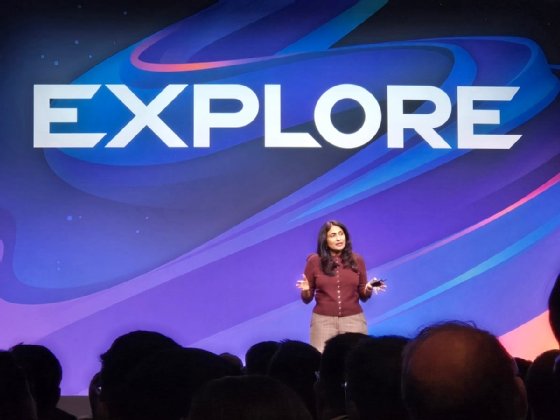
Broadcom Tanzu Division General Manager Purnima Padmanabhan presents during a plenary session at VMware Explore 2026.
Kubernetes clarity prompts VCF and Tanzu rethink
While Broadcom claims the bundling of previously separate products into VCF justifies its pricing increases, it's also been a boon for its competitors as 69% of organizations look for alternatives to their current virtualization platform, according to recent research by Omdia, a division of Informa TechTarget.
However, a final adjustment this week to Broadcom's Kubernetes application platform strategy prompted some attendees to reassess both VCF and Tanzu.
Previously, the company's Kubernetes support was tied to its Tanzu product, but that connection was severed last year. With VCF 9.1, the VMware vSphere Kubernetes Service (VKS) became a core part of the infrastructure platform, allowing IT ops teams to manage containers alongside VMs with a unified API. This week, Tanzu introduced support for Kubernetes IaaS across VCF and other container orchestrator distros, including those hosted in public clouds.
VCF 9.1 is finally what everybody had wanted.
Richard Kenyan,Buffalo VMUG leader
One VMware Explore attendee said his company is still on the fence about upgrading to VCF 9 or choosing a competitor, but what keeps Broadcom in the running is the new positioning of VKS.
"VCF 9.1 is finally what everybody had wanted," said Richard Kenyan, leader of the Buffalo, N.Y. VMware User Group and an infrastructure engineer at an aerospace company he requested not be named. "It's a certified platform, it's a first-tier citizen in the Kubernetes space, and it's just included with whatever VMware licensing you choose."
The strategy clarification on Kubernetes also prompted some attendees to revisit Tanzu, which also added agentic orchestration and data services features in April.
"For a long time, it's been like, 'Where does Tanzu fit in the portfolio with VCF and VMware?'" said Adam Little, director of IT operations at New Belgium Brewing in Fort Collins, Colo., which already runs VCF 9 and is evaluating multiple agentic orchestration platforms. "Our developers are interested in it, [for faster] time to delivery and time to integrate with the [VCF] platform, and then there is something a lot of people struggle with between VMs and containers -- what is the glue that holds them together and talks across them?"
Tanzu, which has hundreds of customers compared with the broader VCF platform's thousands, remains an underdog in the agentic AI orchestration race, but the change in Kubernetes strategy and April's agentic AI updates have renewed interest in Tanzu, said Purnima Padmanabhan, general manager of the Broadcom Tanzu Division.
"We are starting to see a resurgence in adoption over the last six to eight months," Padmanabhan said. "It's a very clean stack … and the specific use cases that are getting traction are data services management, security and AI."
VCF 9.x roadmap emphasizes AgenticOps
AI agents already underpin VCF 9.0's AI assist, which is built into the VCF 9.1 interface as a top-level tab to support chat-based queries into the VCF knowledge base for incident management. Next, Broadcom plans to expand AgenticOps automation for the VCF platform, including the ability to take action on users' behalf, said Chris Wolf, global head of AI and advanced services in Broadcom's VCF division.
"In our next two upcoming dot releases, there's going to be … everything from support question search and help with diagnostics to what we call proactive diagnosis, where we can look at a particular problem space and help the customer to parse their logs to get down to quickly root-cause a problem," Wolf said. "Even with what we demoed this week, the agent can go and find particular problems or configuration issues, and then prompt the human to confirm if they want to make the change or not."
Explore attendees said they're keen to try AgenticOps once they migrate to VCF 9. Laforet, for example, built his own agentic workflow using Microsoft Copilot to help manage his existing VCF infrastructure, but it's limited by token costs.
"I use it to answer specific questions, like 'What's the environment level of that virtual machine?' Or, 'How much vSAN are we using in relation to everything else?'" he said. "If I try to use [it beyond that], I'm flagged by internal guardrails saying 'No, that's 38,000% over your token limit.'"
Beth Pariseau, senior news writer for Informa TechTarget, is an award-winning veteran of IT journalism. Have a tip? Email her or connect on LinkedIn.