OpenText wants to orchestrate its own AI, not run the whole show
OpenText is saying out loud what other vendors might be afraid to say: It wants to orchestrate AI within its own products, not become the enterprise-wide orchestrator.
ORLANDO, Florida -- You read that right. As AWS, Salesforce, ServiceNow and others vie to orchestrate enterprise AI agents, OpenText says it does not want to be the company running the whole show.
Period.
"We are not going to be the enterprise orchestration engine for our clients," said Shannon Bell, executive vice president and chief product and technology officer at OpenText. She is scheduled to deliver a keynote this morning at OpenText World, the company's annual user conference.
That does not mean OpenText is abandoning agentic AI. More of its Aviator agents are coming online this week and beyond, Bell said. The approach follows a customer listening tour by CEO Ayman Antoun, who took over April 20 from interim CEO James McGourlay.
That's a shift in emphasis from last year's OpenText World, when the company described its AI Data Platform as an orchestration layer for agents from multiple vendors. Bell now says OpenText will integrate with other orchestration systems rather than attempt to run enterprise-wide orchestration itself.
"We are absolutely going to provide composable AI on top of our products and solutions, and use industry-standard protocols to plug into [others'] enterprise orchestration capabilities," Bell said.
According to Bell, OpenText customers are not necessarily ready to turn their companies over to autonomous bots. Instead of a cavalcade of agents from many vendors working autonomously -- and in harmony -- they asked for tactical agents to take time-consuming tasks off employees' plates.
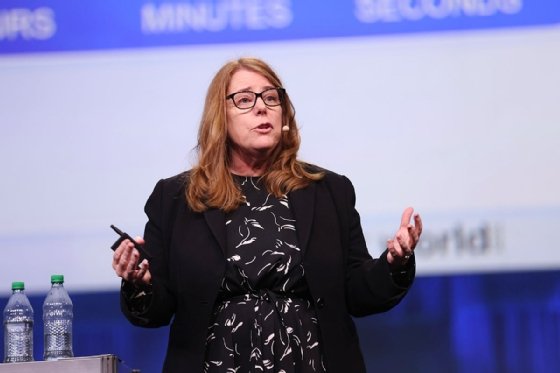
Shannon Bell, executive vice president and chief product and technology officer at OpenText, speaking at an earlier conference.
Agentic AI orchestration is also a very difficult technology market in which to compete, said Alan Pelz-Sharpe, founder of Deep Analysis.
"There's two big problems with it," Pelz-Sharpe said.
"One, there's going to be very few winners, so there's going to be a lot of losers. Two, it's easy to promise, and it's really difficult to actually deliver. So you almost wonder: Does anybody really want to win this race? Because they're responsible for everything now. From a go-to-market perspective, it sounds great. From an operational perspective, it's a nightmare."
New regime makes its mark
OpenText's commercial and government customers -- many in heavily regulated industries -- will see new products released and previewed this week.
What they will not see, Bell said, is the three-plus-hour keynote walking through the entire product list that became a trademark under longtime CEO Mark Barrenechea, who was ousted in August 2025.
Customers will have a larger share of the keynote time, Bell said. This is part of a larger plan for OpenText to demonstrate the value it brings to its customers, rather than a sales pitch for every new tool coming out this quarter and next.
"We're not going to be putting up 62 different releases and walking through them," Bell said.
So far, the strategy seems to be working. Barrenechea was fired after the company's revenue was down more than 10% following the fiscal year ending June 30, 2025. Revenue rose about a percent and a half in fiscal 2026, although it has yet to return to its previous peak.
So you almost wonder: Does anybody really want to win this race? Because they're responsible for everything now.
Alan Pelz-Sharpe, founder, Deep Analysis
Building toward organic growth
Under Barrenechea, OpenText relied on M&A of distressed technology assets across many vertical industries to drive growth. That is no longer the direction the company will take, Bell said.
Future deals will be aimed at filling gaps in its product line, rather than making acquisitions a growth strategy in themselves, she said.
"We've really honed our focus in on surgical M&A -- not M&A as a strategy for growth," Bell said.
The company could benefit from such a change in mentality, Pelz-Sharpe said. Over the years, OpenText had acquired so many companies that it wasn't entirely clear what it was focusing on.
OpenText has divested some acquired properties, including Vertica, a structured data analytics platform, and eDOCS, its on-premises legal document management product. The company also sold its application modernization and connectivity business in 2024, under Barrenechea.
How far the portfolio changes will go remains unclear. OpenText still has data-protection businesses built on acquisitions such as Carbonite and Guidance Software.
But the company has more work to do to build mindshare, Pelz-Sharpe said.
"I have friends who have been security industry analysts for years. They've never heard of OpenText," Pelz-Sharpe said. "It's not even on their radar."
Don Fluckinger is a seasoned B2B technology journalist with over 30 years of experience specializing in enterprise IT, digital experience and content management. As a senior news writer at Informa TechTarget, he delivers award-winning analysis that helps IT and business leaders navigate complex technologies to enhance customer and employee experiences. Got a tip? Email him.