The annual Modern Infrastructure Impact Awards recognize the top cloud and data center products from the previous year. These award-winning technologies stood out among a crowded field as the top tools to help IT professionals support both on-site data center infrastructure as well as off-premises cloud services.
The competition is limited to products or technologies that were new or underwent a significant update in 2016. The MI Impact Awards began in September with an open invitation for vendors and users to nominate products and services across seven categories. Readers were then given the chance to weigh in, voting for their top choices. TechTarget editors and independent experts reviewed submissions and tallied hundreds of reader votes to select winners.
This year's categories included: Best Converged and Hyper-Converged Infrastructure Product; Best Software-Defined Infrastructure Tool; Best AWS Partner; Best Public Cloud Migration and Optimization Tool; and Best Private/Hybrid Cloud Management Tool. Seeing a renewed interest in DevOps collaboration tools, this year we split an existing category into two: Best Systems Management Tool and Best DevOps Product.
This year's winners include a mix of established names that have succeeded in keeping their brands fresh with new innovations and a few newer vendors looking to disrupt the market.
Click through to see all of this year's winners.
As AWS has grown as a public cloud provider, so too has its ecosystem expanded. Amazon relies on its AWS Partner Network as a means to fill gaps in service offerings and offer expertise for organizations with limited in-house IT personnel.
Within the AWS Partner Network (APN), Technology Partners provide a diverse scope of services and tools for developers. But APN Consulting Partners are tasked with knowing how to use and implement Amazon services across an equally wide range of infrastructures and methodologies. And trust is crucial among the ever-expanding list of AWS consultancies.
"It has definitely grown, maybe exponentially," said Meaghan McGrath, an analyst at Technology Business Research. "AWS' brand awareness, and cloud has become a more accepted part of business environments. AWS' first-to-market position has drawn in a lot of partners. There's been a need for the network to grow from the partner side."
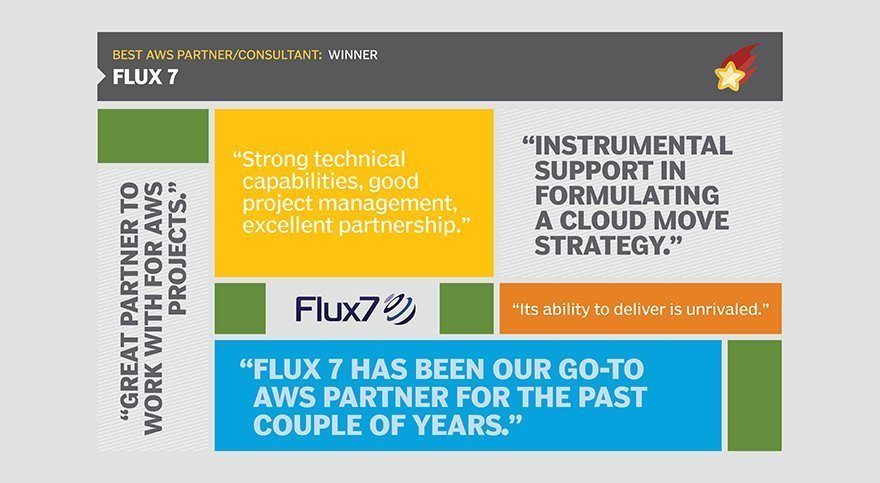
The Modern Infrastructure Impact Award for Best AWS Consultant/Partner recognizes a standout APN Consulting Partner that helps enterprises craft a cloud strategy, including resource provisioning, cost reduction, application migration and security management.
Voters overwhelmingly selected Flux7 as the top AWS consultancy among our list of finalists, praising the Austin, Texas, company for its innovation, breadth of knowledge and outstanding customer service. One voter touted Flux7's "cutting-edge implementations." Another voter said, "Flux7 [does] not just look at the problem on the table. They go above and beyond to look at the holistic view of the business and solve your problem end-to-end."
Flux7 offers a variety of services for AWS customers, including security and compliance, workload and data migration, DevOps implementation and internet of things architecture design.
With the network of consulting partners growing so quickly, customers find it difficult to choose a consultant. Many partners have the same AWS competencies and certifications, so finding ways to stand out is important. Flux7 has found a niche in the healthcare, energy and digital business industries among other cloud customers, and has benefited from word of mouth.
"It's reached a point where customers were having trouble sorting through all the noise and finding the partner that could address their certain need or situation," McGrath said. "Success stories and proven use cases are a huge driver of vendor selection. Those are more compelling on a general basis than a specific certification. Most [customers] will look for some proven [consultant] expertise in their own industry or in an environment they're trying to transform."
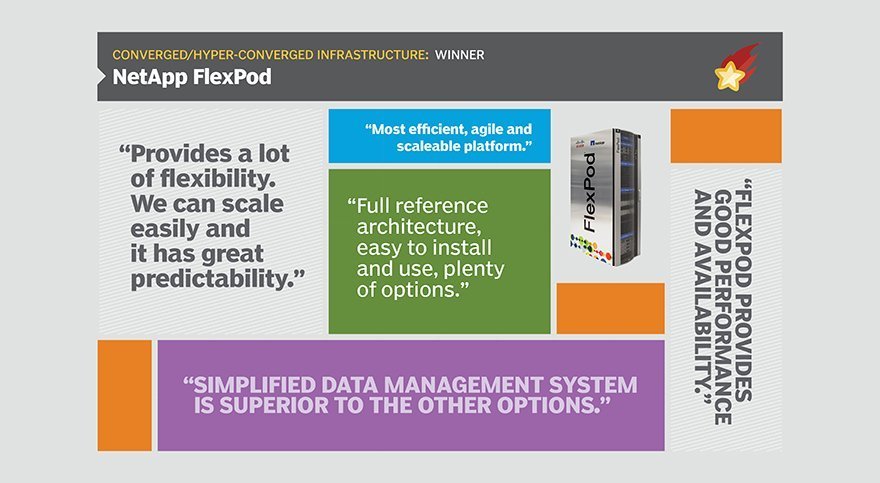
Flexibility and scalability, among other benefits, helped NetApp FlexPod achieve its first win for Modern Infrastructure's Best Converged and Hyper-Converged Infrastructure Product Impact Award.
NetApp's FlexPod is a converged platform reference architecture that incorporates Cisco UCS servers, Nexus switches and NetApp FAS storage arrays.
The platform is available in three different configurations within the data center. Those with a traditional data center setup can use FlexPod Datacenter, which includes a full-height rack of equipment; organizations with specific workloads such as Hadoop big data can use FlexPod Select, an a la carte system; and FlexPod Express is designed for quick deployments in remote or edge data centers. The specificity of each design allows FlexPod to be tailored to an organization depending on its needs.
Because NetApp FlexPod is an open, flexible infrastructure, it enables the platform to easily integrate with other NetApp infrastructure, said Reinoud Reynders, IT manager of infrastructure and operations at UZ Leuven Belgium, a large healthcare provider. Although Reynders isn't a FlexPod user, his organization has been a NetApp customer for 16 years. NetApp products have been crucial to support the company's two on-premises data centers and additional remote backup data center, he said.
"When you're a customer for 16 years in a critical environment such as ours, that means that there is definitely an added value that NetApp provides," Reynders said. "Otherwise, we would've already changed to another vendor."
FlexPod's Cisco compute layer is one of the infrastructure's strongest components, Reynders added. NetApp and Cisco have been in a partnership since 2003.
A more recent partnership adds value to the FlexPod platform, as well. Earlier this year, NetApp acquired SolidFire, an all-flash array platform. SolidFire's flash storage option is now available as an add-on for the FlexPod environment, which enables automation, further agility and scalability and raises operational efficiency. SolidFire's latest operating system, Flourine, includes support for VMware VVOLS and greater VM integration.
"[FlexPod] is a mature, yet evolving and flexible product that creates stability and consistency in an IT organization," one voter said. "No matter if a customer needs to keep data on site, in the cloud or mixed in a hybrid infrastructure."
Continuous improvement and developer feedback are crucial, but often overlooked, aspects of DevOps pipelines. True DevOps requires developers and ops specialists to quickly fix problems as they arise in production.
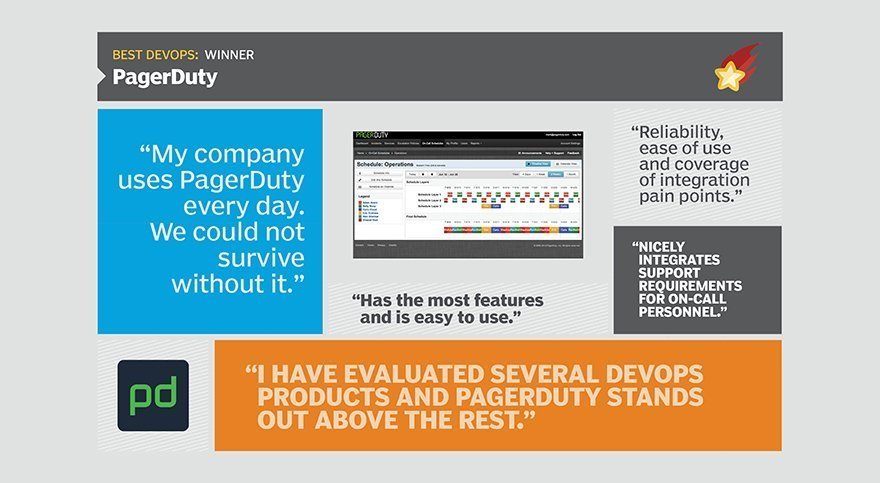
The tool that wins Modern Infrastructure's DevOps category this year, PagerDuty, fits squarely in the DevOps monitoring and incident resolution category. San Francisco-based PagerDuty is a reliable critical-incident management platform, funneling important alerts from applications and infrastructure to the right IT personnel for resolution.
In addition to its reliability, PagerDuty was lauded for its ease of use by several of our voters, as well as its coverage of integration points with other tools in DevOps environments, such as Slack and HipChat, AWS CloudWatch, logging tools and dozens more.
"My company uses PagerDuty every day," a PagerDuty user, and voter, said. "We could not survive without it. It always works and it scales with our growing company, which is awesome."
PagerDuty is a helpful way to organize on-call schedules for IT personnel that may be distributed around the country or the globe, other users said. The tool also allows for virtual teams to come together in case of emergency or significant events.
For cloud communications platform maker Twilio Inc., PagerDuty's ability to absorb changing notification routes as teams rotate on-call duties was key to dividing and delegating responsibilities as the company grew.
PagerDuty's popularity speaks to its strength as a tool for critical-incident management, said Robert Stroud, an analyst with Forrester.
"Based on adoption and use by the community, PagerDuty is the leader in this domain with a large customer base and usage, according to inquiries I've received," he said.
While PagerDuty was our winner this year, competitor VictorOps was hot on its heels.
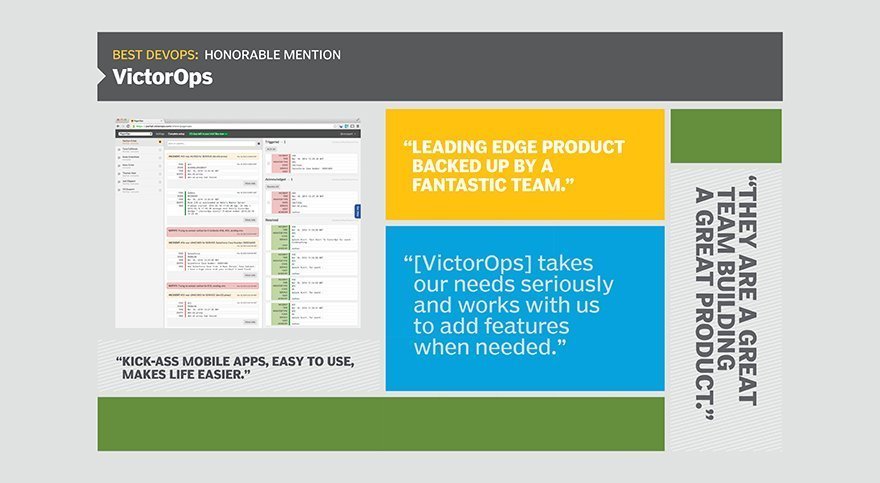
VictorOps, which trailed PagerDuty by just a few votes, received glowing reviews for its innovative approach to critical-incident management that is specifically tailored for DevOps teams."VictorOps has strong DevOps messaging, [such as] feedback loops, team collaboration and messages sent directly to DevOps pros, amongst other domains," said Robert Stroud, a Forrester analyst.
The tool manages on-call teams and incident notifications, creates a virtual environment for teams to practice and then put a remediation plan into action, and provides post-mortem reports. It offers a live IT infrastructure timeline visible from any location or device.
The VictorOps platform features unlimited U.S. and international push, SMS and phone notifications per month, a standard service-level agreement, and its mobile device integration led one Impact Awards voter to cite its "kickass mobile apps [that] make life easier."
Voters praised VictorOps' many integrations with third-party ChatOps tools such as HipChat and Slack, as well as cloud monitoring and logging tools, which it uses to generate and process incident alerts. The company, based in Boulder, Colo., boasts customer references that include DirecTV, Edmunds.com, The New York Times and Vevo.
Voters also said VictorOps' technical support is second to none.
"They are a great team building a great product," said a VictorOps fan. "They are always working with their customer base to build the best possible call management system for DevOps-based companies."
As enterprise IT environments become increasingly diverse, admins must manage a mix of technologies, from public and private clouds to on-premises systems and containers. They also need a management tool that's up to that task.
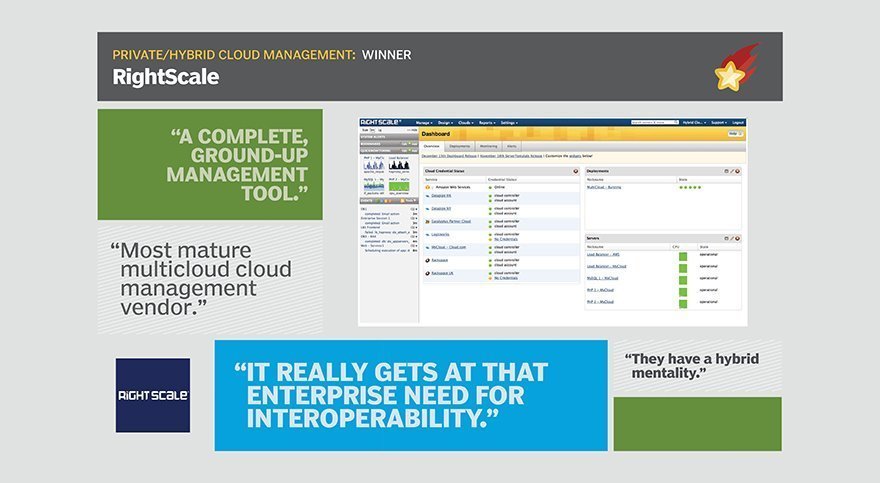
That trend is what propelled RightScale, a software as a service tool that manages workloads across various cloud and on-premises platforms, to the top of Modern Infrastructure's 2017 Private/Hybrid Cloud Management category.
RightScale helps IT teams orchestrate and automate workload management across a range of cloud platforms, including Amazon Web Services (AWS), Microsoft Azure, Google, Rackspace and IBM Bluemix, as well as open source cloud environments such as OpenStack and CloudStack. In addition, the tool can streamline application management across virtual and bare-metal servers, as well as Docker containers.
Its feature set continues to be one of the most robust hybrid cloud management tools, said Matt Wise, senior systems architect at Nextdoor.com, a private social media network for neighborhoods that use RightScale. Nextdoor.com primarily uses AWS, but has designed its underlying infrastructure to enable instances to launch in Google Cloud Platform, as well.
"RightScale's focus on building a complete, ground-up management tool for the cloud is what drove us to them," Wise said. "There were a few other tools available at the time that solved a problem here or there, but none that really gave you a full framework all the way from monitoring and alerting, to auto scaling of compute, to individual employee access controls and permissions."
The "hybrid mentality" will continue to be RightScale's biggest strength, said Cassandra Mooshian, cloud senior analyst at Technology Business Research in Boston. "It really gets at that enterprise need for interoperability," Mooshian said. "End users don't care as much anymore if a stack is based on open source or proprietary standards, as long as there are functionalities and integration, like APIs, to connect to different environments. That's all that really matters."
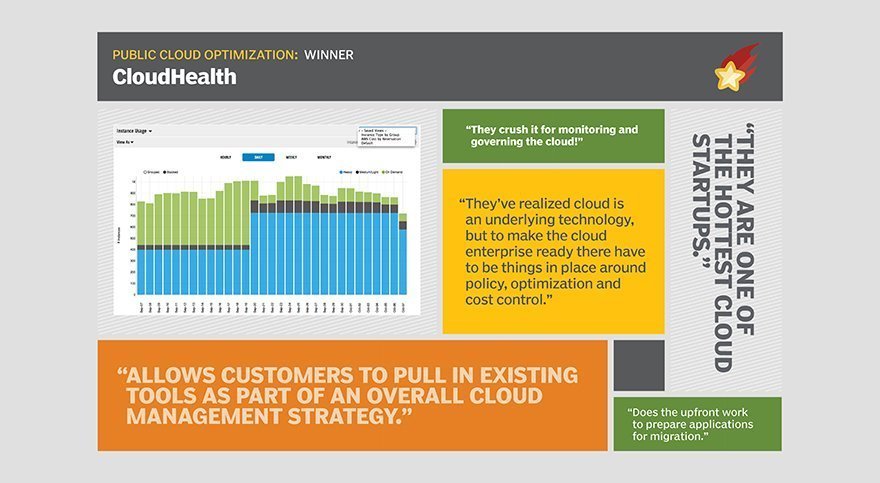
As early cloud adopters make way for the mainstream, migrating and managing existing workloads remains a constant challenge. There's a flood of third-party companies trying to ease that on-ramp, but for our readers CloudHealth Technologies is the best bet.
The Boston-based IT services company provides a range of tools, offering a consolidated view of workloads running in multiple public clouds and on premises. This includes API-driven analytics to help evaluate workflows to improve optimization and add automation.
"They've realized cloud is an underlying technology, but to make the cloud enterprise-ready there has to be things in place around policy, optimization, cost control," said Owen Rogers, research director at 451 Research's digital economics unit.
One thing that distinguishes CloudHealth is that rather than saying customers need one technology for everything, it allows customers to pull in existing tools and partners as part of an overall cloud-management strategy.
The CloudHealth Migration Assessment tool does the upfront work to prepare applications for migration by analyzing their dependencies. It also integrates the new AWS Application Discovery Service to help analyze and map application assets to speed the migration process.
There's also a lightweight agent installed that provides interactive reports to look at configurations and policies to make recommendations and address total cost of ownership, usage, performance and security on Amazon Web Services or Microsoft Azure, and to determine how to optimize workloads.
By simply sharing a file, users can build, deploy, run and manage data center infrastructure. That's just one reason why readers voted Cypherpath Infrastructure Container System as the winner in Modern Infrastructure's Software-Defined Infrastructure category in the 2017 Impact Awards.
Cypherpath Infrastructure Container System puts the entire IT stack -- storage, networks and apps -- into a software-defined container, which allows organizations to build highly scalable portable infrastructures on top of existing investments. While the popularity of containers has just recently spiked, readers are encouraged by Cypherpath's new wrinkle.
"Cypherpath is an extremely useful and very powerful software that is very user friendly," one voter said.
After the entire selected infrastructure is encapsulated by the container, users can inspect differences and go back to previous versions, or even reuse them. Users can also share the infrastructure containers with other users via a remote repository. Another reader liked the ability to create networks with different routing, protocols and switches in an infrastructure container.
"It's out with the old and integrating the new," said another Modern Infrastructure reader and Cypherpath user.
Users can create new machines or upload existing machines from traditional hypervisors, such as Hyper-V or VMware, and customize the settings when it comes to disks, memory, CPUs and more. The containers can be suspended or restarted -- or even transported -- between deployments.
With Cypherpath Infrastructure Container System, multiple containers can run on the same physical server without any interference.
"The idea of infrastructure in a container is a great twist," said Brian Kirsch, IT architect and instructor at Milwaukee Area Technical College. "The infrastructure in a container is an ideal solution for DevOps teams looking to develop software that simply doesn't fit in the traditional container architecture.
"This also allows for more enterprise solutions that can be applied to top tier applications without complete rewrites for existing container technology."
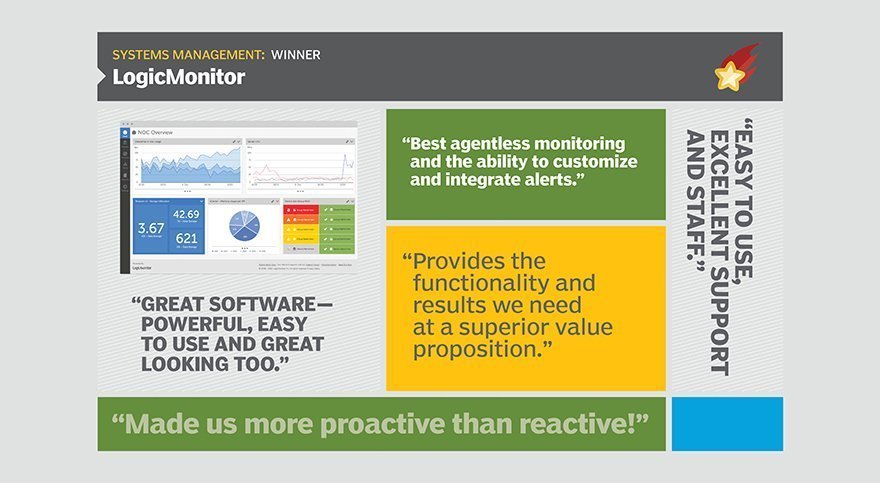
As managing both on-premises and cloud-based environments grows more complex, system administrators are placing more value on tools that offer them different ways to monitor existing performance and forecast future performance.
LogicMonitor, a software as a service-based agentless automated monitoring tool, with a built-in workflow feature that includes alert routing and escalation management, does precisely that. And this is precisely why readers put it at the top of the heap of Modern Infrastructure's 2017 Systems Management Tool category.
"With LogicMonitor the capabilities to capture relevant data and receive alerts against it are far greater than I have personally used," one voter said. "This isn't to say that other products aren't capable of the same level of data collection, but LogicMonitor does it in a way that, while technical, is still easy enough to build from scratch with some ability."
Readers also appeared taken with the product's flexibility that provides different monitoring capabilities, along with the ease of use in setting up and maintaining it.
"We chose this product above all competitors because it gives such a wide ranging scope for monitoring," another voter said. "Also, the support and assistance received in setup and ongoing management of the tool is the best I have seen in a very, very long time."
Voters also lauded the offering's customizable dashboards, which some said helped improve their response time to address performance issues and other technical problems. Some also appreciated that the product does not require an agent.
"The product is unique in that it doesn't require the use of an agent," one respondent said. "Through the use of dynamic directories and DNS naming, one can easily automate a structured view of a complex environment and can bring in AWS (Amazon Web Services) cloud watch metrics to view on that single pane of glass."
Several readers also gave a shout out to LogicMonitor's technical support team, praising its quick customer response and willingness to go beyond the scope of a request to help resolve an issue.
When it debuted OneView 3.0 and a handful of other cloud-based offerings in 2016, Hewlett Packard Enterprise was in the process of retooling its cloud strategy for the new age and to play catch-up with a few archrivals.
While Hewlett Packard Enterprise's (HPE) overall cloud effort remains a work in progress, OneView 3.0 has its share of fans, earning an honorable mention in Modern Infrastructure's 2017 Systems Management Tool category
Part of the Helion CloudSystem 10 suite, which helps IT professionals manage applications from traditional to containerized applications, HPE OneView 3.0 laces the company's infrastructure lineup with software-defined intelligence. The offering works with CloudSystem 10 to permit automatic provisioning of cloud resources from bare-metal infrastructure.
"This is the best tool for infrastructure automation we have seen," one voter said.
OneView 3.0 also serves as an integral piece of HPE's Composable Infrastructure, HPE Synergy and HPE Hyper Converged offerings. Working in concert with HPE Helion, the two products serve as the foundation to simplify the next generation hybrid IT.
New features in Version 3.0 include a global dashboard to ease IT operations for distributed environments, a simpler way to manage heterogeneous network switches by marrying the HPE Intelligent Management Center with OneView and the product's tight integration with CloudSystem 10, which can provision physical servers and entire virtual clusters from a single console.