Months ahead of its projected release date, the Raspberry Pi Foundation has unveiled its next-generation minicomputer, the Raspberry Pi 4 Model B. The size of a deck of cards and starting at the vendor's signature $35 price point, the Raspberry Pi 4 brings more desktop-like capabilities than previous iterations.
Notable in this release is the offering of multiple memory capacities for the first time. All other Raspberry Pi single-board computers max out at 1 GB RAM, while the 4 gives users the choice of 1 GB, 2 GB or 4 GB LPDDR4 SDRAM, ringing in at $35, $45 and $55, respectively.
Additionally, a 1.5 GHz quad-core 64-bit ARM Cortex-A72 processor brings three times the performance of the preceding Raspberry Pi 3 Model B+, which featured a 1.4 GHz 64-bit Cortex-A53 CPU.
The boost in memory and adjustments to the form factor of the new model unlock its potential to serve as a viable desktop computer replacement, which might be worth the increased price points for users.
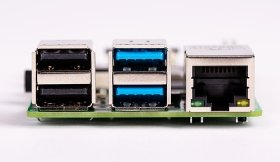
The Raspberry Pi 4 moved from USB micro-B to USB-C, supporting an additional 500mA of current to accommodate heavy CPU load, and features two USB 3.0 and two USB 2.0 ports. The Raspberry Pi 4 also supports dual-monitor support for the first time, with up to 4K resolution -- a significant step into the everyday work- or consumer-desktop realm.
The Raspberry Pi 4 also ships with an overhauled OS, Raspbian Buster, based on the upcoming Debian 10 Buster release. The Raspbian OS brings a modernized UI, updated apps in the Chromium 74 browser and a new graphic driver stack -- retiring its legacy one for the Mesa V3D driver -- that offers faster web browsing, supports 3D applications and eliminates almost half the lines of closed-source code in the platform.
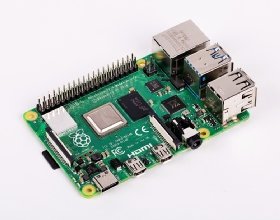
Additional specs of the Raspberry Pi 4 include the following:
- 5 GHz quad-core 64-bit ARM Cortex-A72 CPU
- Full-throughput Gigabit Ethernet
- Dual-band 802.11ac wireless networking
- Bluetooth 5.0
- VideoCore VI graphics with OpenGL ES 3.x
- 4Kp60 hardware decode of HEVC video
Traditionally, the Raspberry Pi line of boards have been used for smaller computing projects, a supplement to an enterprise's environment of devices or a low-cost computer for kids to learn how hardware and software work.
The developments and added power -- especially with the higher-end models -- of the Raspberry Pi 4 make the machine a more universal and traditional computer, without sacrificing the flexibility and versatility of its predecessors.
Raspberry Pi debuted in 2012 and has since gained many competitors in the single-board computer realm as users realized the benefit. Popular alternatives in a similar price range -- many building off the nod to fruit-filled pies -- include the Orange Pi Prime, Odroid XU4, Banana Pi-M64 and NanoPi NEO4.
Except for its slightly altered form factor from the Raspberry Pi 3 Model B+ and, subsequently, new casing, Raspberry Pi 4 retains compatibility with most of the brand's earlier products.
The Raspberry Pi Foundation has historically offered pared-down iterations of boards, categorized as Model A, that are more limited in features but come at a lower price point. As noted in a blog post, the vendor has not developed a Model A of the Raspberry Pi 4, but it will continue to explore the possibility.