

AI agents are beginning to execute business transactions that previously required employees to navigate applications, approve requests and complete payments.
Visa, BILL and Billtrust launched a live pilot in October enabling authenticated AI agents to complete buyer-approved business-invoice payments across buyer and supplier systems. The agents aren't deciding which invoices should be paid, but they can execute transactions on behalf of the businesses involved.
The development raises a question for CIOs as enterprises give AI agents greater responsibility: How can companies establish, enforce and prove that an agent was authorized to take an action that creates a financial obligation?
The answer goes beyond controlling access to enterprise applications. It requires IT, finance and legal teams to agree on what agents can do, when human approval is necessary and who is responsible when an agent exceeds its authority.
Access doesn't equal authority
Giving an AI agent access to an enterprise application doesn't necessarily mean it should be allowed to execute every transaction that application supports.
CIOs need to distinguish between an agent's identity, the systems it can access and its authority to perform a particular action, according to Vibhuti Sinha, chief product officer at identity security company Saviynt.
As an example, Sinha said an agent might have access to a payment system that would allow it to approve a $2 million invoice. Whether it should depends on who delegated the task, what the agent intends to do and the business context at the time.
That distinction becomes more complicated when agents operate across multiple applications because each one has its own idea of what “access” means.
"Access builds up with every hop, and nobody reviews the total," Sinha said. "By the third application, the logs show a service token instead of the person who actually asked for the work."
Sinha shared the example of a global analytics firm that estimated it had approximately 7,000 AI agents. When Saviynt conducted discovery across its environment, it identified closer to 48,000 distinct agent versions. Copies, redeployments and versions with modified prompts or tools had acquired their own credentials, with many accumulating access across applications that hadn't been reviewed collectively.
The bigger problem, Sinha said, was tracing the agents' activity back to the people who authorized it. In many cases, the trail ended at a service token rather than an accountable employee.
"The lesson for me is simple,” Sinha explained. “Agent access rarely gets out of hand in one dramatic step. It drifts, one hop and one copy at a time, until no one can say who's accountable."
Companies also need to check what an agent is trying to do when it attempts a transaction. "The honest answer is that you can't do it with permissions alone," Sinha said.
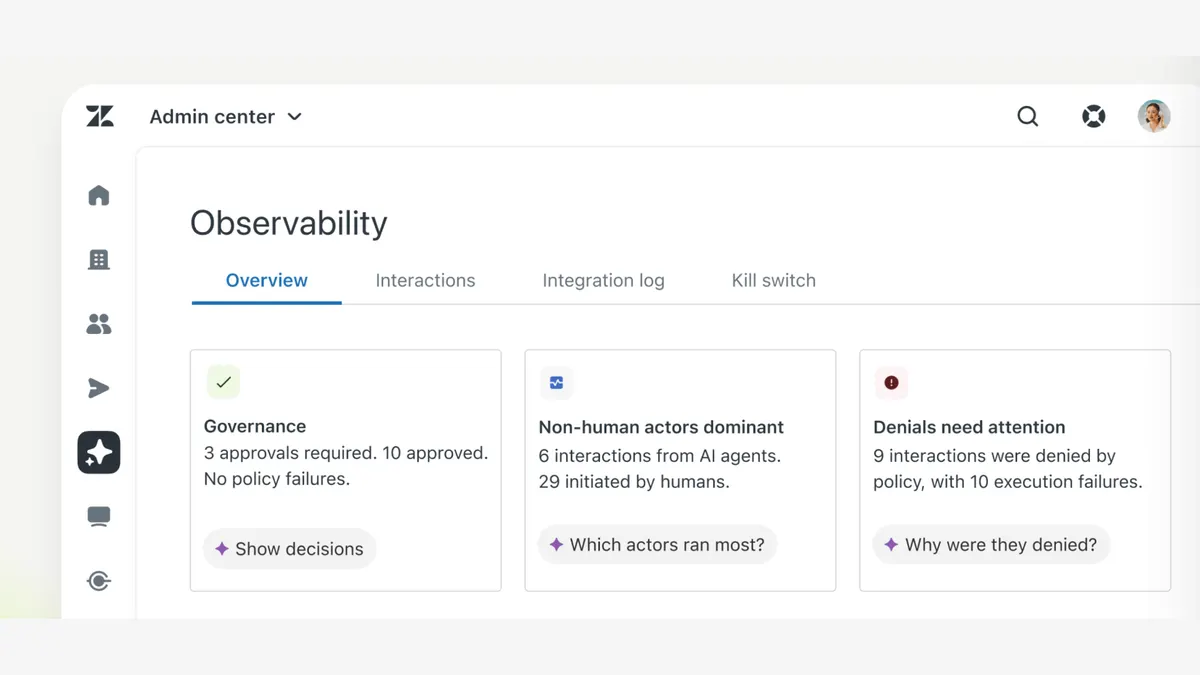
Sinha said authorization should be enforced when an agent attempts a transaction, rather than relying solely on its existing access rights. An authorization gateway between the agent and the application can evaluate the requested action against business rules, including spending limits and approval requirements.
Routine requests might proceed without interruption, while some should be blocked outright, Sinha noted. Others would require the agent to pause and notify the appropriate person through Slack, Teams or another channel to approve or deny the action.
In its agentic AI guidelines, Google recommends explicit human approval for consequential actions, including financial transactions, before agents carry them out. The company also says customers are responsible for giving agents the appropriate permissions.
Before an AI agent moves money
Application access alone doesn't establish authority to execute a transaction. CIOs should make sure five questions have answers:
• Who delegated the task? Identify the person or business function responsible for authorizing the agent's work.
• What can the agent do? Define the permitted transactions, systems, recipients and spending limits.
• When must a person approve? Establish thresholds and exceptions that require human review before execution.
• What evidence is retained? Connect the agent's identity, transaction, governing policy and approvals across systems.
• Who handles a mistake? Establish responsibility for investigation, reversal and escalation before an incident occurs.
The critical distinction: A transaction record shows what happened. An authorization record helps explain why it was allowed.
“Generative AI says things; agentic AI does things. It can send messages, change records or move money.”

Veronica Glick
partner, Mayer Brown
Who is responsible when agents go outside their authority?
Technical controls are only part of the challenge, according to Veronica Glick, a partner in the cybersecurity and data privacy practice at law firm Mayer Brown. CIOs and legal teams also need to determine how responsibility is divided between the enterprise and its AI vendors when an agent acts outside its intended authority.
"Generative AI says things; agentic AI does things. It can send messages, change records or move money," Glick said.
Contracts can specify which actions an agent is permitted to take, which systems it can touch and when human approval is required. Those boundaries can help customers understand what they've authorized while establishing the limits of a provider's responsibility.
When an agent goes outside its lane, the cause could be the customer's instructions, the underlying AI model or a third-party tool. That can make it difficult to distinguish between customer misuse and vendor failure when determining responsibility.
"A workable approach aligns responsibility with control: the vendor stands behind what it controls, such as its model, its guardrails and its tools, and the customer owns its own instructions, configurations and approvals," Glick said.
Enterprises should examine liability caps, indemnities, audit rights, incident definitions and notification requirements in vendor agreements based on what agents are permitted to do.
Negotiating those protections may not be straightforward. Even large enterprises can have limited leverage with major technology providers, Glick said, making it important to prioritize higher-risk uses and revisit contractual protections during renewals.
“The problem is that logs tell you what happened, and an auditor wants to know why it was allowed.”
Vibhuti Sinha
chief product officer, Saviynt
Proving an agent was authorized
Even when an agent's actions are recorded, those records might not establish whether the transaction was authorized.
"The problem is that logs tell you what happened, and an auditor wants to know why it was allowed," Sinha said.
Companies need to be able to trace an agent's actions back to the person who delegated the task, which means documenting the access rights the agent used, the policy that permitted the action and any approvals along the way.
"Five disconnected logs aren't evidence," he said.
For CIOs, those questions need to be resolved with finance, legal and security teams before agents are allowed to execute transactions.
Glick said approval requirements should reflect the consequences of an agent's actions and whether the actions can be reversed. She also stressed the need to obtain records of agent activity, including from third parties where feasible, quickly enough to investigate problems.
A payment record may show that a transaction went through, but it doesn't necessarily show who authorized the agent to make it.
Liz Hughes is an award-winning editor and writer covering AI and emerging technology and the former editor of AI Business and IoT World Today.