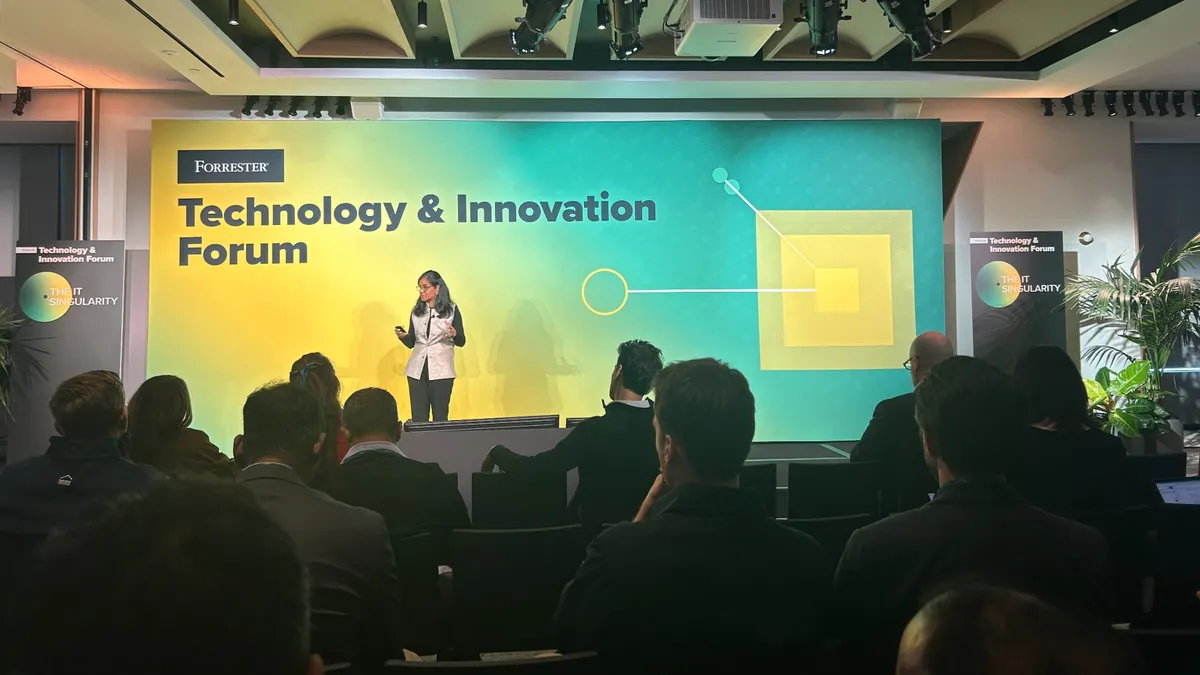



NEW YORK CITY — When Forrester principal analyst Kevin Ogunsua asked a conference audience to share its AI spending horror stories, one attendee had an example.
“We had a surprise invoice from OpenAI,” the attendee said. The charges for that month roughly equaled what the organization normally spent over a year.
The exchange opened Ogunsua’s session, “Avoid the AI Horror Show: How to Control Spend and Prove the Value,” at Forrester’s Technology & Innovation Forum East on Thursday. He urged CIOs to budget for costs that don’t show up on a vendor invoice, set limits on how much work AI agents can do and decide how they’ll measure returns before expanding a project.
In its 2027 predictions, Forrester projects that AI will account for 20% of business technology spending, with most of that AI spending going toward servers and equipment.
Why AI spending is hard to forecast
A CIO can know what a vendor charges per token and still have trouble forecasting the bill. The missing piece is how much work an AI agent will do to finish a task.
“You don’t know what your bill is going to be like. So it becomes very hard to budget."

Kevin Ogunsua
Principal analyst, Forrester Research
Traditional IT budgets gave CIOs a clearer starting point, Ogunsua said. They could estimate how much computing power, network capacity and storage they would need, then use multiyear contracts and cloud commitments to plan for those expenses. With AI agents, the amount of work can vary each time a process runs.
An agent might answer a request with one call to a model. A more complicated request might take several calls or prompt the agent to enlist other agents, each of which can generate more usage.
“You don’t know what your bill is going to be like. So it becomes very hard to budget,” Ogunsua said.
CIOs also have to account for expenses that a model provider’s invoice won’t capture. A team might build a prototype within budget, then discover that putting it into production requires additional infrastructure, security controls and changes to how employees do their jobs. Those costs can extend across departments when an AI tool changes a process several business units share.
“Even if someone gives you an LLM free, if you’re an organization, it’s still going to cost you money to implement it because you have to operationalize it,” he said.
Put spending limits on what AI agents can do
CIOs can make AI spending easier to forecast by limiting how much work an agent can do on each request, Ogunsua said.
He pointed to three places to set limits. Teams can restrict how much information they send to a model, cap the number of model calls a workflow can make and limit how many other agents it can enlist. Without those limits, one request can set off a chain of model calls, making it harder to predict what the workflow will cost, he said.
Ogunsua also described how organizations can enforce a budget before approving spending. In a public-sector system he worked on, purchase orders could proceed only after a check that confirmed funding was available. He suggested applying similar checks to AI spending and defining which activities each department’s budget could fund.
“Productivity alone is not going to get you your ROI.”
Kevin Ogunsua
Principal analyst, Forrester Research
Teams can also lower the cost of each run. Ogunsua recommended deciding which steps need AI, choosing a model suited to the task and using caching where appropriate. When a step calls a model, teams can limit its response to what the workflow needs.
Tie AI spending to a business result
Spending controls help CIOs forecast the bill. Deciding whether a project is worth funding requires a different calculation. Before scaling an AI project, CIOs should identify how it will grow revenue, lower costs or reduce risk, Ogunsua said.
“Productivity alone is not going to get you your ROI,” he said.
Consider a wealth management firm that uses AI to complete client work faster. The time saved can help the firm handle more work, Ogunsua said. The business result to track is whether that extra capacity lets the firm serve more clients and increase its assets under management.
Three limits to put on AI agents
Forrester analyst Kevin Ogunsua highlighted three ways to keep individual AI requests from generating unexpected costs.
1. Limit the input: Restrict how much information a workflow sends to a model.
2. Cap model calls: Set a maximum number of model requests per workflow.
3. Control delegation: Limit how many other agents a workflow can enlist.
Ogunsua recommended using metrics the business already tracks. Once leaders agree on what the project should deliver, they should give one person responsibility for the result and set quarterly milestones to track progress. That puts a business measure behind what he called the shift from “tokenmaxxing” to “valuemaxxing.”
That distinction also matters in vendor contracts. Under token-based pricing, companies pay for the tokens they use. Outcome-based pricing ties payment to a result agreed upon by the buyer and vendor.
Ogunsua used a hypothetical $5 million AI investment to illustrate the difference. A company could spend that much on tokens, or it could negotiate a contract tied to a business target such as generating $50 million in revenue over eight quarters. When vendors promise outcomes, he urged CIOs to put measurable commitments in the contract and review progress each quarter.
“This is what some hyperscalers are promising, but what I would encourage you to do is put their feet to the fire,” Ogunsua said.
Tim Murphy is a reporter covering IT strategy for Informa TechTarget, with a focus on IT leadership, governance, workforce skills and AI strategy. His enterprise technology coverage has earned multiple Azbee Awards.