

ORLANDO, Fla. – AI needs governance because it is moving at a pace faster than humans, outpacing security and driving up costs for an organization. Another area of AI advancing quickly is physical AI, which will change the relationships between humans and machines.
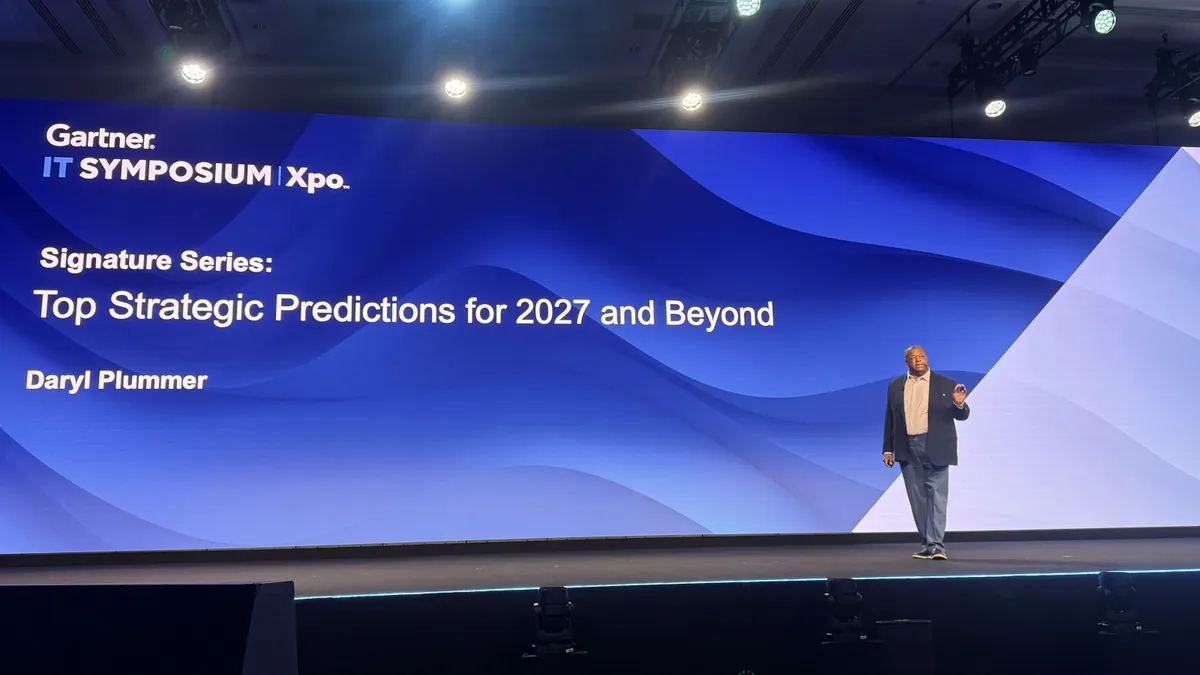
Daryl Plummer, distinguished vice president analyst at Gartner, presented this and more of Gartner's top strategic predictions for 2027 and beyond at Gartner's IT Symposium from Oct. 19-22.
"We always say a year ahead because we're predicting 2026; it's already happened," Plummer said. He went on to say that predictions can be tricky, and while it's not about the date, it's about "putting you on the right path at the right time to do something about it before it happens."
These are the 10 strategic predictions for 2027 and beyond.
1. Physical AI will create a new relationship with humans
Gartner predicts that by 2030, 80% of frontline workers will be assisted in some way by physical AI systems. Plummer said physical AI is more than robots.
"Physical AI is everywhere. It's in your watch. It's in your car," Plummer said. "If you have one of those cars when you fail to brake -- and you're coming up too fast behind someone -- it brakes for you. This is physical AI at work."
Physical AI will continue to grow, creating a new relationship between humans and machines, according to Gartner. Ways they will change this relationship include the following:
- Risk will go to drones and robots first to help monitor the safety of humans.
- Routine and mundane tasks will be delegated to the machines, including sensors.
- Data will be able to turn into actionable insights with physical AI because it moves at a much quicker pace.
Plummer said CIOs should consider investments that can create virtual simulations, help reduce energy consumption, lower human safety risks and fit into the building. He said companies should not just look to replace workers with robots and expect a higher ROI.
2. Agent swarm will overwhelm public services with slop
Gartner says that by the end of 2030, more than 10 billion autonomous agents will swarm public services. These agents will look to use government benefits on a large scale. People can set preferences for these agents to find benefits such as government payouts, scholarship opportunities and health insurance.
Plummer said companies will need to ensure controls are in place, such as counteragents, to require human review of an action when necessary. He said banks are beginning to ban AI agents from accessing accounts to protect their investments.
"Your next best action as government CIOs should counter the overflow of agent-driven traffic with your own automated response system," Plummer said. "Do not allow agents to act as a mob. They're going to do automated proxies for everything -- automated payments and automated requests."
3. Cost exhaustion attacks threaten AI systems
Cost-to-value is a hot topic with AI. To build value with AI, companies need to control and mitigate costs. By 2030, 80% of organizations with public-facing AI will face cost-exhaustion attacks, leading to excessive AI costs, according to Gartner research.
To control these costs, companies should consider the following:
- Use rate limiters.
- Monitor token rates.
- Use security monitoring tools on all AI technologies.
- Monitor costs beyond internal token usage.
Plummer said companies should treat token costs as a security indicator and target.
4. Token governance roles need to be established
By 2029, 60% of organizations deploying AI will establish a dedicated function responsible for mapping the total cost of AI to value or profit, Plummer said.
"A single task can end up costing 100 times more than expected because of endless retries on the task," Plummer said.
He went on to say that vibe coding is a good example of this -- continuing to tweak the vibe and having it regenerate, regenerate and regenerate. It drives up costs, and the context window gets bigger; larger prompts lead to larger output.
Another issue is the frontier model overprovisioning. Companies do not need the most powerful model for everything. Find the model best suited to business needs. Find one that can do the task at the right cost and the right speed -- it may not be the top model. Try tying token consumption directly to business value metrics.
5. AI FinOps will be embedded
Gartner said that 60% of Fortune companies will embed AI FinOps in inference. This will shift the cost governance to real time optimization from reactive reporting, and companies can see exactly how many tokens are used by each employee.
"The point is, you have to track it. Then you decide what the response to that should be," Plummer said. "So, runtime control, cost control at machine speed is the next FinOps frontier."
He added that leaders will have the control to monitor consistently and see who is delivering the most value.
6. Enterprises will be their own power producers
By 2030, $10 trillion in enterprise-owned energy will make Global 2000 firms unexpected power providers, according to Gartner.
"They're going to sell energy back to the public grid and AI data centers and reshape the utility industry," Plummer said. "We're talking about a massive change in the impetus because the energy providers, the producers, are having a hard time building enough energy production facilities to put new electrons on the grid."
The current grid is unstable, and businesses are consuming too much. Businesses need to start thinking about consumption to drive cost savings, resilience and sustainability. The first step is to know how much is spent on energy. To do this, businesses must manage peak-time supply and extend usage when energy costs are lower. Plummer said investing in automation platforms for real time energy decisions can help with this insight.
7. CIOs will also be the AI officer
Gartner predicts that by 2030, 80% of Global 500 companies will designate their CIO as the keeper of responsible AI. The key to this role is to increase transparency of ethical and operational AI guardrails. Leaders need to track evidence of what the AI agents did.
"You need to increase transparency because, if you have transparency, you can define accountability," Plummer said.
Companies need to know who is accountable, not just responsible, for AI.
8. Procuring AI liability insurance will be a driver of AI governance
Gartner said that by 2030, insurers -- not regulators -- will drive AI governance. They will do this with strict underwriting standards for AI liability. Insurance will also be required to keep costs down. Transparency is part of the company's due diligence to get coverage. Governance, risk and compliance (GRC) is not the same as AI governance. GRC focuses on risk, process and regulation, while AI governance is much broader.
Plummer said companies will have to layer the technical controls as they go. They will have to control the risk-value gap by mitigating risk. Companies should begin comparing, testing and evaluating AI governance technology platforms to see how insurance would evaluate them.
9. Competitive advantage may rely on AI
By 2029, 25% of Global 500 companies will out-innovate their competitors by adopting componentized AI, making past strategies obsolete. They will innovate so quickly that their competitors won't be able to catch up, and the next innovation will leave these competitors even further behind. Plummer said traditional business models are becoming obsolete faster than ever -- so fast that followers risk building on legacy foundations from day one. Instead of leapfrogging ahead, they're leaping into unsustainable trouble.
He went on to say that a team of AI agents could be a competitor and used Blockbuster and Netflix as examples. IT leaders should focus on front-office opportunities with AI to avoid falling behind as Blockbuster did to Netflix.
10. Software applications will be intentionally disposable
By 2029, Gartner said 80% of new applications will be intentionally disposable -- used for less than one year. This will change the software lifecycle.
Companies will begin building software faster and then dispose of it just as quickly. This will tie in with the disposable economy. Companies can eliminate technical debt by avoiding the modernization of existing programs. Plummer said that upgrades can be harder than ripping and replacing them for some programs.
However, disposability creates new security postures, and that rapid level of change will create some security gaps. Leaders should focus on the cost and speed of application creation and disposal -- not just on application modernization, according to Gartner. Plummer said companies should not focus too much on long-term application stability and multi-year contracts, as they may not want to be locked in for too long on some programs.
Amanda Hetler is senior editor and writer within the Reader Engagement and Outreach team of Informa TechTarget.