


ATLANTA - Updates this week to IBM's IT Automation portfolio deepened integration among its products for DevOps and site reliability engineering. It's a sign of further consolidation to come, according to one IBM exec.
This week's product updates were primarily focused on the IBM Concert AIOps tool set, which uses AI agents and API integrations behind the scenes to coordinate workflows for observability; hybrid cloud operations; performance and cost optimization; vulnerability and risk management; IT resilience; and low-code workflow orchestration and automation.
IBM unveiled new integrations among IBM Concert and products from its HashiCorp acquisition, including Vault and Terraform, as well as components of its Infragraph knowledge graph.
The overall IBM IT Automation portfolio is broader, with tools for network management; identity and access management; quantum-safe security; application integration and development; FinOps; and asset lifecycle management. Beginning next year, that portfolio will undergo further consolidation, according to Tyler Lynch, outbound CTO for IT automation at IBM, in a podcast interview here this week.
"Where we want to get to is more converged products," Lynch said. "We're going to start in 2027 with co-hosting these on our platform and shared billing, shared metering, [and] shared identity. But where we really want to get to is more of a console experience where you don't have an individual product; you have capabilities. You have your finance capabilities, your IT automation capabilities, your patching capabilities [with] an overarching console experience … that's where we're headed with IBM Automation 2.0."
This is similar to how IBM Concert works already, with tabs for the different product modules within a shared UI, but IBM plans "a brand-new console experience," Lynch said. "And instead of having product names like Cloudability or Apptio or Terraform, we might deliver their capabilities, but through … a portal that could do all the things you need, and you could choose to use them or choose not to use them, just like an Amazon console."
Time travel with IBM Concert and Terraform
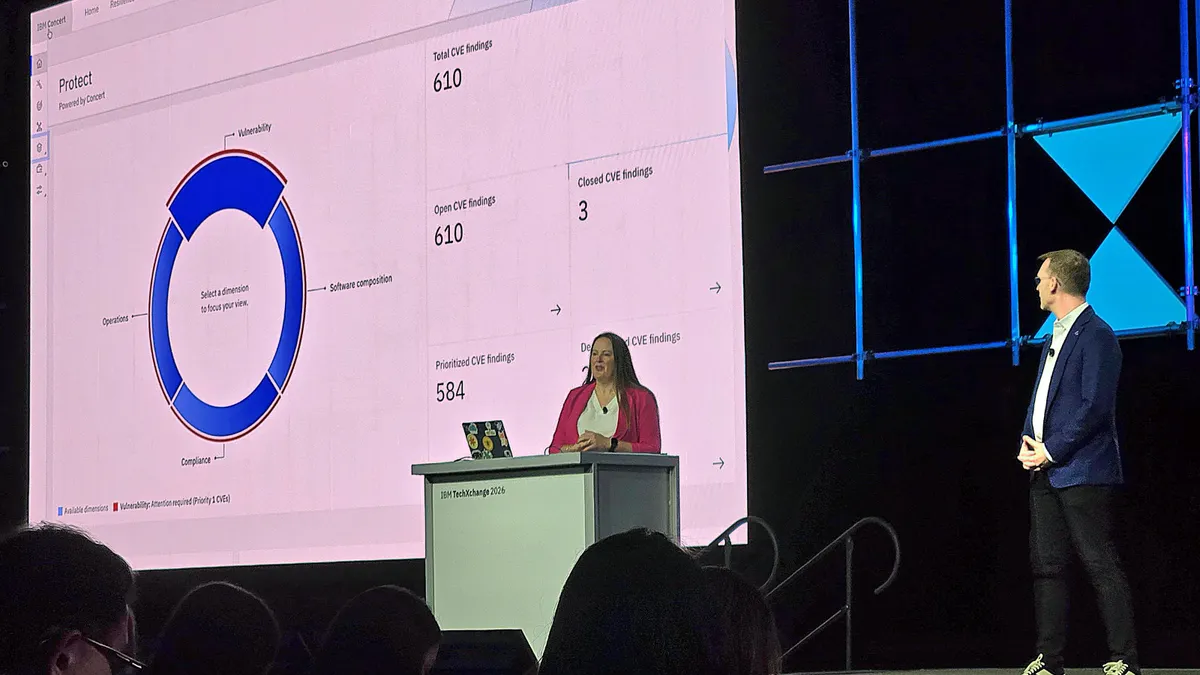
This week, IBM demonstrated a new integration between IBM Concert Protect and Terraform using the Infragraph knowledge graph. It drew on Terraform infrastructure topology data to create a proof of exploitability that operators can use to prioritize patching.
Infragraph isn't yet generally available, but some components were rolled out in June, including those used by Concert Protect. In December, the full knowledge graph will become generally available, with support for multiple graph databases and query languages, according to Vikram Murali, IBM's vice president of software development, in an interview this week.
After that release in the first quarter of 2027, Infragraph will enable Concert to perform "time travel" using Terraform topology data to show what an infrastructure environment looked like at a given point in time and to roll back to that state, if necessary, Murali said.
"With time travel, we'll be able to go back and say, well, this change caused a problem, so I'm going to go back to my previous state," he said.
Infragraph will eventually link Concert Protect to the IBM Confluent Streamhouse data platform to surface where sensitive data might be exposed to vulnerabilities without requiring IT ops teams to access data repositories. Concert also embeds governance, security and identity management mechanisms from Watsonx Orchestrate as part of an overall effort within IBM to reuse components across products so they're easier to use together, Murali said.
"That way, if a customer has both the Concert Platform and in the future they bring Orchestrate, it becomes plug-and-play," he said.
Platform engineers grapple with AgentOps groundwork
IBM's streamlining of its automation products won't solve the larger problem facing platform engineers at large enterprises. Platform teams must assess how to combine AgentOps tools from different vendors; prepare their company's existing environment, including infrastructure as code (IaC) data, for automation by AI agents; and work with developers to provide the right user experience.
For example, PayPal is undertaking multiple internal transformations at once as it adopts agentic AI, said Shyam Patel, head of cloud and platform engineering at the payments provider, speaking during an IBM press briefing call last week. It's also transitioning to a cell-based architecture for its platform, which divides systems into self-contained, independent units; rolling out Terraform IaC as a standard throughout the IT organization; and adding an agentic interface to the platform for developers as an alternative to an internal developer portal (IDP).
"When we started this journey … developers had to make configuration changes for infrastructure that they didn't know, and that's where the agentic platform kind of came to the rescue," Patel said. "It's providing the interface for developers to define their intent and then let the platform do the hard part of delivering everything the developer is looking for."
Terraform helps add deterministic automation and policy enforcement for infrastructure provisioning behind the scenes, according to Patel, but the platform's overall orchestration layer is being built internally. Meanwhile, PayPal's platform team, like most enterprise AI early adopters, still faces questions about agentic security and governance.
"How do we assure the agents' authentication, authorization and identity? How are agents actually behaviorally controlled?" he said. "Where should human intervention be required, and how do we simplify it without blocking our developers or the critical flows?"
Developers are also unlikely to move en masse to an agentic interface, Patel predicted; the platform team will likely need to maintain both an agentic developer experience and an IDP.
An engineer at American Honda Motor Co. described his team's AgentOps development as somewhere between the "crawl" and "walk" stages of "crawl, walk, run."
Among the items left to sort out are a reusable set of IaC modules and centralizing them within the platform, said Charlie Studdard, senior principal cloud engineer at the automaker, during a breakout session at the conference.
"The hard work … is going out [and] talking to people, going out and updating your CMDB with the proper ownership, going out and tagging the resources so you can use those to dynamically act on them," Studdard said. "Without putting in those foundational steps … it's going to work 95% of the time, but if you're doing 1,000 operations a month … that 5% becomes more deadly."
Beth Pariseau, lead editor for infrastructure news at TechTarget, is an award-winning veteran of IT journalism. Have a tip? Email her or connect on LinkedIn.