The SearchStorage annual list of the most promising startups in storage confirms the trends we've been hearing about from data center administrators and vendors.
Larger applications, coupled with high performance and speed, are changing how data centers predict and scale their capacity needs. As a result, opportunities have never been greater for an innovative data storage startup to disrupt traditional buying and deployment models.
Rather than expensive forklift upgrades, many organizations prefer to purchase storage as a commodity-based service. Promising startups are applying software-defined storage and off-the-shelf servers to tackle big data, cloud-based analytics, containerized applications and memory-based storage.
Although legacy hardware isn't disappearing, proprietary storage management software packaged with a commodity cluster is gaining favor inside more and more enterprises. In addition to software hopefuls, we will keep our eyes on promising startups that market storage hardware platforms for distributed database recovery, NVM Express (NVMe) flash and object storage clusters.
We culled our final list from storage newcomers that mostly sprouted within the past calendar year. While these companies seem promising, startups face a tough road. The challenge is underscored by would-be web-scale storage vendor InterModal Data, which quietly foundered almost as soon as it launched. InterModal serves as a cautionary tale: No matter how cool its storage technology may appear, how well it executes in the market will determine if a promising startup sizzles or is merely a flash in the pan.
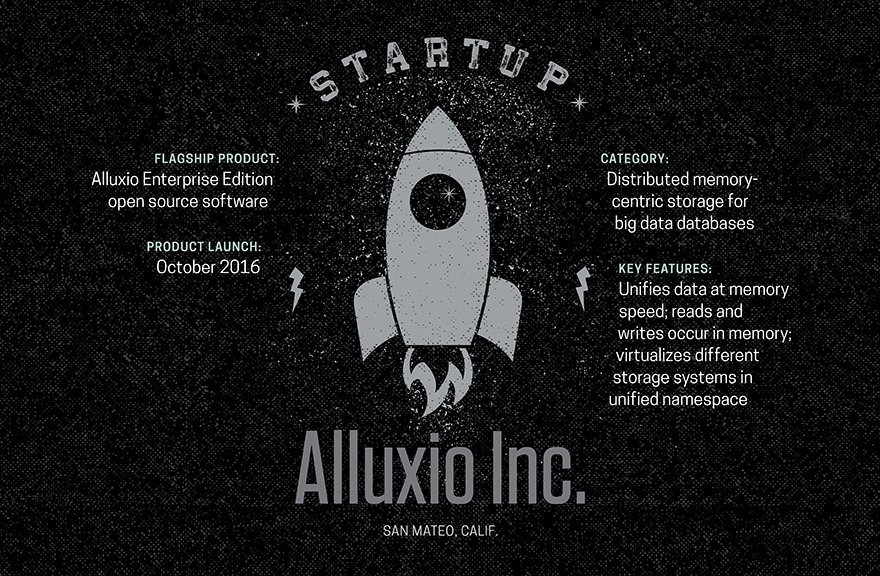
Fledgling software vendor Alluxio Inc. is trying to make a splash in big data storage.
Alluxio is a virtual distributed storage layer developed by researchers at the Massachusetts Institute of Technology and University of California at Berkeley. The vendor (formerly Tachyon) claims its open source platform allows any computing framework to access application data at memory speed across disparate storage systems.
Alluxio converts idle server memory to storage capacity for processing Apache Spark and other big data workloads. Enterprises use it to extract greater value from high-performance applications on distributed computing frameworks.
The objective is an alternative big data architecture to a disk-based batch approach. Alluxio software is installed between a compute layer and underlying storage to virtualize file and object stores. A columnar data format spawns in memory to overlay traditional batch processing.
Different storage systems are virtualized under a unified namespace. Data is read and written in memory, with hot files cached in memory and less active data tiered to back-end storage.
Two versions are available: a pay-for Alluxio Enterprise Edition and a free Alluxio Community Edition. Pricing for the Enterprise Edition is based on the number of nodes and includes Kerberos authentication and data replication to ensure high availability.
Alluxio does not replicate file storage across a cluster. Instead, changes to data (and metadata) are logged and retained in memory. That allows unused processors to immediately inherit ongoing calculations if a primary server ceases to function.
Alluxio software includes object storage interfaces for Amazon Simple Storage Service (S3) and Swift. Aside from Apache databases, file storage support encompasses Hadoop Distributed File System/MapReduce and Red Hat GFS scale-out NAS.
For optimal performance, the vendor recommends installing its software on the same computational nodes that process big data jobs. The system scales out as additional hardware nodes join the compute cluster.
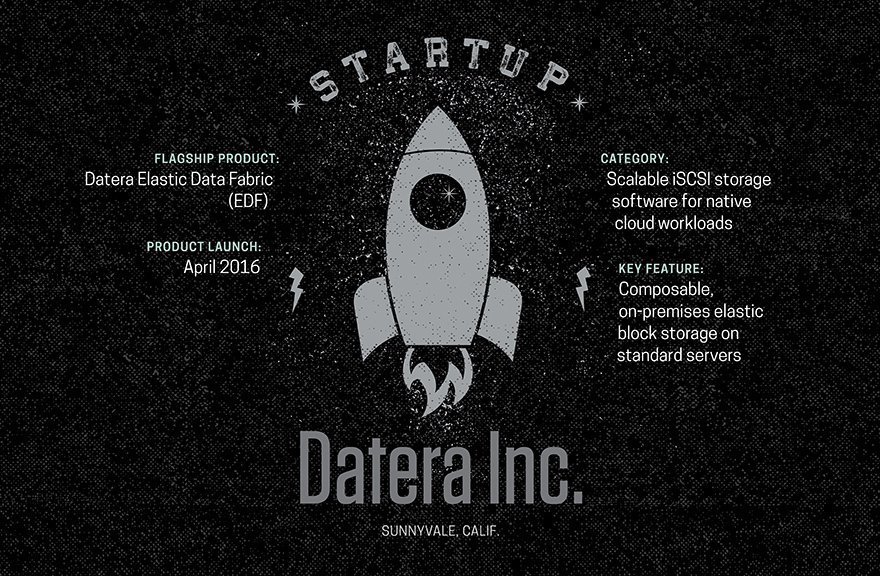
Providing elastic block storage on premises? Newcomer Datera Inc. hopes that concept isn't a stretch.
Fueled by $40 million in funding, the Mountain View, Calif., data storage startup in 2016 took the wraps off its Datera Elastic Data Fabric (EDF) iSCSI block software. The product attempts to provide locally managed block storage that resembles the Amazon Elastic Block Store cloud.
The vendor wants to tap into the growing demand for self-service provisioning of storage tuned for cloud and containers. The challenge will be establishing itself in a market with no shortage of competing elastic block storage products.
Datera's selling point is a hyperscale architectural design, including a symmetric control plane for uniform latency and performance across clustered nodes. Elastic block storage is used to quickly deploy cloud-native applications.
EDF is billed as composable infrastructure that treats underlying storage as a service. Datera fabric knits together commodity hardware nodes, which are available from resellers. The nodes capture writes at memory speed before eventually flushing the data to flash or SAS disk.
Datera nodes include 50 TB models that bundle NVMe flash and Supermicro 2U servers. All-flash Datera nodes scale to 100 TB with Dell PowerEdge servers, enabling customers to mix and match flash and hybrid storage.
The key to Datera is its EDF software for intelligent, policy-based data placement. Application profiles help determine access patterns to ensure data is mapped to the appropriate elastic block storage media.
Role-based multi-tenancy allows customers to run discrete workloads in isolation on the same cluster. Datera EDF supports at-rest encryption, data compression, clones, instant volume resizing, multifactor replication, thin provisioning and zero-overhead snapshots.
Development teams can design customizable application templates or use built-in templates for Cassandra, Hadoop and MySQL databases. They also may choose Apache Mesos, Docker Swarm and Google Kubernetes to orchestrate large deployments of containers.
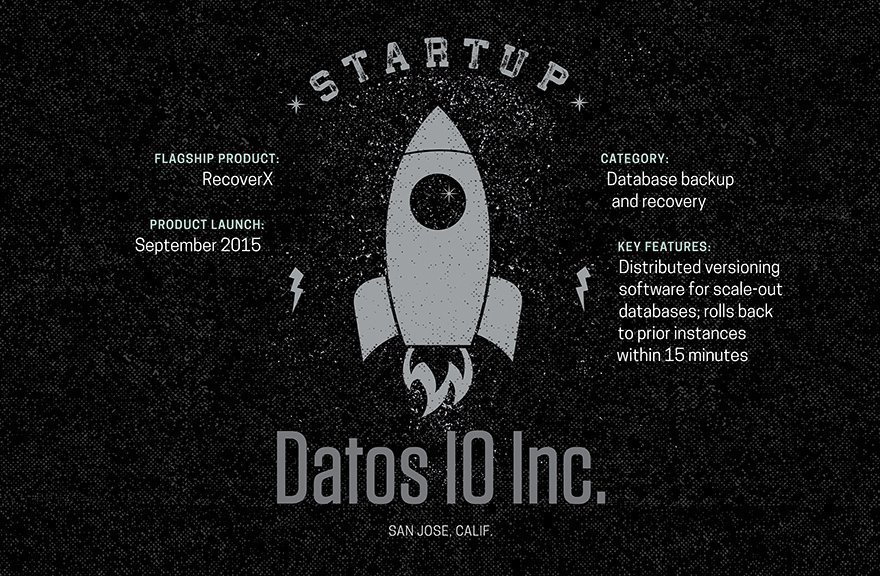
With its RecoverX platform, Datos IO thinks it may have discovered the storage equivalent of the Holy Grail: fast, granular recovery of distributed databases and third-platform applications.
The RecoverX data protection software is aimed at application architects, database administrators and development teams. Customers use it to manage, protect and recover third-platform and internet-of-things applications situated locally on premises and on software-as-a-service platforms.
Datos IO RecoverX works with a variety of scale-out databases, including Amazon DynamoDB, Apache Cassandra, DataStax Enterprise, Google Big Table, MongoDB, Redis and SQLite.
Although distributed databases support multisite replication for high availability, they typically lack native features for granular backup and recovery. That increases the potential for operational errors on one node to corrupt dependent nodes.
The RecoverX backup framework allows admins to roll back to a previous database instance in the event of failure. Datos IO claims its distributed versioning recovers data in approximately 15 minutes.
The branded Consistent Orchestrated Distributed Recovery backup engine transfers data in parallel to and from file-based and object-based secondary storage. Datos IO claims its flexible recovery point objectives help customers curb secondary storage costs up to 70%.
RecoverX includes two backup options. Basic recovery restores a version to its directory on the destination cluster. The more advanced Orchestrated recovery allows a version to be restored directly to a destination database.
The vendor recommends a three-node RecoverX cluster for failover. The software uses an application-defined quorum for consistency and keeps databases in their native formats. Semantic data deduplication removes replicas of a source database to ensure a consistent point-in-time backup across a Datos IO RecoverX cluster.
Co-founders Tarun Thakur (CEO) and Prasenjit Sarkar (CTO) have a long history in storage. Thakur worked at Data Domain, IBM Research and Veritas. Sarkar spent seven years as a manager with IBM Research. The data storage startup has raised $15 million in private funding, including $12.5 million from Lightspeed Venture Partners and True Ventures, and $2.5 million in seed capital.
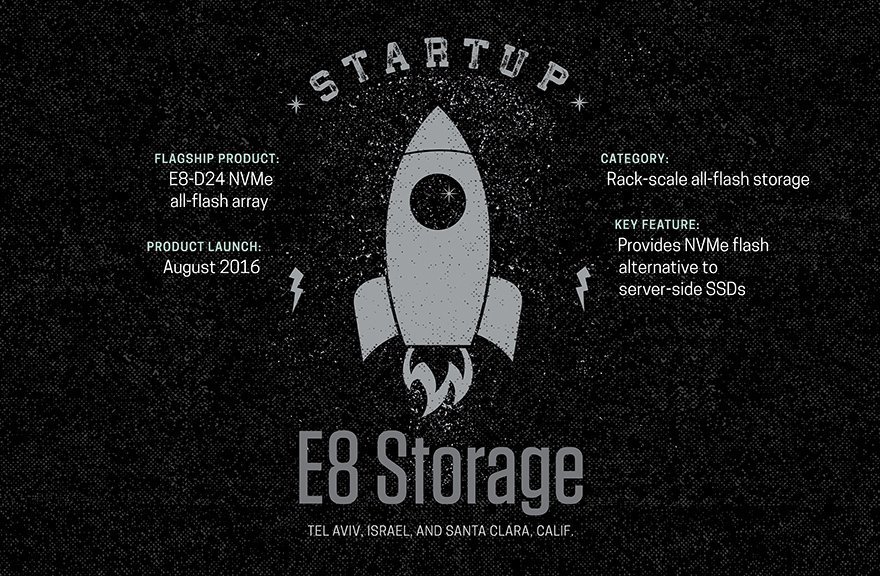
All-flash array startup E8 Storage is trying to carve a niche with its rack-scale D24 appliance, which packs two dozen 4 TB NVM Express-based PCI Express solid-state drives in a 2U chassis.
E8 said its system blends local flash performance with centralized provisioning for highly available storage with fault tolerance.
A D24 box provides 88 TB of raw storage that equates to roughly 70 TB of effective capacity. A single D24 rack can support 100 servers. Each server is able to access the same data. Capacity utilization approaches 90% by extracting full performance from the SSDs.
The E8 Storage array is aimed at enterprises considering local SSDs in a server-side flash model. Its disaggregated flash architecture allows customers to scale compute and storage independently.
High-performance block storage, hyperscale data centers, NoSQL and SQL databases, and real-time data analytics are among the projected D24 use cases.
The design integrates Mellanox Remote Direct Memory Access network adapters. The startup claims D24 SSDs will deliver latency and throughput comparable to that of host-attached flash. Connectivity support includes 40 Gigabit Ethernet and 100 GbE.
E8 Storage rates D24 performance at 10 million read IOPS and four million write IOPS, with sub-100 microsecond read latency and 40 Gigabit per second read latency and 20 Gbps write latency.
D24 flash storage uses commodity cabling, Ethernet network interface cards and NVMe drives in a bid to keep costs below that of competing proprietary systems. Dual controllers provide high availability, while E8 Storage software handles dynamic LUNs, RAID 6 and thin provisioning.
Unstructured storage vendors have divided into two camps for using the cloud: One group favors public clouds and the other prefers hybrid clouds with local control. But what if your company, for reasons related to comfort or compliance, won't send corporate data to a public cloud service provider?
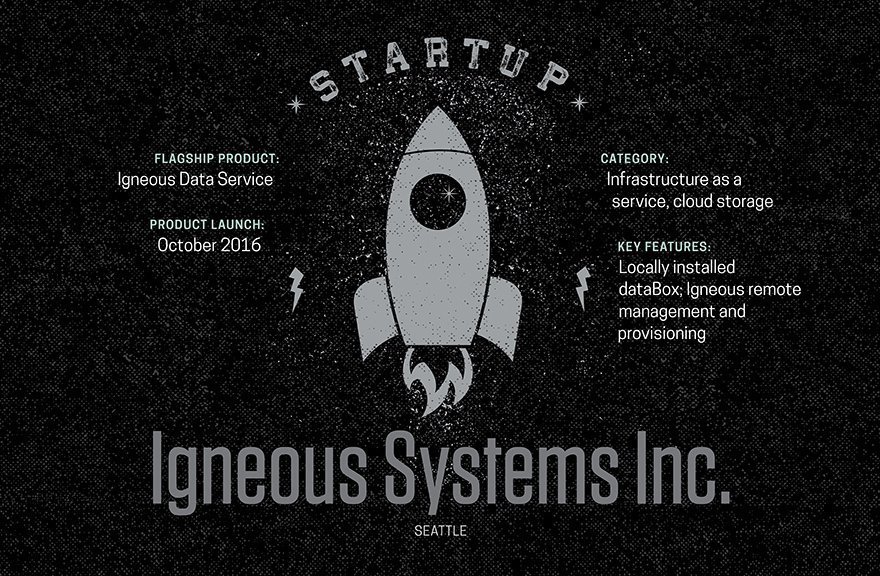
The latter enterprises form the core market for Igneous Systems, maker of the Igneous Data Service for hyperscale storage workloads. The Seattle-based data storage startup's infrastructure-as-a-service platform combines a disk appliance with Igneous Cloud software APIs to Amazon Simple Storage Service.
Igneous Systems' storage technology is intended for enterprises that can't risk exposing data sets in the cloud. Yet, in an era when data growth has outpaced IT budgets, building capital-intensive data centers usually isn't an option.
Igneous Systems offers characteristics of the public cloud while reducing cost, management and risk. Rather than manage the storage in house, enterprises pay annual subscription fees to Igneous to install its hardware locally and to remotely manage, provision and scale storage.
The purpose-built appliance gets installed behind a corporate firewall. Customers access data inside the data center at LAN speed via the Igneous cloud.
The Igneous Data Service consists of a 4U dataBox for capacity storage and a 1U stateless server to connect protocol endpoints. A single dataBox accommodates 60 drives and 212 TB of capacity.
Annual subscription prices start at approximately $40,000 per year. Exabyte-scale capacity is achieved by purchasing additional 212 TB increments from Igneous Systems.
The system-on-a-chip architecture entails an on-premises enclosure of ARM-based nano servers, each with dedicated processing, networking and storage. The self-healing components support failure in place.
If you're launching a data storage startup, getting the attention of established storage hardware vendors can be a challenge. Komprise seems to have found a niche during its first year of commercial production, forging integration deals with major cloud and object vendors.
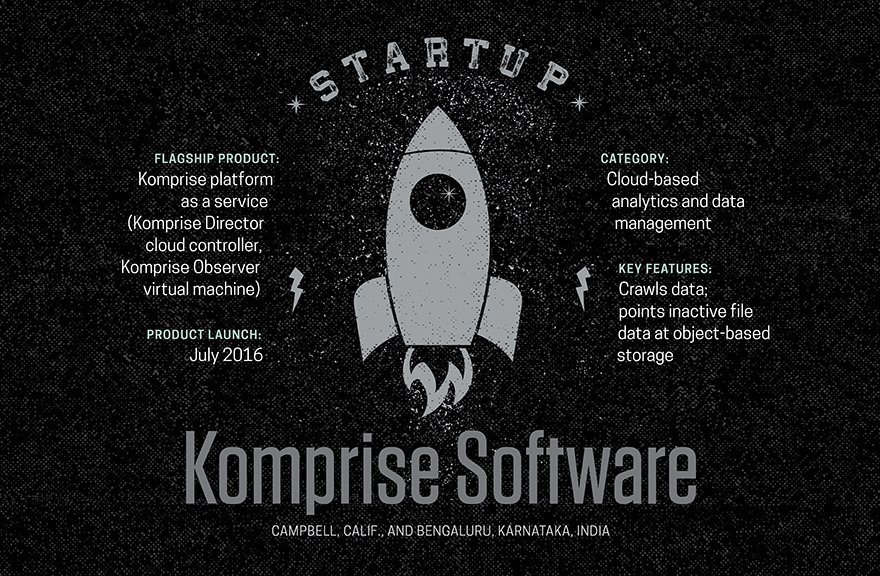
Komprise provides analytics related to data management, allowing you to extend primary file storage with a NAS interface to secondary storage. The platform analyzes file storage across siloes to identify inactive data and recommend a course of action. The analytics projects costs savings or performance improvements of moving files to an object store, either on premises or in the public cloud.
Komprise's estimated cost is $750 per terabyte, inclusive of primary storage, backup software and disaster recovery capacity.
Komprise data management moves files to object storage in Amazon Web Services, Cloudian, EMC, Google Cloud Platform, Microsoft Azure, NetApp, Quantum Corp., Scality and Spectra Logic tape.
The Komprise data analytics platform as a service sits outside the active data path to observe file data and metadata. It discovers seldom-used file storage, the type of data, access patterns and users. There are two components: Komprise Observer and Komprise Director.
The Komprise Observer virtual machine runs locally in a hypervisor to gather information on storage. Komprise Director is a cloud-based controller that oversees data collection and suggests optimal data placement.
Installing Komprise does not require application changes or agents. The hosted data management appears to users as a primary NFS or SMB client.
This is the third startup for Komprise's co-founders. CEO Kumar K. Goswami, President and COO Krishna Subramanian and CTO Michael Peercy previously teamed on scale-out desktop virtualization infrastructure vendor Kaviza, now part of Citrix Systems, and software-as-a-service-based application lifecycle management provider Kovair.
With its shared-nothing approach, OpenIO is trying to find footing in a packed object-storage market. The company's technology has its origins in email and messaging, expanding recently to address cloud archiving, video files and voice recordings.
Some data storage industry experts claim object storage provides an alternative to traditional scale-out NAS file storage. To capture adherents, OpenIO has to ward off more than a dozen established object vendors.
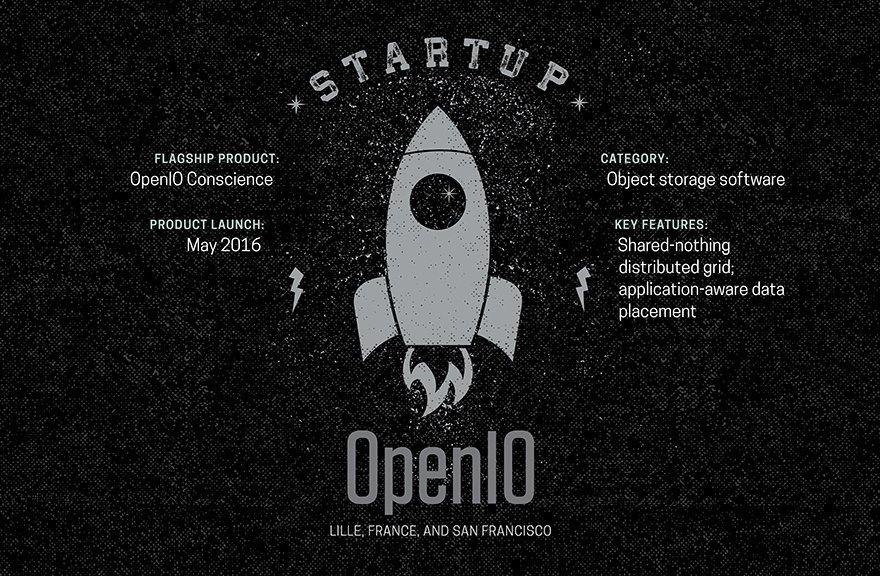
OpenIO is an eponymous software-only product that aggregates x86 server capacity from flash, disk and tape. The servers are organized as a massively distributed grid that shares compute storage and compute under a single global namespace linearly scaling to petabytes of capacity.
Each OpenIO object node participates in directory management and storage services. The grid-based architecture distributes metadata to eliminate a single point of failure.
Detection is automatic when a new node joins the OpenIO cluster. The new servers contribute immediately without the need to rebalance data.
Hyperscale cloud service providers, content delivery networks and long-term archiving are among OpenIO projected use cases.
Central to the OpenIO software is its application-aware Conscience technology for dynamic data placement. The Conscience algorithm continuously collects metrics on the node cluster, calculating a score for each node based on the available compute, memory and I/O. Metrics determine where data objects are written based on an application's performance requirement.
OpenIO is based in France, although it recently opened a U.S. office in San Francisco. Software versions are available for email, enterprise and video storage. The enterprise edition builds file services on the OpenIO open source core engine, including a REST API that supports Amazon S3 and OpenStack Swift metadata access. Data objects are protected on the fly using Reed-Solomon erasure coding.
Plexistor wants to capitalize on falling RAM prices by converting persistent memory to scalable storage.
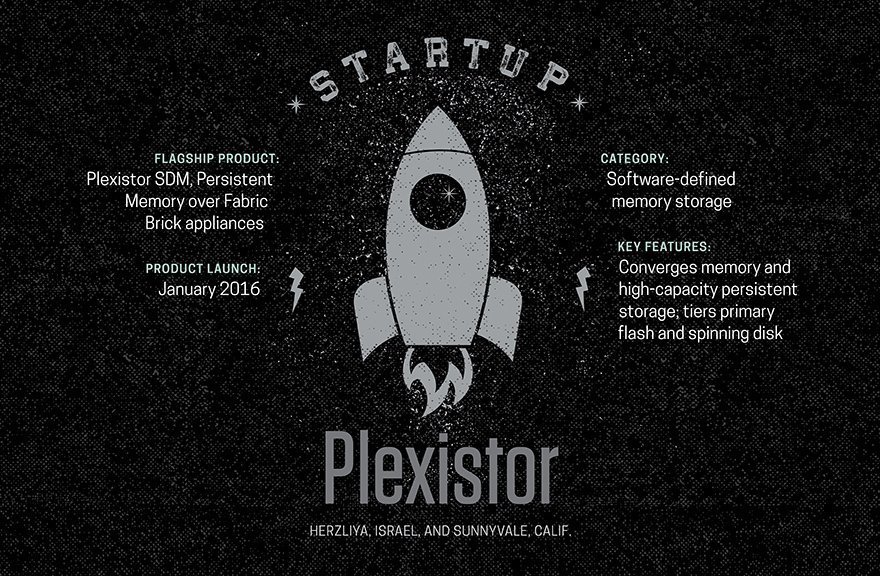
Plexistor SDM is a software-defined memory product that delivers high-capacity nonvolatile storage at near-memory speed. The target is big data analytics and in-memory database processing.
SDM bypasses the operating system to talk directly to a physical memory device. Dynamic RAM and persistent storage are presented in a single namespace.
The SDM layer uses nonvolatile dual-inline memory module (NVDIMM) memory cards, SATA or NVMe flash for scalable storage, backed by a tier of spinning disk to cold or warm data. The Plexistor file system moves data between primary and secondary storage. Persistent memory storage comes from flash-based NVDIMMs or commercially available SSDs.
Requested files appear as local storage to the user, although Plexistor SDM is actually transferring data in at high speeds across a network.
High data throughput, large memory and ultralow latency are defining characteristics of the product. SDM allocates resources to an application based on its consumption requirements. Traditional enterprise applications see Plexistor SDM as a file system, but it appears as byte-addressable storage to in-memory applications.
When first launched, Plexistor SDM was available only as a server-side installation on commodity hardware. The Israel startup has since introduced Persistent Memory over Fabric Brick (PMoF Brick), which allows disaggregated persistent memory to be shared across clusters of servers.
A PMoF Brick scales to 50 TB with bundled Plexistor SDM software on 2U servers and NVDIMM devices from Micron Technology. It uses DRAM as a primary tier, with a secondary tier of flash storage. Qualified PMoF hardware includes the Hewlett Packard Enterprise Persistent Memory ProLiant DL380 Gen9 line and Supermicro X10 servers.
Plexistor uses memory semantics to allocate memory ranges, mirroring data from servers to subsystem memory via Remote Direct Memory Access and 100 GbE switching technology.
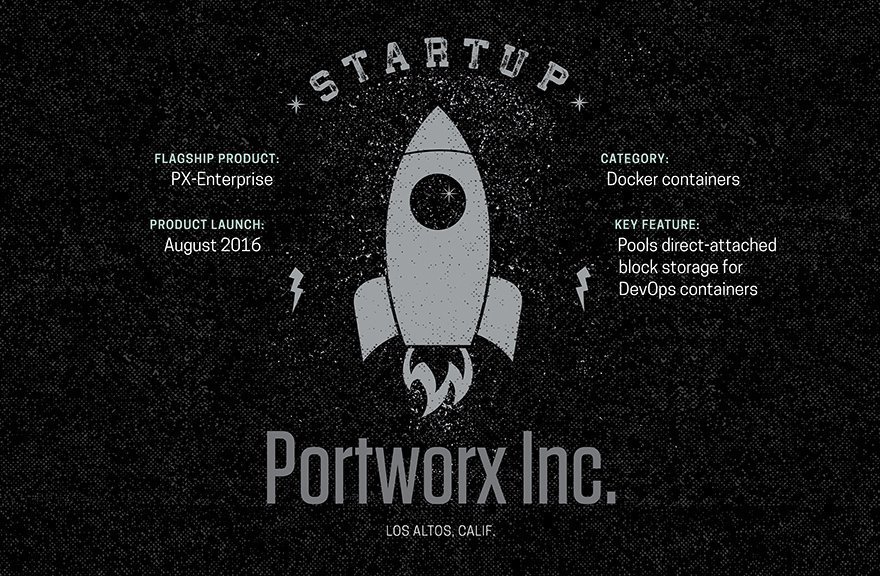
The line between containers and enterprise storage is narrowing. Portworx wants to further bridge the gap with its converged PX-Enterprise architecture that combines scale-out persistent block storage and container-level data protection.
Rather than Docker plug-ins, PX-Enterprise uses a more agile approach to provisioning and managing capacity. The thin software-defined storage infrastructure is geared to operational teams that deploy stateful applications in Docker and other container platforms.
Customers can purchase Portworx as a cloud deployment for Amazon Elastic Compute Cloud or an on-premises installation with clustered Linux-based x86 servers.
PX-Enterprise creates a logical pool of capacity from direct-attached block storage, NFS mounts or external storage arrays. The virtual storage is presented to users as a block device.
Using Portworx requires an enterprise to install PX-Enterprise on each node in a cluster. The Redwood City, Calif., data storage startup claims its containers deploy within seconds and burst to hundreds of containers per node.
The container software treats infrastructure as code to enable self-service provisioning. When a user requests an application, Portworx translates the encoded application requirements and places the container on the appropriate node. There is no need to write custom script.
By sitting in the data path, PX-Enterprise keeps tabs on disk and flash performance, balancing it against application requirements. The software exposes recommended storage tiers for moving data to ensure consistent performance.
Rather than externally mounted storage, Portworx provides persistent storage via Docker graph drivers. PX-Enterprise retains whichever file system a Docker container may be using, providing access to underlying block storage mounts.
The vendor claims its architecture enables containers to be portable between different nodes. Scale-out block storage provides high availability. An orchestration and scheduling layer manages container-level replication and snapshots.
The Portworx founders are not strangers to enterprise storage. CEO Murli Thirumale and CTO Gou Rao founded compression and deduplication vendor Ocarina Networks, which Dell acquired in 2010 and integrated across its storage platform.
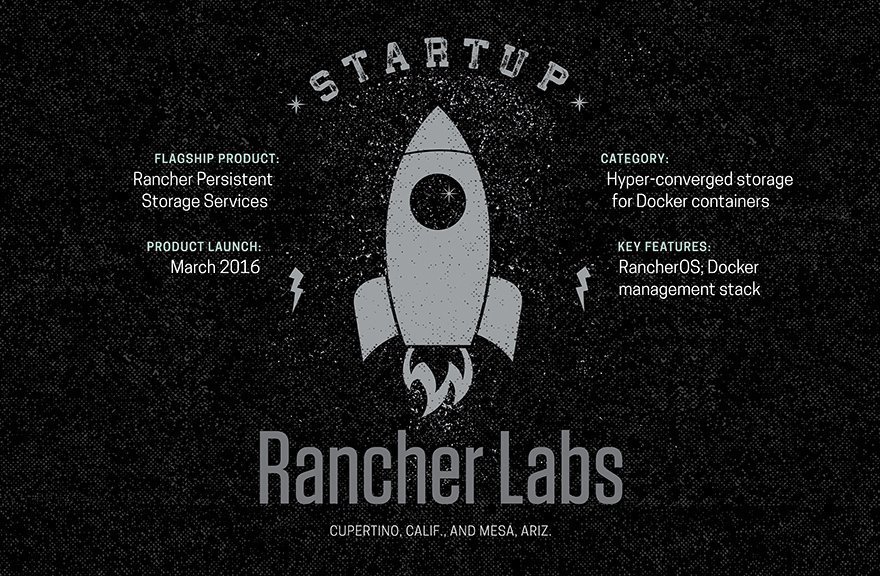
Portworx isn't the only vendor trying to innovate persistent storage with Docker. Rancher Labs has unveiled Persistent Storage Services, a Docker-focused operating system to extend the concept of hyper-convergence to containers.
The Rancher container open source technology supports large-scale Docker clusters deployed for line-of-business applications. The vendor's stated objective is to supply a full software stack that eliminates building containers from scratch.
Rancher container features include multi-tenancy, role-based access control and credentialing, including Microsoft Active Directory and LDAP authentication protocols.
Persistent Storage Services runs in tandem with the vendor's Linux-based RancherOS. The Rancher stack embeds persistent storage with containerized applications, including backup, data analytics, load balancing, networking, remote replication and volume snapshots.
Rancher is deployed as a pair of containers. One Rancher container serves as a management server for system services. The second container is a Docker agent installed on a node.
Four discrete elements make up the Rancher platform: infrastructure orchestration, container orchestration and scheduling, application catalogs and role-based access control/authentication.
Customers use Docker management tools to create mountable containers and apply storage services directly on a host. A Rancher host resides in a Linux virtual machine (VM) or on a physical machine.
Rancher orchestrates deployment of block storage volumes with Ceph, Gluster and NexentaEdge on x86 servers containing solid-state drives. In addition to Docker Swarm container orchestration, Rancher Labs supports deployment with Apache Mesos and Google Kubernetes orchestration frameworks.
Key to the success of the Cupertino, Calif., startup is its ability to persuade customers to switch from VMs to containers.
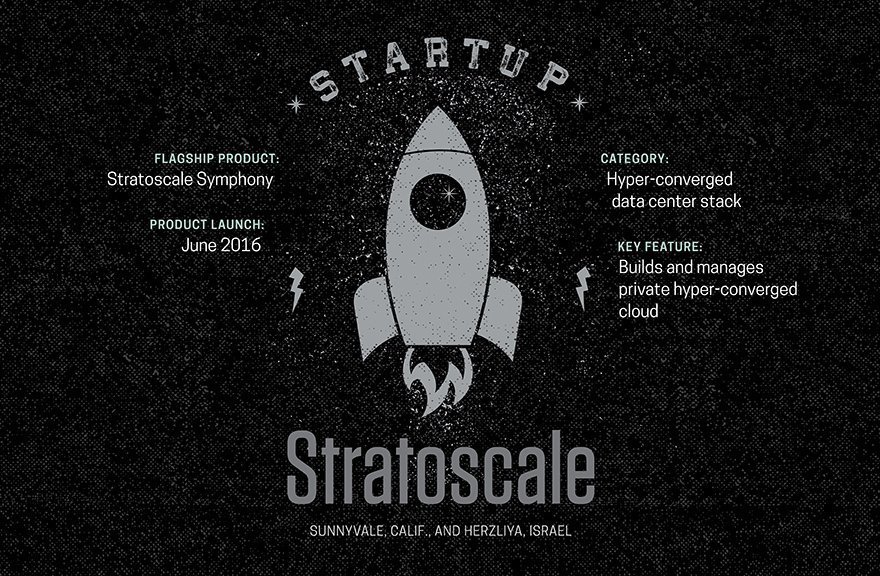
Stratoscale sells a hyper-converged software architecture known as Symphony. The key functionality rests in a compute, storage and network virtualization layer that underpins the development of OpenStack-based cloud storage.
Stratoscale storage technology has attracted institutional investment from Cisco Systems, Intel Capital, Qualcomm Ventures and SanDisk Corp. The Symphony software-defined data center stack aims to turn a rack of x86 servers into a do-it-yourself hyper-converged architecture.
That pits Stratoscale against established hyper-converged competitors, including industry pioneers Nutanix and SimpliVity. The startup is trying to stand out by championing open source tools, including Docker, Linux KVM and OpenStack, to build a private cloud.
The system is designed to make it easy to configure, distribute and manage hyper-converged resources. Physical and virtual storage is aggregated as a shared pool of block storage, including available disk and flash.
Stratoscale software also supports storage arrays from Dell EMC, Hitachi Data Systems, IBM, Infinidat, NetApp, Nimble Storage, Pure Storage and Oracle.
A Symphony configuration requires 32 GB of memory, at least one 256 GB solid-state drive and two hard disks. It works across a 10 GbE connection.
The Symphony intelligence instantly recognizes attached storage. Stratoscale stripes I/O operations across available storage devices in a cluster. Multiple replicas provide for high availability against disk or node failure.
The Stratoscale subscription model includes an annual license of $5,000 per server. Customers have the option to install Symphony on their preferred hardware or via reference architecture with network partners.
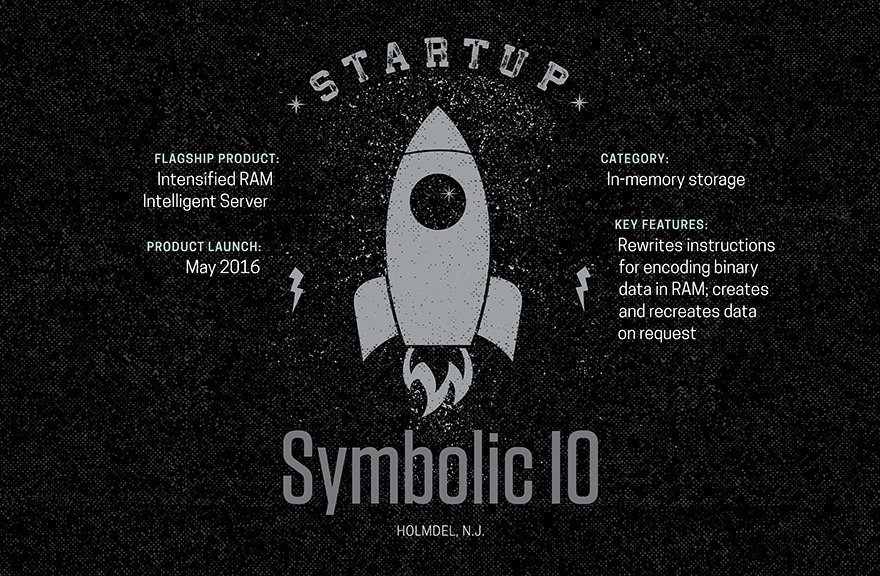
By changing how binary bits are processed, Symbolic IO may have uncovered a way to reimagine in-memory storage.
The Holmdel, N.J., firm came out of stealth to bring its computational-defined storage to market. Symbolic IO claims its Intensified RAM Intelligent Server (IRIS) storage infrastructure can shrink the footprint of data stored in RAM and quickly rehydrate it intact as needed.
With IRIS, Symbolic IO offers a new way to encode binary data in server RAM. In short, IRIS creates and recreates data in real time upon a user's request. The process moves storage processes in front of the CPU, freeing computation from a dependency on underlying storage media.
IRIS deconstructs blocks of decoded raw data, dividing it into a plurality of data vectors. Each vector is mapped to a bit marker table in RAM, ultimately producing an encoded representation of the original raw data.
Data is decoded by retrieving mapped bit markers, combined with data vectors and other blocks to produce a decoded raw data composite. To recreate data, IRIS recalls the blocks and applies a proprietary algorithm contained in the Symbolic IO Conversion Engine.
The Symbolic IO platform is a 2U commodity server with modified BIOS intelligence to accept nonvolatile memory as storage. Three IRIS hardware modules are available, starting with the IRIS Compute building block.
The IRIS Store version scales to 1.8 PB of usable flash storage, while IRIS Vault comes with a proprietary multimodal application-specific integration circuit for physical security and an NVMe backup engine. IRIS Vault also features a trauma sensor, which detects if a device has been damaged and automatically renders data unusable to unauthorized users.
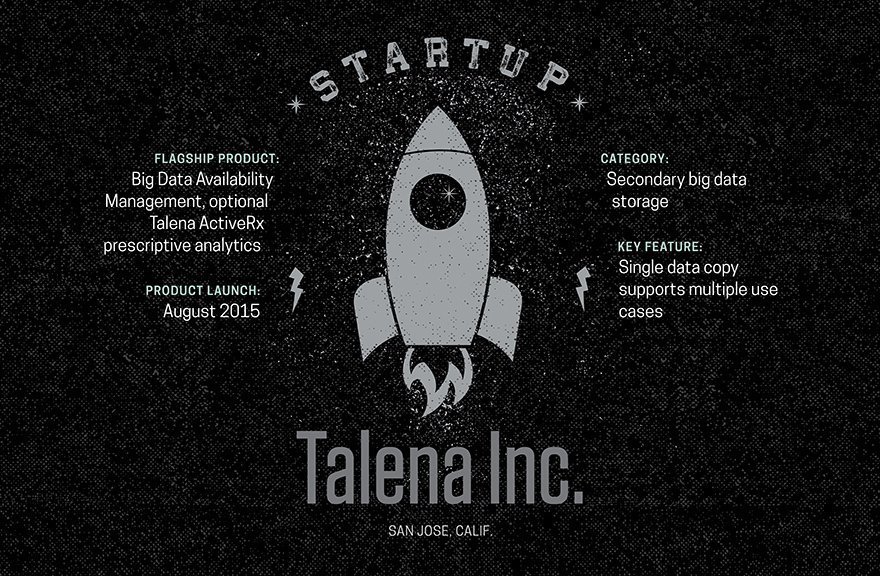
Talena came to market with a big idea for big data. The vendor's software-defined big data analytics architecture uses a single copy of data to support multiple use cases, encompassing archival storage, development and testing, and disaster recovery.
The Talena Big Data Availability Management data-aware platform provides dedicated software-defined secondary storage for Hadoop, NoSQL databases and enterprise data warehouses. The product is available as a consumption-based annual subscription based on the capacity under management.
Customers may choose to run Talena on commodity boxes, inside VMs or in a public cloud object store with Amazon S3, Amazon Elastic Block Store and Amazon Glacier.
Another software component, Talena ActiveRx, forecasts how rapidly data is growing to aid capacity planning. The predictive intelligence performs data analytics on passive backups in Amazon. Talena ActiveRx is available as a separate software license.
The Talena Big Data Availability Management agentless software deeply scours each storage node in a big data cluster. It uses a distributed file system to pool direct-attached and networked storage. Distributed block-level data deduplication and multiple point-in-time snapshots are supported to optimize storage capacity and reduce overhead. Erasure coding is applied as a safeguard against multiple node failures.
Talena FastFind is a distributed metadata catalog that supports full recovery of individual files or databases. Application-specific data movers provide a mechanism to pull data and restore storage to and from big data repositories, including Hadoop Distributed File System, Cassandra and other NoSQL databases.
Talena's policy engine allows workflows to be flexibly configured for each use case, including frequency of execution, workflow priority and specific attributes for archiving criteria, backup and long-term retention.
CEO Nitin Donde founded Talena following a brief stint at EMC after it acquired e-discovery software startup Kazeon in 2009. Donde also previously served as vice president of engineering for data storage startups Intransa and Aster Data Systems.