Video



In this episode of Tech News this Week, host Kelsey Sung and Amanda Hetler discuss Gartner's predictions about the top 10 strategic technology trends for 2027, how far along these technologies are in production and which will be the most critical to CIOs in the year to come.
Be sure to follow Tech News this Week on Podbean, Spotify, Amazon or wherever you get your podcasts.
AI powered by living tissue? It might sound like a science-fiction plot, but the technology could be closer than you think.
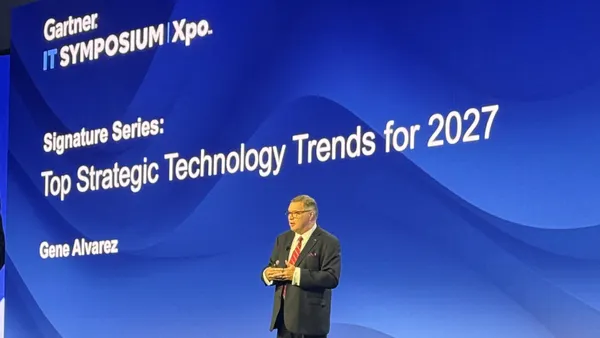
Wetware as a service — an emerging AI computing concept that uses biological neurons and neural networks in place of silicon — closed out Gartner's list of the top strategic technology trends for 2027 at the research and advisory company's IT Symposium/Xpo this year.
But while WaaS is still in its infancy, CIOs should take note of several trends from Gartner's list that can be implemented today, according to Amanda Hetler, senior editor of Reader Engagement and Outreach at TechTarget.
"Gartner finds these trends by venture capital funding, patents, analyst submissions, innovation profiles and its own hype cycles to identify what's gaining traction over the IT world," Hetler said on a recent episode of Tech News this Week.
"This [year's list] reflects a strong concern about AI operating without structure, accountability or governance. It's moving fast, and companies need to take time to step back and ensure governance and safety."
Hetler cited agent coding harnesses and AI context platforms as two of Gartner's top trends that are currently being deployed by organizations to help manage AI development and governance.
"[CIOs] should prioritize governance infrastructure," she said. "They should also establish clear accountability structures — not just who's responsible for AI but who's accountable for AI."
Watch this episode of Tech News this Week for the full list of Gartner's predictions for the 10 strategic technology trends of 2027, plus insight on which of these trends CIOs should start prioritizing now.
Kate Murray is an editor for TechTarget's Reader Engagement and Outreach team. She joined the company as an associate managing editor of e-products in 2020 and has also served as managing editor for TechTarget's Infrastructure sites.
Transcript
Kelsey Sung: What are the top 10 strategic technology trends that CIOs should be aware of in 2027?
That's a hard one, but thankfully, Gartner analysts just released their answer at the Gartner IT Symposium. We're here with Amanda Hetler, senior editor of Reader Engagement and Outreach at TechTarget — who was present at the conference when the list was released — to hear what Gartner came up with.
So, Amanda, let's start out with a quick overview of the top 10 tech trends that Gartner highlighted — you know, how far these are along in production, generally speaking, and just what do you think might have raised them to Gartner's attention?
Amanda Hetler: Sure. The first one was large quantitative models, which can process equations with math and physics, unlike the typical LLM that just uses context.
Speech reasoning models, which focus on audio and inflections of voice to escalate a call. So, if you're frustrated, it can sense it in your voice, and it'll take you to a person.
World models, which use physical AI and physics to predict outcomes, so businesses can prepare. Think of, like, a car accident — they can figure out what to do if something like that happens with simulation.
AI context platforms, where your information is stored, automated systems that can scan and get the documentation across the business to help these businesses make decisions.
Agent coding harnesses, which write code by managing the control plane on how the business does it. You know, developers need to be involved with that, too. It's not just the technical part.
And then there's AI agent identity, which gives AI access to only the programs it really needs. Just like employees, they don't need access to everything. It's controlling AI's access as well.
And then there's autonomous exposure remediation, which uses both AI and automation to scan and fix security vulnerabilities before they become a problem.
Sovereign tech is another big one. It gives companies control over their hardware and software databases, AI models, if they need to exit a vendor,
Disposable applications, giving an end date to an application when it's no longer needed, and then getting new ones before, instead of trying to keep up to date with every application.
And then there's wetware as a service. It's kind of far out there, but it's using living tissue to power AI. There's, you know, questions on that one and more to come.
So, they're all at different stages. Some, like the agent coding harnesses and AI context platforms, are already being deployed to help manage AI development and governance, while others like the world models and wetware as a service are still emerging. They're in pilot form. And Gartner finds these trends by venture capital funding, patents, analyst submissions, innovation profiles and its own hype cycles to identify what's gaining traction over the IT world.
And this year reflects a strong concern about AI operating without structure, accountability or governance. It's moving fast, and companies need to take time to step back and ensure governance and safety. So, a lot of these trends are about implementation.
And another thing, costs are going up, and businesses don't have the budget. Gartner said that companies are spending 18 times more than they did just two years ago. And a lot of the IT leaders that I talked to said they don't have an AI budget and they have to find some funding somewhere else. So, IT leaders are taking the time to ensure that they get the right ROI for what they're spending and using the right models so they aren't spending more than they should.
And data was another hot topic — and making sure the data is ready for AI. Without proper context, the data lies in various areas of the company, so then the output's difficult, and it's not what the company is looking for.
Sung: Awesome. So, as you kind of have already alluded to, a lot of AI. And, specifically, making sure that AI is more secure and more manageable, I think, which has been a big push industry-wide lately. Given your coverage over the last couple of years, how do you see the relationship between AI adoption and cybersecurity evolving over, I don't know, the next few years or whatever timeline you're willing to commit to? And what will organizations need to do differently as a result?
Hetler: So, first and foremost, AI adoption is outpacing the security and governance structures. It's moving very, very rapidly. And, you know, there's the talk of dark AI, malicious intent, it's in the mind of all security leaders. Gartner has warned that it's generating software faster than humans can review it, creating unmanaged credential paths. And Gartner also thinks that ungoverned AI agents will cause 25% of enterprise breaches by 2028. So, it's really got people thinking.
So, organizations, there's this shift of they're treating security as a secondary issue to now making sure it's embedded directly into their systems. It was all about just implementing AI, implementing AI, but now they're taking a step back and saying, 'Hey, we need to have something to govern this.' So, they're building continuous automated vulnerability remediation directly into their software development lifecycle, instead of relying on manual review because they just don't have the time with it evolving so quickly.
Sung: I was curious about the reactions from the conference. Which, I guess, like, two or three of these 10 trends — because 10 is quite a lot. I mean, no one's going to get all of these, do all of these at the same time. So, which two or three of these 10 trends do you think that CIOs in the room were really taking notes on, thinking about implementing this year versus which ones felt more like, 'OK, this is maybe somewhere over the course of the next decade, we will get to this.'
Hetler: Sure. So, the CIOs now are looking at implementation. It's happening now, for a cost. So, the main concerns, I think, are safety and governance, such as the agent coding harnesses, AI agent identity and AI context platforms are probably the three biggest ones I see right now because they are all about the implementation, the governing software development, controlling agent access and feeding business context into AI systems that are already in use. It's basically getting more of a bang for their buck and keeping everything safe.
Some of these other ones are a little bit more exploratory. I talked about wetware as a service, which is using living tissue to help power AI. Those are kind of way out there. And even the world models are a little bit out there, which is using physical AI to determine possible outcomes of something like a car accident or something.
So, I think the CIOs are looking for the stuff that helps with implementation and with cost — keeping their costs down as much as possible.
Sung: Yeah. Especially in this economy.
Hetler: Yeah, everything's up, so, yeah.
Sung: So, in the article, Gene Alvarez — who's a VP analyst at Gartner, one of your primary sources for this piece — he characterized AI as operating within an 'architectural vacuum,' which is an interesting phrase. And I was curious, what does that comment tell us about the technological environment or mood kind of going into 2027?
Hetler: So, it's signaling a sense of urgency and concern. AI capabilities have advanced faster than the organizational structures, boundaries and governance needed to manage them responsibly. So, his comment is: Organizations cannot be a passive observer of model capabilities. They need to be architects of the organization and human and machine boundaries suggest the overall mood. They have to keep up. They can't just take a backseat.
Businesses are starting to embrace AI's potential, but now they're finding problems with unmanaged credentials, vendor lock-in, unreviewed code. They must all be addressed so it can scale sustainably and move to implementation.
Sung: Yeah, 'vacuum' feels like a very accurate phrase to have chosen. I can see how ideally these top 10 trends are going to lead to more structure, more kind of — more guardrails, as people keep talking about, going forward. But of course, we can't just rely on technology to provide the guardrails, and I think one of the most important questions that I could close us out here with is: For the CIOs and the technology leaders who are listening, what should they be doing in response to these trends? Like, are there any, you know, foundational investments or capabilities or governance decisions that they should be prioritizing now, even if, you know, they're not ready to adopt all 10 of these amazing technologies?
Hetler: Correct, they should prioritize governance infrastructure — you know, establish identity controls for AI agents, build and adopt coding harnesses — so it's consistent across the board, you know, the company protocols and oversight of the software development lifecycle. Invest in AI context platforms to ensure models are working with accurate organization-specific data. It's kind of like — Gartner compared it to onboarding a new employee who gets better over time with the better data.
They should also establish clear accountability structures — not just who's responsible for AI but who's accountable for AI. Track what AI agents do, and technically who's in control, and start evaluating long-term cost and vendor dependency risk. You know, that's where sovereign tech comes in.
Cost controls — use the right models for the right tasks. You don't need the biggest, shiniest model to do a search function, you know? You don't need to waste tokens on things that are unnecessary. Determine if AI is really needed and set limits on token consumption to keep costs down.
Sung: Amanda, thanks so much for coming on to share these insights with us. And to our audience, if you liked what you heard today, first of all, like and subscribe. But also, you can get more of Amanda Hetler's work and coverage on TechTarget CIO, and if you want to follow her on LinkedIn, you can find the link to her profile in the description.
See you next time.