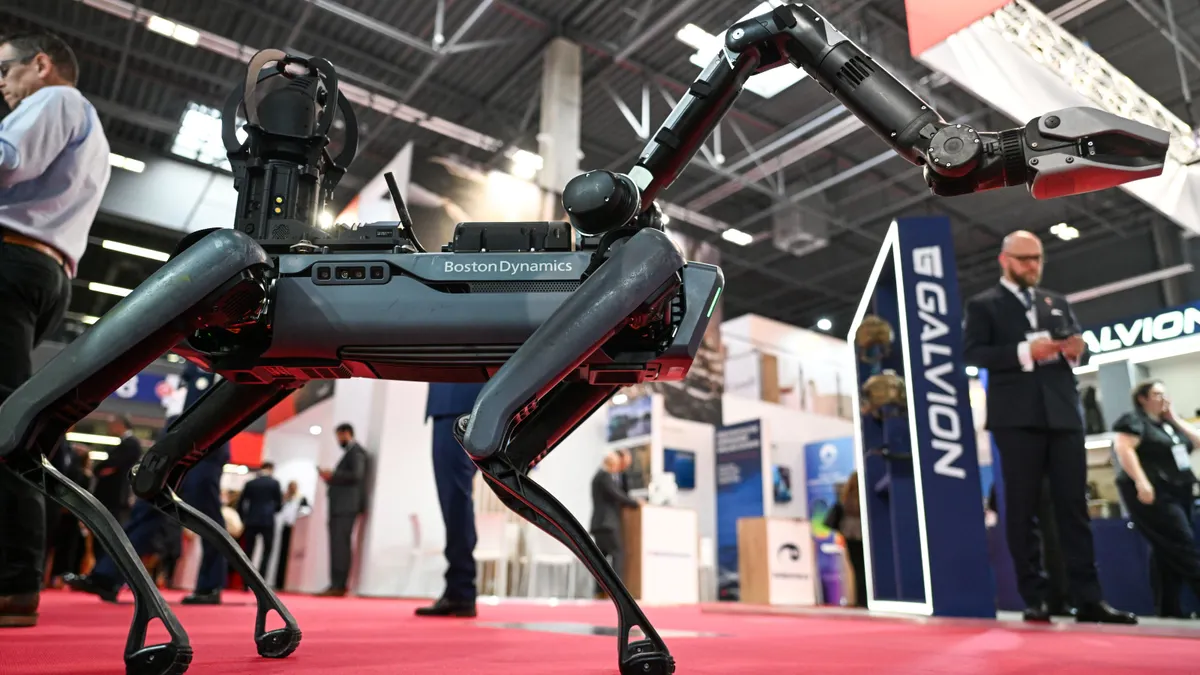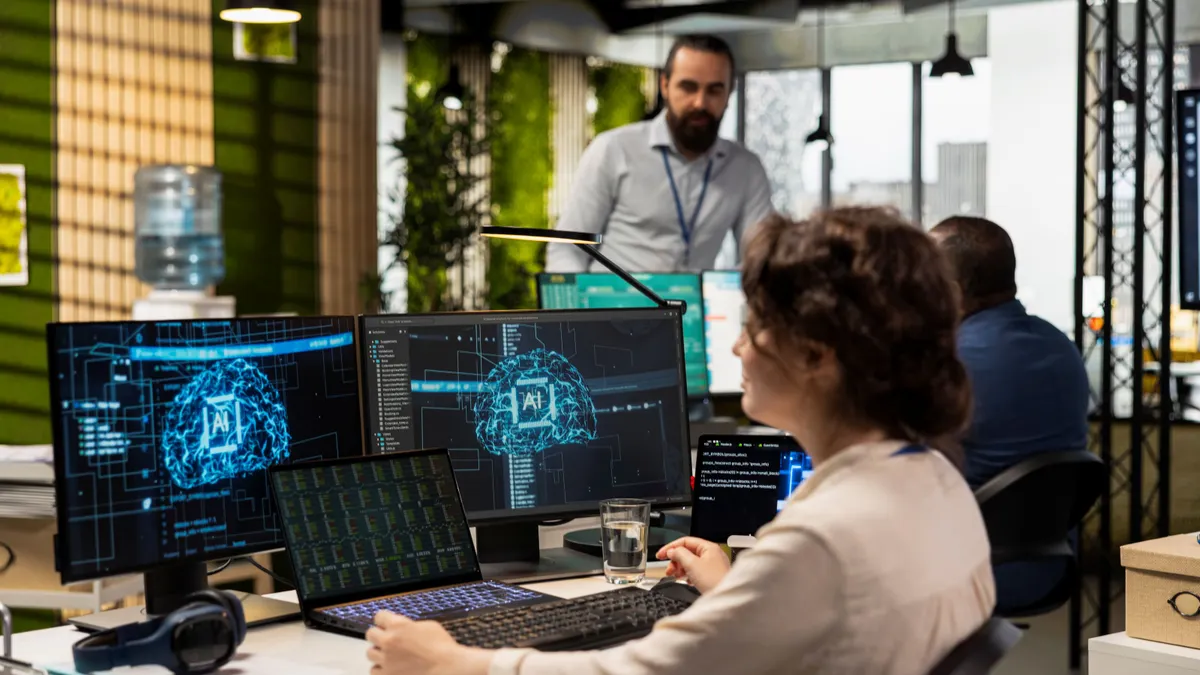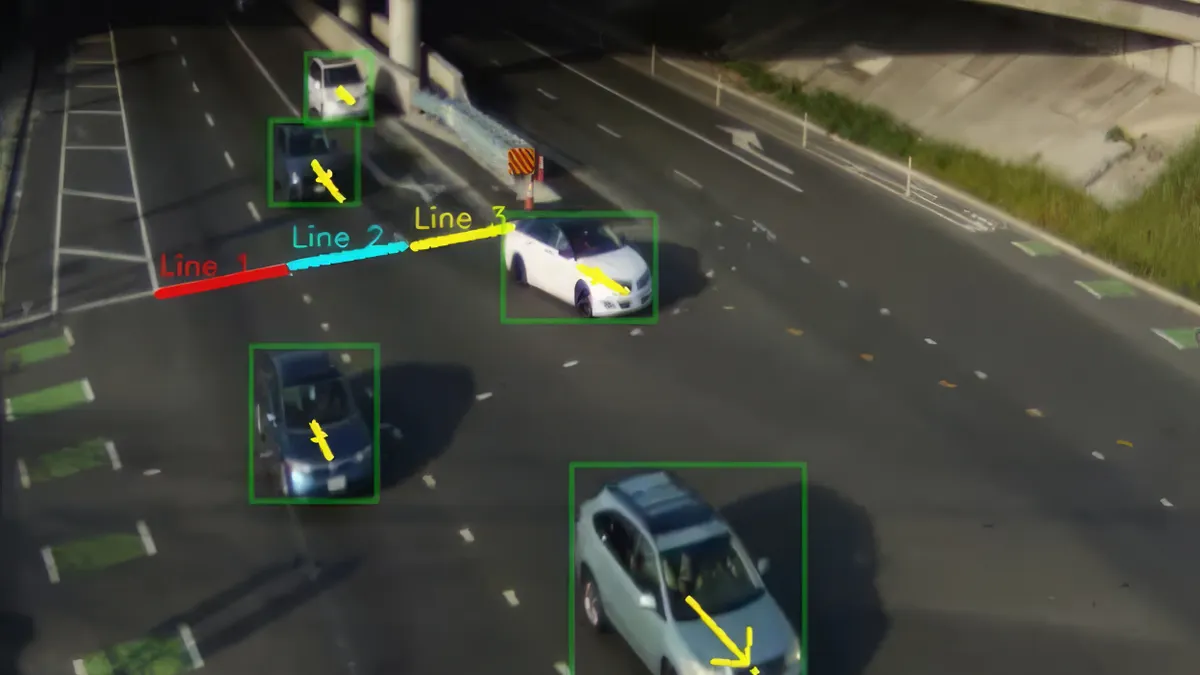
While physical AI enables robots to perceive, reason, make decisions and operate autonomously within businesses, ambient intelligence and edge AI are creating a new class of autonomous systems that use sensors and IoT devices to continuously collect data, creating proactive physical environments.
"Ambient intelligence is becoming practical as machines combine sensors, AI, computing and connectivity to understand what is happening around them and respond in the moment," said Aaron Wells, senior director of engineering and autonomy at Blue River Technology, a John Deere company. "In agriculture, connected vehicles and equipment in the field can become part of an intelligent system: each machine senses conditions, performs its task and shares information that can help farmers manage their operations."
This autonomous technology creates real-time connectivity shared among devices and is beneficial for industries beyond farming. Gyebong Jang, chief AI researcher at HD Korea Shipbuilding and Offshore Engineering, shared that another Hyundai maritime subsidiary, Avikus, combines vision, radar and automatic identification systems to support situational awareness, collision avoidance and route and speed control for ships.
"In shipbuilding, we are extending the same principle toward physical AI-based autonomous manufacturing, moving from fixed, repetitive automation toward robots that can perceive changing work conditions and adapt their actions accordingly," Jang said.
According to Jang, Hyundai uses data from cameras, sensors, production equipment and robots to improve visibility and optimize production, quality, safety and logistics. "Our Smart Yard roadmap progresses from making the yard visible to connected and predictive operations and eventually toward an intelligent autonomous shipyard where AI can make decisions and machines can execute them."
Wherever it's deployed, ambient intelligence will help continue to advance AI systems.
"We are moving beyond AI systems that simply wait for a command," said Dani Cherkassky, CEO and co-founder of voice AI provider Kardome. "The next stage is technology that understands enough about the people around it, the environment it is operating in and its own state to respond naturally and in context."
Business benefits of ambient intelligence
Ambient intelligence and edge AI offer other business advantages, such as reducing cloud connectivity and operating costs while providing always-on data insights.
"The benefits come from two perspectives: Opex optimization and enhanced brand image," said Will Wong, principal analyst at ABI Research, who focuses on AIoT technologies. "For Opex optimization, ambient intelligence and edge AI can minimize cloud and bandwidth costs by processing data locally on the device."
Ambient intelligence and edge AI will also help further advances in physical AI and robotics. Wong explained that the key elements for physical AI are the following:
- Machine vision.
- Acoustic and voice sensing.
- Motion and biometric detection.
- Environmental sensing.
He said that ambient intelligence devices capture the necessary data for these elements, providing the sensory foundation for physical AI.
Cherkassky also shared that voice could become a key component in the sensory foundation for physical AI. "Most voice interfaces today can recognize words, but they often do not understand who is speaking, what they said, whether that person is actually addressing the device, what has already happened in the conversation or what the device itself is doing," he said. "Speech recognition, contextual processing and smaller language models can run on device, which gives the system the ability to respond immediately and maintain context without making every interaction dependent on a cloud round trip."
Ambient intelligence could also prove beneficial to automation, providing technology monitoring and self-reporting capabilities, such as at Denali National Park in Alaska. The National Park Service wanted to track the accelerating movement at the Pretty Rocks Landslide along the park's main road. Manual service couldn't keep pace with the movements, so the park instead deployed technology to track continuous positioning measurements with environmental sensor data from Trimble, an agentic AI and ambient intelligence company. The site could then report on itself with automated threshold alerts, enabling safety and maintenance decisions based on live conditions, according to a case study of the project.
"We are past asking whether a machine can sense and understand its environment," said Aviad Almagor, vice president of technology innovation at Trimble. "Ambient intelligence has moved into practical, task-specific systems. On a construction site, an excavator or a compactor operates as a moving sensor platform, combining sub-centimeter positioning, site models and local sensor data to adjust its position, blade or bucket in real time. Those adjustments occur in milliseconds."
Challenges of ambient intelligence
There are also challenges in moving ambient intelligence beyond proof of concept. One challenge is in the realm of connected robotics, particularly those that perform continuous or repeating tasks, such as in a factory.
"They know if their robot is making the part, and they know how many parts X robot is making," said Jeff Collins, CEO of WanAware, a company that deals with connected IoT devices. "What they don't know is what is the efficiency, from a technology perspective, of the communications coming off the robot. That's where there is a large gap for organizations."
Collins explained that whenever a robot performs an action, data flows from the robot to various systems. These systems could trigger another robot to perform a different action or store the status information of an existing part intended for production. As this communication progresses, bottlenecks begin to appear, Collins said.
"It's just like if every single day your job is to take a piece of paper from the right side of your desk to the left side of your desk, and you do that all day long," he said. "But what happens if every 32 seconds a rock drops on the desk? Every single time that rock drops, you have to go and pick up that rock. It's not a rock in this example; it's an API call. It's an integration between systems. Those types of things are where we look at optimization, and those become extremely important."
Wong sees additional challenges, like the realities of Capex and legacy systems. "When migrating to ambient-edge systems, enterprises often face the prospect of replacing thousands of legacy field devices," he said. "This incurs significant Capex, both in hardware procurement and technician labor for physical installation."
Wong explained that organizations typically adopt a retrofit approach, deploying edge gateways or on-premises edge servers while keeping legacy sensors. But once they validate how edge AI minimizes Opex and optimizes operational efficiency, they're more willing to expand into full ambient-edge deployments.
Companies such as HD Hyundai continue looking ahead with a holistic view.
"Ultimately, the challenge for HD Hyundai is not simply to develop a better AI model, but to establish a closed loop from data to training, simulation, edge deployment, physical action and continuous learning from real-world operations," Jang said.
Chuck Martin, a New York Times bestselling author, futurist, speaker and columnist, has been a thought leader in emerging digital technologies for more than three decades.