Reconciliation is a standard part of business, and often a responsible one.
A finance team should check numbers before closing. Operations should question inventory or shipment data before committing. Managers should want to know whether the report in front of them is reliable before they act on it.
The problem starts when the same check becomes permanent.
That is where reconciliation turns into a form of software debt. Software debt is the business cost that accumulates when applications, integrations, reports or workflows no longer fully support how work gets done. The company pays that cost through manual fixes, extra reviews, duplicated work, slower decisions and numbers that people do not quite trust.
A one-time check can protect the business. A recurring fix can hide the fact that the software estate is not doing its job.
The issue is the file, export or correction that becomes part of the routine. The business is waiting for it. Meetings depend on these updates. People trust the fixed version more than the official one.
At that point, reconciliation is no longer just cleanup. It is a signal.
The spreadsheet might not be the problem. It could be where the real problem finally shows up.
Reconciliation can become invisible work
Most enterprises have reconciliation work, whether anyone calls it that or not.
Finance knows which numbers require a second look before close. Sales operations understands which forecast file needs work before leadership sees it. HR identifies which employee records need cleanup after a system change. Supply chain recognizes which inventory or shipment numbers need a sanity check before any commitments are made.
Some of that is ordinary control work. The trouble starts when the correction becomes normal.
A report gets cleaned every week. A dashboard is ignored until the export is adjusted. A spreadsheet becomes the version people trust. An analyst knows which fields always need attention. A manager waits for the fixed file before making a call.
That can look like discipline. It can also let weak software processes hang around for years.
The cause might sit in the systems, but the effect shows up in the business. ERP might define a customer one way. CRM could define the customer differently. A finance report might still use an old category. A service case could close in one tool even though the work continues somewhere else.
The reconciliation keeps work moving. It also raises a question the organization might not want to ask: Why is this still necessary?
The fixed file can take over
Reconciliation debt usually has a boring home.
It might be an Excel file, a BI export, a shared-drive report, an email attachment or a local dashboard. Nothing about it looks dramatic. The file might not have a formal owner. It might not be documented. It could simply belong to the person who knows the business well enough to spot the number that looks wrong.
That is how the workaround gets power.
People wait for the file. They use it in meetings. They copy it into decks. They use it to explain performance, defend spending, check service levels or decide which problem needs attention first.
The system holds the official data, while the fixed file holds the decision.
That is the part worth stopping on. Once a corrected file carries that much weight, the company has a trust problem. It might also have an ownership problem. The correction has business authority even if no one has named it as a control.
If the real answer is "we've always used it," the business has a problem.
A spreadsheet can become the real report long before anyone gives it that title.
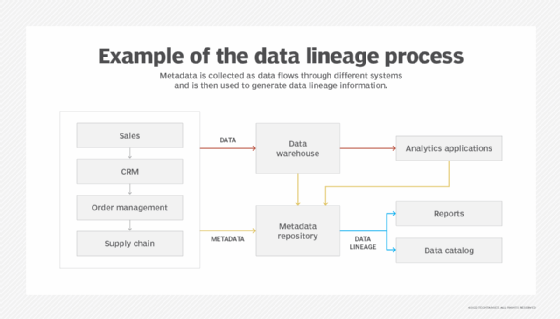
Data lineage shows how information moves through systems, reports, analytics tools and catalogs.
The issue is not every spreadsheet
The answer is not to eliminate every spreadsheet. That is fantasy.
Business work is messy. Teams need quick comparisons, temporary analysis, local planning, exception handling and one-time checks. Finance, compliance, operations, HR, customer service and supply chain teams sometimes need ways to inspect data outside the main system.
How data lineage can expose reconciliation debt
Data lineage helps show where data comes from, what happens to it and where it ends up. That becomes important when the same report, spreadsheet or dashboard needs the same correction repeatedly. The fix might keep work moving, but it also points to a problem somewhere earlier in the data path.
For recurring reconciliation work, follow the number. Which system created it? Which system changed it? Which report, dashboard or spreadsheet picked it up? Where did it stop matching the official source? Who owns the field, rule or integration behind the mismatch?
Data lineage will not fix software debt by itself. But it can show whether the recurring fix points to a data-quality issue, integration gap, outdated report, unclear ownership model or business process that changed faster than the software supporting it.
The issue is the spreadsheet no one can retire.
It runs the same correction every week, month or quarter. People trust it more than the system report. The person who maintains it becomes the only person who understands why the numbers differ.
A process that was supposed to be temporary becomes part of how the business actually works.
That is not just a data problem. It is a software management problem.
A spreadsheet can become the real report long before anyone gives it that title.
The company already paid for systems to support this work. If teams still need the same manual fix every week or month, something is off.
Maybe the source data is messy or the enterprise application integration is half-finished. Perhaps the report is old. Maybe the workflow changed and the system did not.
The reconciliation work points to the gap. The mistake is treating the gap as normal.
Start with the recurring fix
Some reconciliation belongs in the business. Finance teams need controls. Compliance teams need evidence. A data migration needs checks. Nobody should pretend every reconciliation is a waste.
The recurring fix is different. It is the Friday file, the month-end spreadsheet, the corrected dashboard or the local report everyone waits for before making a decision.
Give that work a name. Give it an owner. Then decide whether it is still protecting the business or just preserving a workaround.
Reconciliation is useful when it protects the business. It becomes debt when the correction has become part of the process and no one owns it.
The spreadsheet everyone waits for
The risky spreadsheet is not always hard to find.
It is usually the one people ask about before a meeting. Did Lisa finish the file? Is the month-end version ready? Are we using the dashboard number or the adjusted number? Someone might know the answer, but the system does not.
That is the giveaway.
The file might have started as a temporary patch after a migration, a bad report, an unfinished integration or a process change. Years later, it is still there. New employees learn it by asking the person who inherited it. Managers trust it because it has always been more accurate than the official report.
At that point, the spreadsheet is not just a spreadsheet. It is part of the way the business runs, even if no one has admitted it.
James Alan Miller is a veteran technology editor and writer who leads Informa TechTarget's Enterprise Software group. He oversees coverage of ERP & Supply Chain, HR Software, Customer Experience, Communications & Collaboration and End-User Computing topics.