
Getty Images/iStockphoto
Adobe in Slack: Access content, production tools from Slackbot
Everyone's spreading the love -- and premium features -- with everyone else's AI interface.

Adobe has embedded more than 70 premium features from Firefly, Express, Photoshop, Premiere, Acrobat, InDesign, Illustrator, Stock, Lightroom and more, into Slack.
Users today can download the Adobe for Slack app in Slack and start a conversation about turning content into posters and PDFs, editing and creating images in bulk, finding content about past marketing projects and campaigns, creating variations on already approved content, and creating shareable content from data.
Adobe in Slack builds upon nearly a decade of integrations between the two companies' technologies. Late last year, Adobe embedded many Express tools in Slack, which could generate limited content from the chat environment.
"With Adobe appearing in Slack, they democratize their tools to a whole new set of users," said Joe Cicman, analyst at Forrester Research. "They didn't have to write a new UI, and they didn't disenfranchise or alienate their pro users."
The cross-pollination of features among vendors is the trend of the year. Adobe has already embedded some graphics features in ChatGPT, and last week, Salesforce announced plans to embed its features in Anthropic's Claude, which is set for open beta later this month.
The Adobe in Slack features are available in different tiers, depending on an organization's subscriptions. All subscribers to Slack Business+ or Enterprise+ plans will be able to access certain features, regardless of whether they have an Adobe account. Those with a paid Adobe subscription will have access to additional capabilities and, of course, content assets if they're stored in Adobe's cloud services.
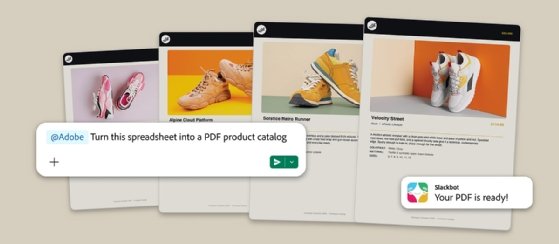
Importing creative tools into Slack
Users might be able to create some of these features themselves using tools such as Claude Code; indeed, Anthropic previewed Claude Design earlier this year, which served as a proof of concept.
But having Adobe embed its tried-and-true features into a plain-language interface provides value that homegrown AI tools might not. One example is image creation with Firefly, which doesn't violate copyright, unlike other image generators trained on copyrighted material.
Some CIOs and tech buyers might view Adobe in Slack as a way for Adobe to remain relevant as a SaaS vendor in an AI world -- or even as an AI harness. Cicman doesn't see either of those as what's actually happening: He sees Adobe in Slack as a means for workers -- marketers, for example -- to become more creatively charged as they test many more campaign ideas faster and compress weeks of work into a day.
"In practice, it could make somebody a more effective marketer because they don't have all of these distractions going on in their head, and they're getting real feedback, fast," Cicman said.
"I think marketers are going to have better ideas, they're going to be able to get through their iteration [faster], and we're probably going to see some better marketing. But it's not going to be because the technology made it possible. It's going to be because the technology allowed the marketers to be more immersed."
Don Fluckinger is a seasoned B2B technology journalist with more than 30 years of experience specializing in enterprise IT, digital experience and content management. As a senior news writer at Informa TechTarget, he delivers award-winning analysis that helps IT and business leaders navigate complex technologies to enhance customer and employee experiences. Got a tip? Email him.
Dig Deeper on Customer Experience
-
![]()
Dreamforce 2026: Marc Benioff beats customer data drum for business AI use
By: Brian McKenna
-
![]()
How asynchronous tools transform team collaboration
By: Irwin Lazar
-
![]()
Salesforce-Anthropic integration expanded, begets 'Claudeforce'
By: Don Fluckinger
-
![]()
Adobe launches ChatGPT plugin toolset & functions
By: Adrian Bridgwater