New book urges CIOs to envision better futures
AI risk matters, but CIOs also need to imagine what could go right. Nikolas Badminton's book shows how futures thinking can turn hope into action and shape what's next.

A vision for the future is only useful if an organization believes it can get there.
As AI spreads across the enterprise, CIOs are becoming more central to how organizations use data, technology and new ways of working. That makes their ability to align people around a vision increasingly important. However, much of the conversation around AI focuses on what could go wrong -- cyberthreats, job displacement and warnings that advanced AI could pose an existential risk. Those risks obviously deserve attention, but leaders also need to imagine what could go right and what they want the future to look like.
Published Sept. 23, The Hope Engineer's Playbook offers a hopeful counterpoint to that risk-focused debate. Author and futurist Nikolas Badminton argues that hope can give organizations the energy to pursue change while futures thinking helps them imagine new possibilities. He advocates setting bold goals, considering multiple paths to reach them and giving teams the agency to act. For CIOs, it offers a way to look beyond short-term technology decisions and help teams move toward a future that keeps the business relevant and competitive for decades to come.
The following excerpt from Chapter 3 introduces the Hopeful Futures Framework, which puts that approach into practice through three stages -- Explore, Empower and Execute.
The Hopeful Futures Framework: Building better futures
The Hopeful Futures Framework is a tried-and-true way of hopeful futures thinking being applied today. It's something you can refer to, adjust, and remix for your organization. Its aim is to be simple and additive to the work you do today.
It's a framework for embedding a hopeful futures mindset in your organization and its teams and their projects while tapping into their wisdom. It's structured to work alongside, be complementary to, and supercharge your existing strategic planning and program/project delivery processes.
At the core of the framework is the futures work that provides a foundation for looking towards more hopeful futures by setting a clear story for your organization through the work of signal scanning, trends identification, scenario building, and storytelling to uncover who you will become and how that will impact the world.
Around the story, we see three cyclical and complementary stages that reference it -- Explore, Empower, and Execute -- all underpinned by the idea that hope is a renewable energy for change.
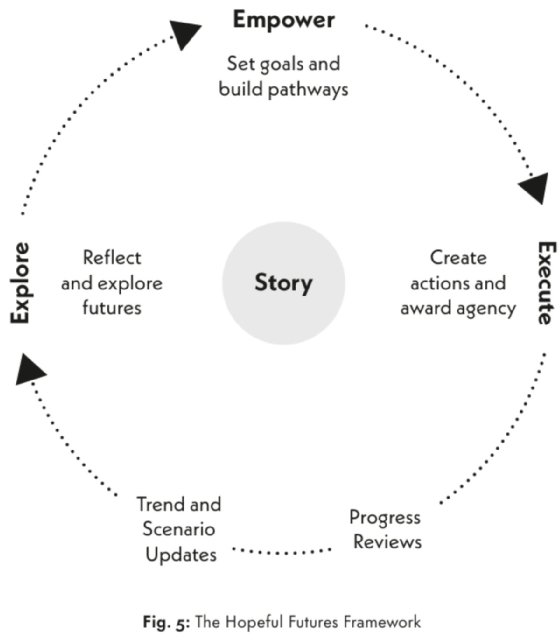
Within each stage, we see two guiding activities:
Explore supercharges strategic framing using futures exploration and foresight methods to determine opportunities, challenges, and risks that lie ahead. Here we reflect and explore futures.
Empower is the first stage that directly contributes to project delivery and provides focus on what is to be achieved. We set goals (to give us focus) and build pathways forward towards achieving those goals.
Execute directly intersects with existing organizational processes and helps us focus on the plans we set in place. This is where we award agency to the team (time, investment, capability, belief) to undertake the work through actions we create.
These stages are cyclical and create energy for change over time. Each, in and of itself, is incredibly valuable for the organization, but they gain more potential and have more impact when undertaken as part of a wider organizational capability to imagine new futures and drive actions and change towards them constantly.
Let's go into more detail on each of these.
Explore
The first thing we need to do is reflect on our current reality and the pivotal hopeful moments that brought us here.
Exploration allows us to clearly define and focus on the problems and dilemmas we are facing. It is the passionate drive to solve the problems of our modern world -- whether ecological, technological, governmental, societal, or geopolitical -- that feeds the energy of hope. Now, problems can be deep and wide hyperobjects, like climate change, or something specific, like the aesthetics of modern life that should be changed to support a better quality of living, or a resolution of a problem area of business, such as accounting practices needing to be updated or a new payment solution implementation to streamline a B2B or consumer journey.
 Click the cover image to
learn more about this book.
Grasping the entire organizational ecosystem is vitally important -- and so is having hope for positive change towards evolved futures. Hope as the energy for change is holistic and applicable to everything. It's an energy that binds us together and creates a commonality of understanding that we are headed in the right direction. Here, we look towards possible futures -- their signals, trends, scenarios, and stories -- with directed curiosity and a vision of positive possible futures. This is our baseline and where we ignite our imagination, build anticipation, and deepen empathy for what we intend to deliver.
At this stage, the ability to reflect and explore is vitally important in creating hope for a better world and creating change today.
Change is inevitable: Either we change, or change happens to us. This fact drives our reflection -- along with the realization that we are not bound to past decisions and outcomes. This process is a disruption of ourselves and/or the world around us: We are reconsidering how we should be doing things to meet the world with ever-changing demands.
Our past is filled with reference points to change that has happened and disruption that has upended industries -- e-commerce and retail, ridesharing and taxis, streaming platforms and movie rental, cryptocurrencies and banking... The list goes on.
When we look back, we find patterns of human perseverance, mistakes, challenges, opportunities, and risks played out. These moments illustrate how organizations, governments, markets, communities, and humans might react to change.
First, we reflect to set the baseline of where we are today and explore past problems, events that occurred, and lessons we learned -- historical and empirical research. Here we search for stories of invention, transformation, and hope to survive, thrive, and ascend. We celebrate the inventors and the effects of their inventions, and the chains of events and innovations that followed, and we deep dive into the area that you and your organization are focused on to create the relevant historical reference (the journey) and baseline (where we find ourselves today).
There's a word of warning for when reflecting on what came before. We must avoid slipping into nostalgia. We may find personal associations within our family units or communities with the "good old days" or when things seemed to be a lot more prosperous than what we see today, but nostalgia is the thief of imagination and progress. We must learn to reflect and let go.
When starting this work, we need to reflect and ready our mindset to accept possibilities and new, hopeful futures. To do this, we must follow four steps.
- Question your own history and perspectives. We come with biases -- apparent or not -- and the idea that "we've always done it this way" is the beginning of slow decline in any organization. We must remain fresh in our thinking, practical in our execution, and aware of mundanity in what we deliver, to make positive progress.
A few years ago, I was speaking on a panel about driving innovation in organizations in Toronto, Canada. I've long believed that our insights and perspectives must be informed by all parts of society and that we often forget the importance of youthful exuberance and the wisdom of our elders. I asked the crowd if anyone brought teenagers into strategic ideation and planning sessions. Out of 350 attendees, just one woman raised her hand. I then asked if anyone brought in elders (folks in retirement, typically over sixty-five years old) for the same conversations. The same woman raised her hand and no one else did. I asked her who she worked with. "First Nations communities," she responded. This led to a wider consideration of and discussion on Indigenous thinking being vital in the business world.
- Shift your mindset from "what is" to "what if...."As we progress through projects we must regularly reflect on new ideas, hypotheses, and innovations that have a bearing on what we are doing. There are so many ways this mindset is applied in the work we do as Hope Engineers, with provocation to go further with our thinking.
- What if we look beyond our industrial complex, reliant on fossil fuels, to create empowerment and resiliency for communities?
- What if we consider empathetic female leadership of global superpowers to circumvent the male-driven war complex?
- What if we more equally distribute global wealth to create an equilibrium where humanity can be supported and thrive?
- Identify strengths and skills. Understand your team's capabilities and the experts within. Understand how they can interplay and contribute to the planning and delivery. Be honest about the gaps you have and the development you need to undertake to address them. In organizations, place the engineer with the artist, the project manager with the developer, the planner with the DevOps team. Organizations that build these bridges actively find a more cohesive and hopeful perspective. In projects, put them all in a room together to discuss the work at hand. New interactions lead to more skill and strength within the team.
- Seek feedback and input. Be open to engaging with others to get different perspectives and ensure your vision is well aligned. This means sharing the work you are doing and being open to input.
I worked with the UK Home Office as a hired consultant to try and solve the problem of alignment of purpose and information ownership (and management) for the Prison and Probation Service. It was described to me as an insurmountable task. They had tried to analyze their services and define new solutions for each in isolation of each other. We found different management and funding structures that were pushing against each other. So, we put key stakeholders and decision-makers in a room together for the first time. We found common ground and from there we found partners and agreement on how to best make decisions and determine pathways forward with a hope for positive change towards better services and reduced cost to serve.
There are several questions we need to ask at this stage:
- What decisions and pivotal moments have shaped our organization -- from our beginning through time?
- What have been our greatest breakthroughs, successes, and moments of pride? How have our experiences made us more hopeful?
- What challenges have we faced over time, how have we responded, and how has hope provided an energy for change?
- What have we learned about our organization's capacity to embrace change, adapt, evolve, and collaborate? How has that fed the hope we need to channel as the energy for change?
Tim Murphy is a reporter covering IT strategy for Informa TechTarget, with a focus on IT leadership, governance, workforce skills and AI strategy. His enterprise technology coverage has earned multiple Azbee Awards.
Dig Deeper on CIO Strategy
-
![]()
Why hope is a CIO leadership skill
By: Tim Murphy
-
![]()
Datacentre planning must be part of broad digital and industrial system
-
![]()
Navigating energy management strategies in AI data centers
By: Mary Shacklett
-
![]()
IT Sustainability Think Tank: Perspectives on the print industry's net-zero push in 2025
By: Louella Fernandes