Why shell out a fortune on high-end PCs for users who just need to access a single app for something as simple as data entry? Instead, organizations can turn to thin clients, which are generally less expensive than full-fledged PCs and can get the job done when implemented correctly.
To execute a successful VDI deployment, end users have to buy in. That's why picking the right VDI clients for users is one of the most important aspects of VDI. But user experience isn't the only thing to consider. VDI shops must keep in mind cost, performance capabilities and compatibility, among other considerations.
Take some time to explore five of the top VDI thin clients and device series on the market, including thin clients from Dell, HP Inc., Raspberry Pi devices, Google's Chromebooks, NComputing's N-series and more.

The Raspberry Pi is a single-board computer with a circuit board, HDMI port, Ethernet connection, four USB ports and a few other specialized connectors. It is ideal for workers who use a single app for simple tasks such as data entry or for kiosk desktops.
To make Raspberry Pi computers into full thin clients, IT must add on a case, memory card, display and other peripherals. Because Raspberry Pi computers are cheap -- the Raspberry Pi 3 is only $40 -- adding all of these components still only costs around $200. Once everything is in place, admins can get a desktop running on a Raspberry Pi device in a few minutes.
Citrix announced its Citrix HDX Ready Pi thin client at Synergy 2016. The Pi 3-based Citrix thin client delivers XenApp and XenDesktop virtual apps and desktops to users with Citrix's HDX system-on-chip technology. Users can access corporate resources with the Citrix HDX Ready Pi because the device automatically connects to the Citrix StoreFront server, the company's app store, as soon as the device joins an organization's network.
Citrix teamed up with ViewSonic and Micro Center to build the thin clients. The package, which costs $75 to $90 depending on the volume of the device, comes with flash storage, a case, power source and a TLXOS management license, the only OS with a Raspberry Pi management console. In fact, Citrix worked directly with ThinLinX, the company behind TLXOS, to ensure that its Receiver client software performs at its peak on Ready Pi thin clients.

Google's Chromebooks are a solid VDI client option because they are cheap, easy to manage and secure. Chromebooks usually cost between $150 and $400. Because no data lives on Chromebooks themselves, IT doesn't have to worry about data breaches if a device is lost or stolen.
To set up a Chromebook, IT can either use a vendor's Chrome OS client app or an HTML5 browser client. Chromebooks require almost no provisioning, which lowers management costs. In addition, the devices boast patching and updating automation. The Chromebook also runs security audits and takes software inventories on its own. Chromebooks perform verified boots every time users power them up. The verified boot searches the device for anything out of the ordinary and resets itself if it detects any tampering.
The Chromebook is ideal for users who are not usually on the move but need a portable device for a specific task. It is also a good fit for users who work intensively with Google Apps for Work such as Gmail. Google's Chromebooks are one of the only options for thin clients on the market that can use 3G/4G wireless connections.
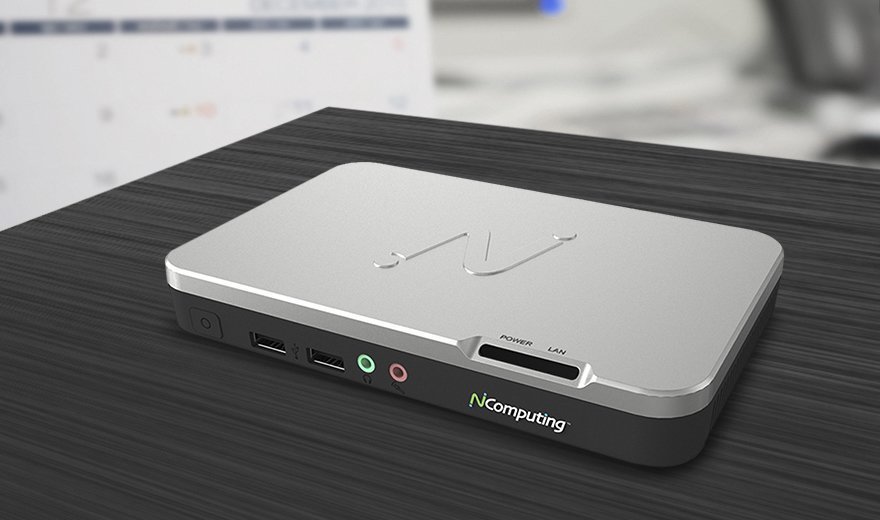
NComputing's N-series of thin clients, which debuted in 2012, are another viable thin client option for Citrix desktop virtualization shops. The system-on-chip thin clients integrate with NComputing's vSpace Management Center console. A network-based app and desktop delivery platform, vSpace comes with client software and network connection management.
The first of three system-on-chip (SoC) thin clients, the N400 HDX SoC device, is less than $200 but limited in terms of its graphics acceleration technology. It does not allow client-side rendering or feature any wireless capabilities.
It's brother, the N500 HDX SoC thin client usually costs about $20 to $40 more. It supports dual monitors and client-side video decoding for H.264 video compression and enhanced graphics acceleration.
The last option is the N600, which adds 1080p HD video playback, Windows Media redirection, Power-on Management and Wake on LAN support. It is a good fit for users who need to work with multimedia.
Because the N-series supports XenDesktop, these SoC thin clients are a good fit for Citrix shops looking to save money.

Dell's Wyse 5020 and 7020 are the first Dell thin clients built specifically for Windows 10 Internet of Things Enterprise, a full version of Windows 10 designed to allow admins to lock down devices such as ATMs and thin clients.
With Windows 10 Internet of Things (IoT) Enterprise, the Wyse 5020 and 7020 support Universal Windows apps and come with the Trusted Platform Module, which uses a special chip on the thin client to deliver a cryptoprocessor. The OS encrypts any data on the device with BitLocker drive encryption and prevents unsigned programs from accessing files or software on the devices. The OS also comes with Windows Defender, Microsoft's antimalware software.
The Wyse thin clients include quad-core advanced micro devices (AMD) G-series processors. They hold up to 32 GB of Flash storage and 4 GB of RAM double data rate 3. In addition, the Wyse 5020 and 7020 include AMD Radeon HD graphics cards, built-in Kensington Security Slots, four USB 2.0 ports and 10/100/1000 Gb Ethernet.
Admins can manage up to tens of thousands of Wyse thin clients with Wyse Device Manager. They can also use System Center Configuration Manager to manage the thin clients remotely or deploy OS images to users.

HP Inc. offers two types of thin clients -- desktop cloud clients and mobile cloud clients. The desktop cloud clients include the t420, t520, t620 and t720, as well as the new t630 client with Blast Extreme support announced at VMworld 2016. The t420 is the cheapest of the bunch at $329. It runs on an AMD Embedded G-Series GX209JA SoC processor. The t420 runs its graphics through the processor, comes with software, including HP Device Manager and ThinUpdate, an image recovery tool, and only runs the Firefox browser. The t520 adds support for independent software vendors and Citrix HDX Ready Premium. With the t620, users can work with up to four monitors, two of which can be HD displays. Finally, the t720, which is the most expensive at $779, allows for quad UHD/4K displays -- the first thin client to do so.
The mobile clients, which are thin client laptops, include the mt245 and mt42. The $699 mt245 runs Windows Embedded Standard 7P tools and has the Write Filter tool to fight against unauthorized updates and viruses. It is designed with VDI in mind and works well with peripheral devices, including printers. The mt42, the most expensive HP Inc. thin client, costs $1,149. It can run Windows 10 IoT Enterprise, works with VMware, Citrix and Microsoft virtualization products, and boasts multimedia redirection.

IGEL Technology and Lenovo are two other leaders in the VDI thin client market. IGEL's UD line includes the UD5, UD6, UD9 and UD10. All these thin clients can run the IGEL Linux OS or Microsoft Windows Embedded Standard 7. With its local protocol clients and tools, IGEL Linux helps the devices find the best possible protocol through which to access apps. Each device also comes with the IGEL Universal Management Suite, where admins can support and manage multiple OSes, databases and directory services. It also includes local protocols, software clients and security capabilities.
Lenovo thin clients include the company's ThinkCentre line of products. The M600 and M700 Tiny thin clients come with Thin Client Manager and integrate with a Lenovo monitor users can lock their thin clients into to access virtual desktops. It includes a 1920 x 1080 display and front and back tilting. The M600 runs on an Intel Celeron processor and the M700 can run on Intel Core, Pentium and Celeron processors. The M700 is also designed to survive harsh conditions such as extreme temperatures.