


Decision models are becoming a standard layer in the enterprise AI stack, between rule engines and generative models. They complement existing AI by adding judgment where it was previously too costly to do so, freeing larger models and human experts for higher-value decisions.
TypeSafe's Jev popularized the category in September 2026. OpenAI, Google, Microsoft, Databricks, Snowflake, Cloudflare, AWS and several startups and open source projects now offer their own versions. Given the emerging market, businesses are considering the role decision models could play in their enterprise AI stack -- including which use cases decision models can solve, their benefits and challenges and how to evaluate tooling options.
2026 introduces the decision model
Decision models answer narrow business questions by selecting from predefined options and assigning a probability to each. They do not generate text or other content. They are fast, often responding in under a second, and inexpensive, costing fractions of a cent per decision. These benefits make it practical to add a judgment gate to a business process instead of relying on a crude rule or human review.
Much of the AI used in business processes involves making small judgments rather than generating content. For example: Is this ticket about billing or a product defect? Does this invoice match the purchase order? Should this agent send that email? Which model should handle this prompt?
Until now, the default approach has been to send each query to a large language model (LLM), request a one-word or short answer and parse the response. This is slow, costly at scale and sheds little light on the model's confidence in the answer.
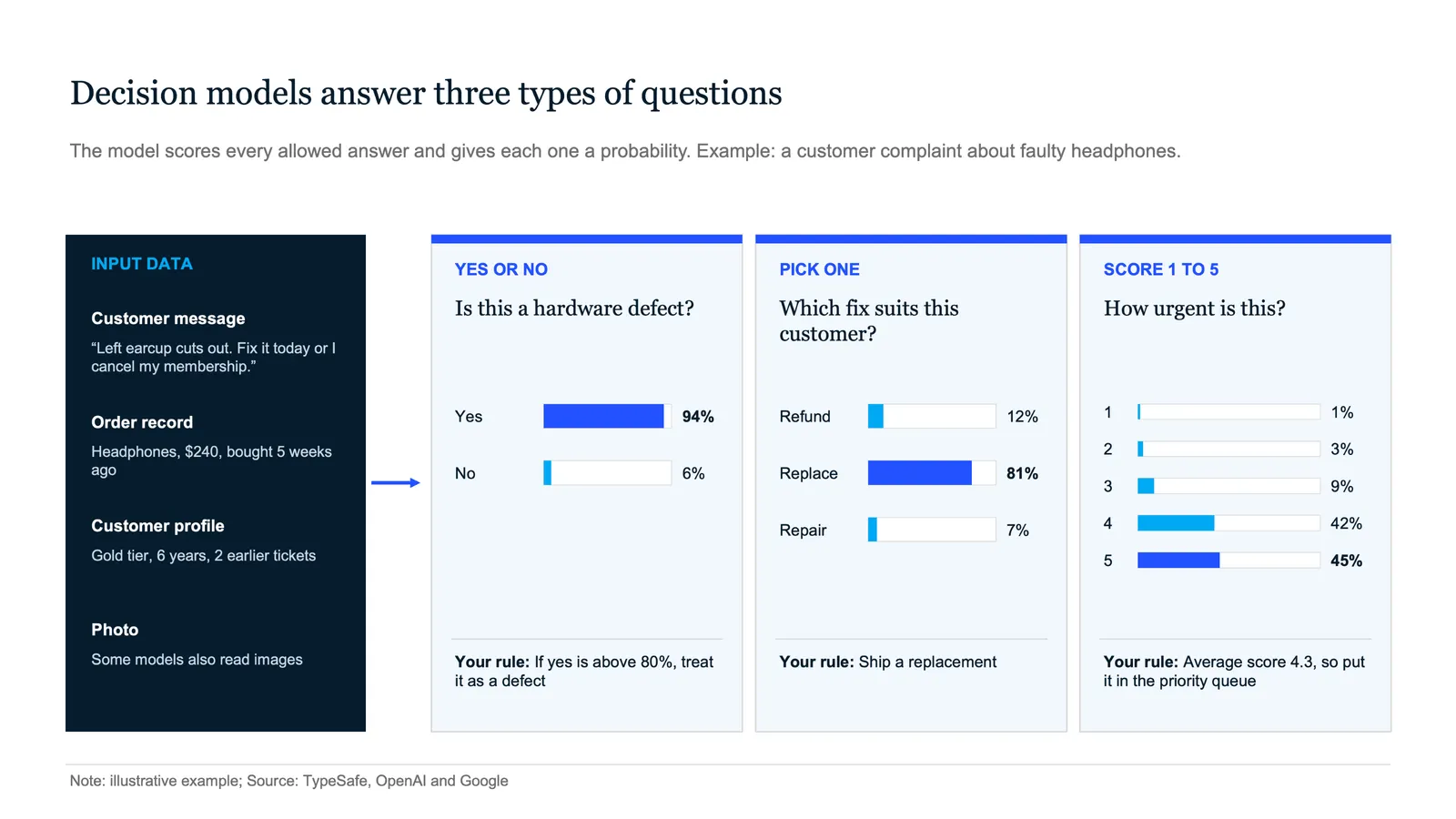
A decision model is designed for this narrow task. The user first provides input data -- such as an email, customer record, document, or, in some cases, an image, call recording or combination of these -- and, second, one or more questions with predefined answer options. The model returns an answer to each question and a probability for every allowed option.
Questions can take three forms: yes-or-no, pick one or score on a scale.
A note on terminology: TypeSafe AI calls its tool a system one model, after economist Daniel Kahneman's term for fast, intuitive thinking. Some vendors use the term decision model, while others prefer small judgment model (SJM), emphasizing its compact size and function.
How decision models work in practice
Think of a decision model as a smart if-statement. It processes inputs and answers questions. Everything else -- calculations, business rules, permissions and so on -- remains in conventional software code that teams can read, test and modify.
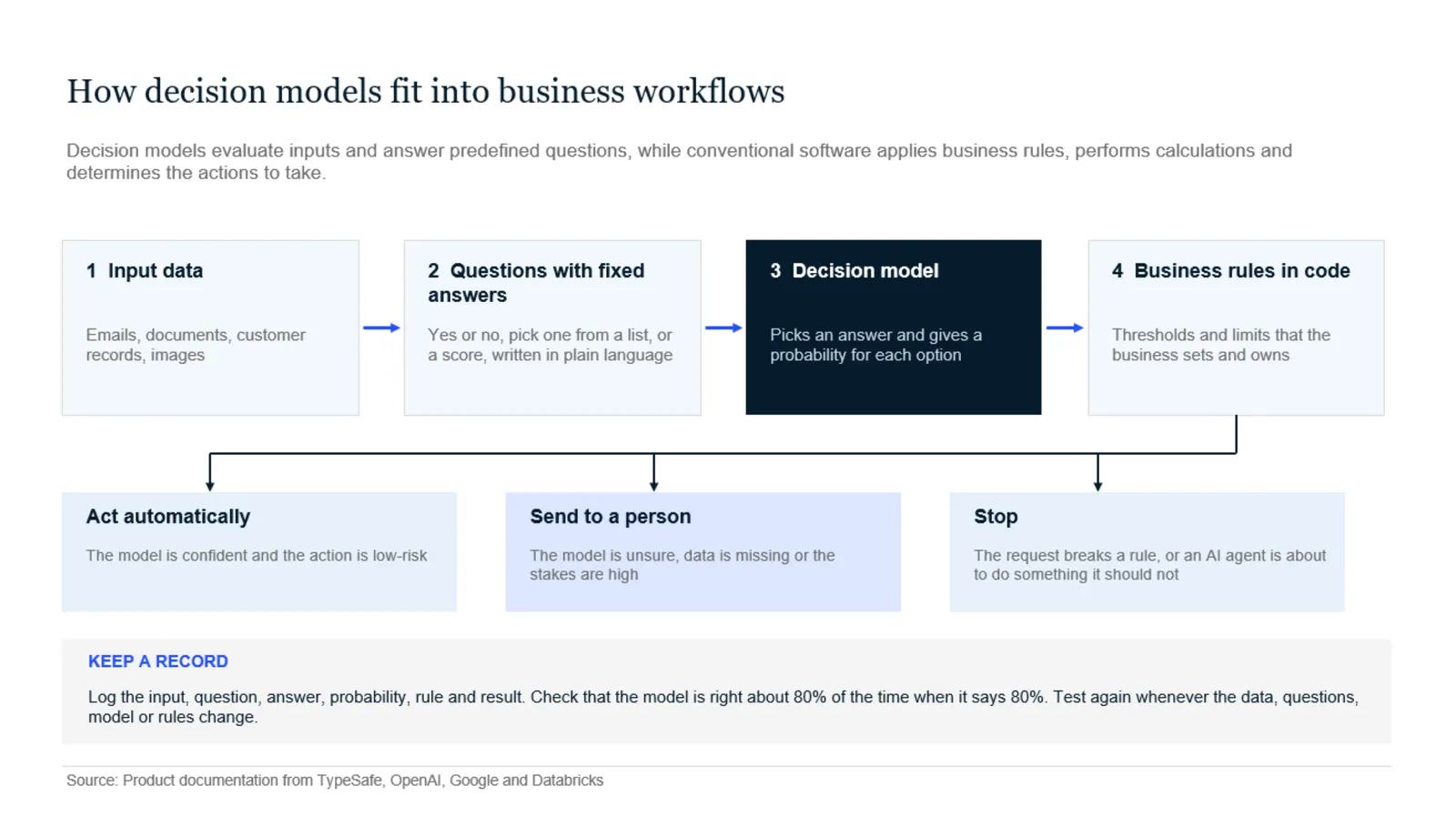
Consider a supplier email about a delayed shipment. You could ask the model whether it specifies a firm new delivery date, whether the delay threatens a customer commitment and which escalation category applies. Enterprise software then precisely compares dates and stock levels. Procurement rules determine whether to expedite, find another supplier or seek clarification.
In this approach, answers remain within defined options. Probabilities help determine when software can act independently and when to involve a person.
But isn't this just an machine learning (ML) classifier? In one sense, yes. Spam filters, credit scores and fraud models have classified inputs for decades; the underlying idea is not new.
The difference lies in cost and ease of use. For example, TypeSafe's Jev is a hosted service priced at about 4 cents per million input tokens, with no charge for output tokens. Its request format has become a de facto standard, often allowing users to switch providers to be switched by changing an endpoint rather than rewriting an application.
Traditional classifiers often require thousands of labeled examples, a data science team, a separate model for each question and ongoing maintenance. Most companies build only a handful for their largest problems, leaving other decisions to predefined rules or people. Decision models avoid much of this engineering and the associated ML pipelines. Users describe questions and answers in plain language and inputs can include data or documents in various formats. A single model serves multiple scenarios, from ticket routing to contract review.
A trained classifier might be cheaper, faster and more accurate when a question is stable and ample labeled historical data exists. Decision models are especially useful when questions change frequently, when several questions must be answered or when labeled data is unavailable.
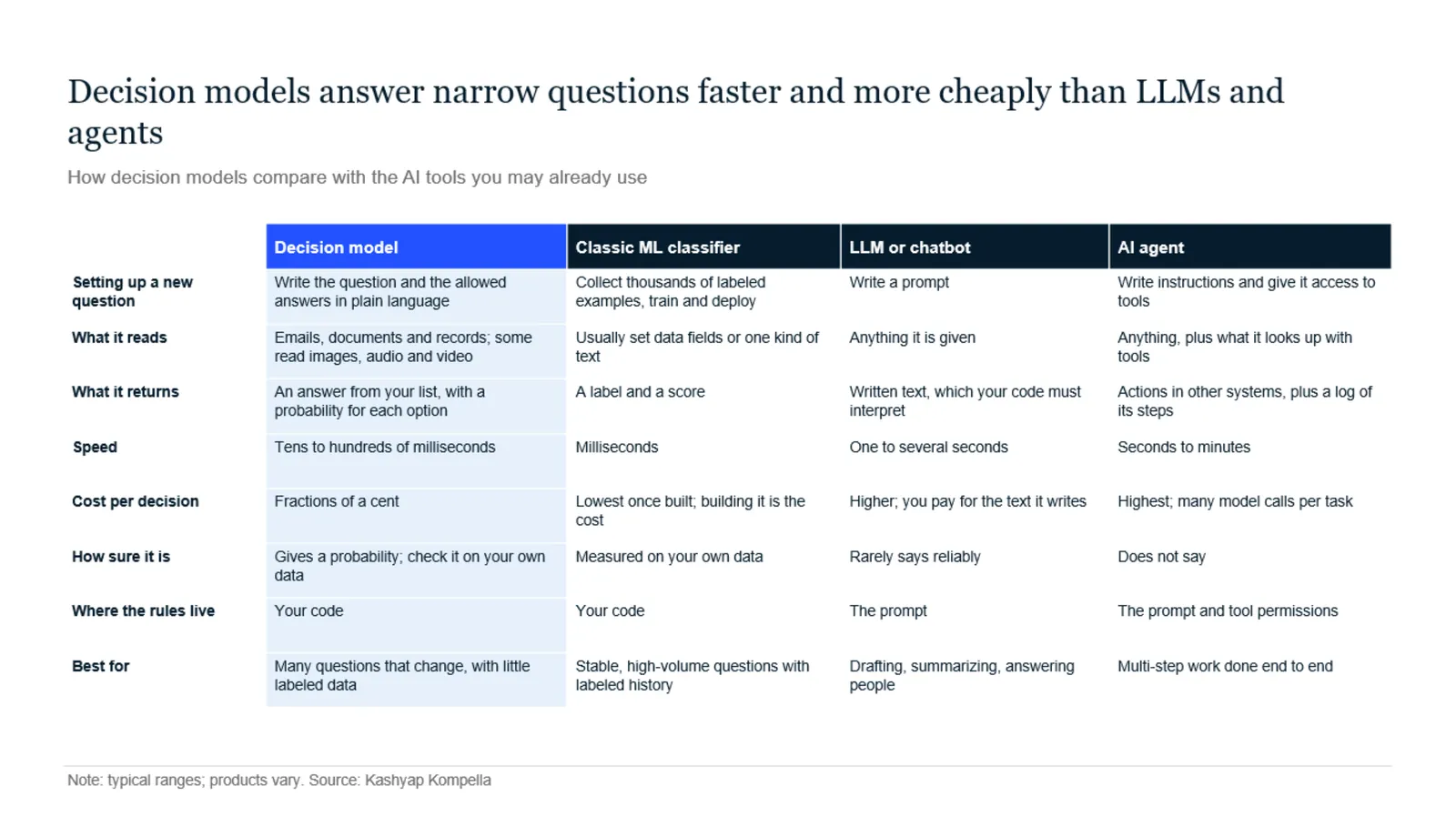
A decision model also differs from asking an LLM for structured output. While an LLM can produce structured output, this only constrains the format of its response; a decision model directly scores every allowed answer and returns a probability for each. Some vendors place a general model behind a decision interface, blurring this distinction. In practice, assess speed, cost and calibration for your task.
Decision models do not replace agents or chatbots. Either of those can call a decision model internally, for example, to select a tool or check a permission. These different models are complementary layers of an application, not competing components.
Decision models can serve as guardrails, but their scope is broader. Purpose-built guardrails, model routers and data-extraction models perform fixed tasks while a decision model answers a range of narrow questions.
A structured answer is not necessarily correct. A model might confidently choose the wrong option. Structure makes errors easier to detect and measure -- it does not eliminate them.
The emerging decision model landscape
The market for decision and judgment models is expanding quickly. After TypeSafe released Jev in September, OpenAI, Databricks, Cloudflare, AWS and numerous startups quickly followed with their own models. Microsoft and Snowflake announced offerings in October; Google launched its Gemini Decisions API in November.
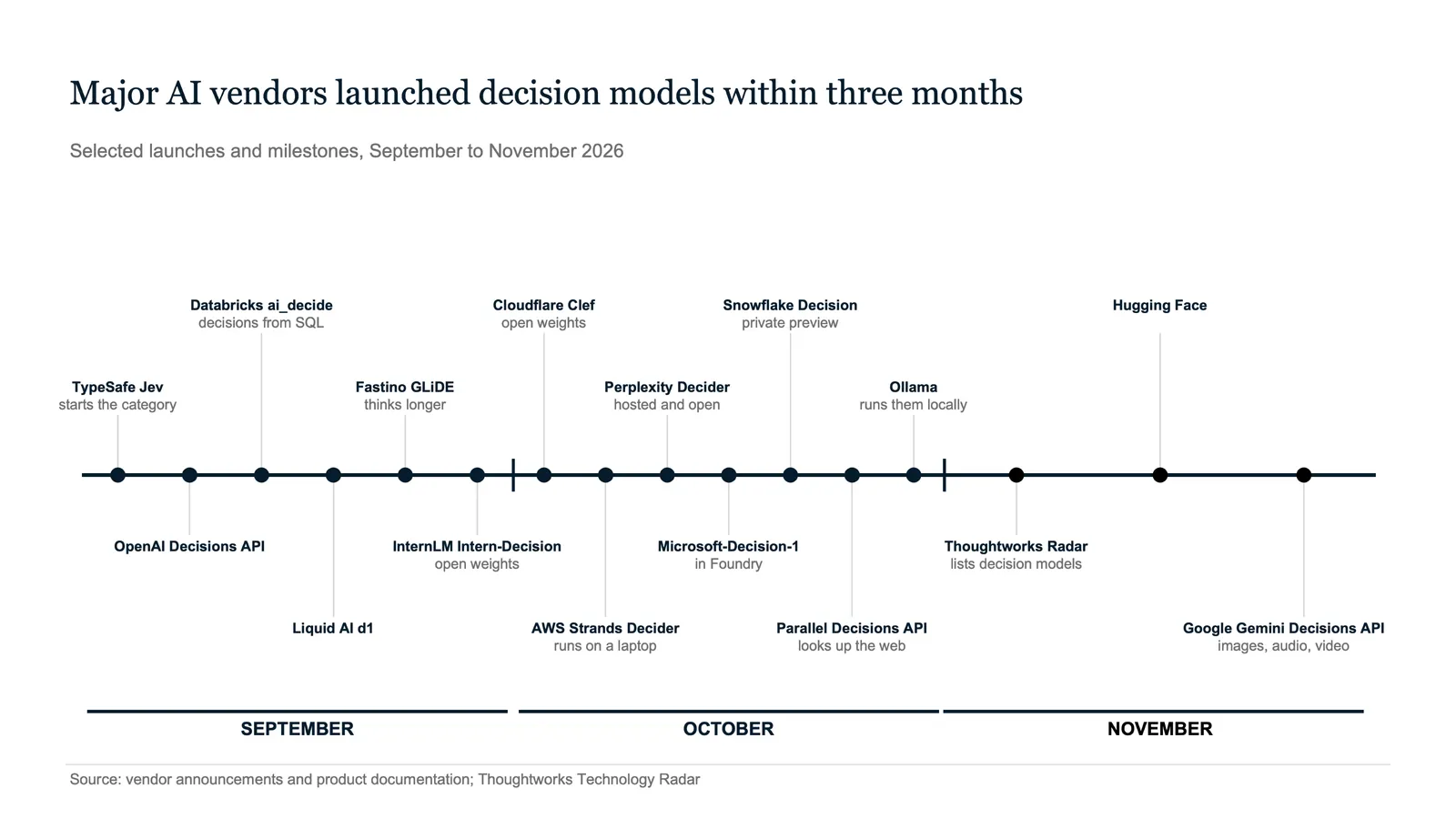
These products share a broadly similar interface but differ in two key dimensions: the capabilities they offer and how they are accessed and deployed.
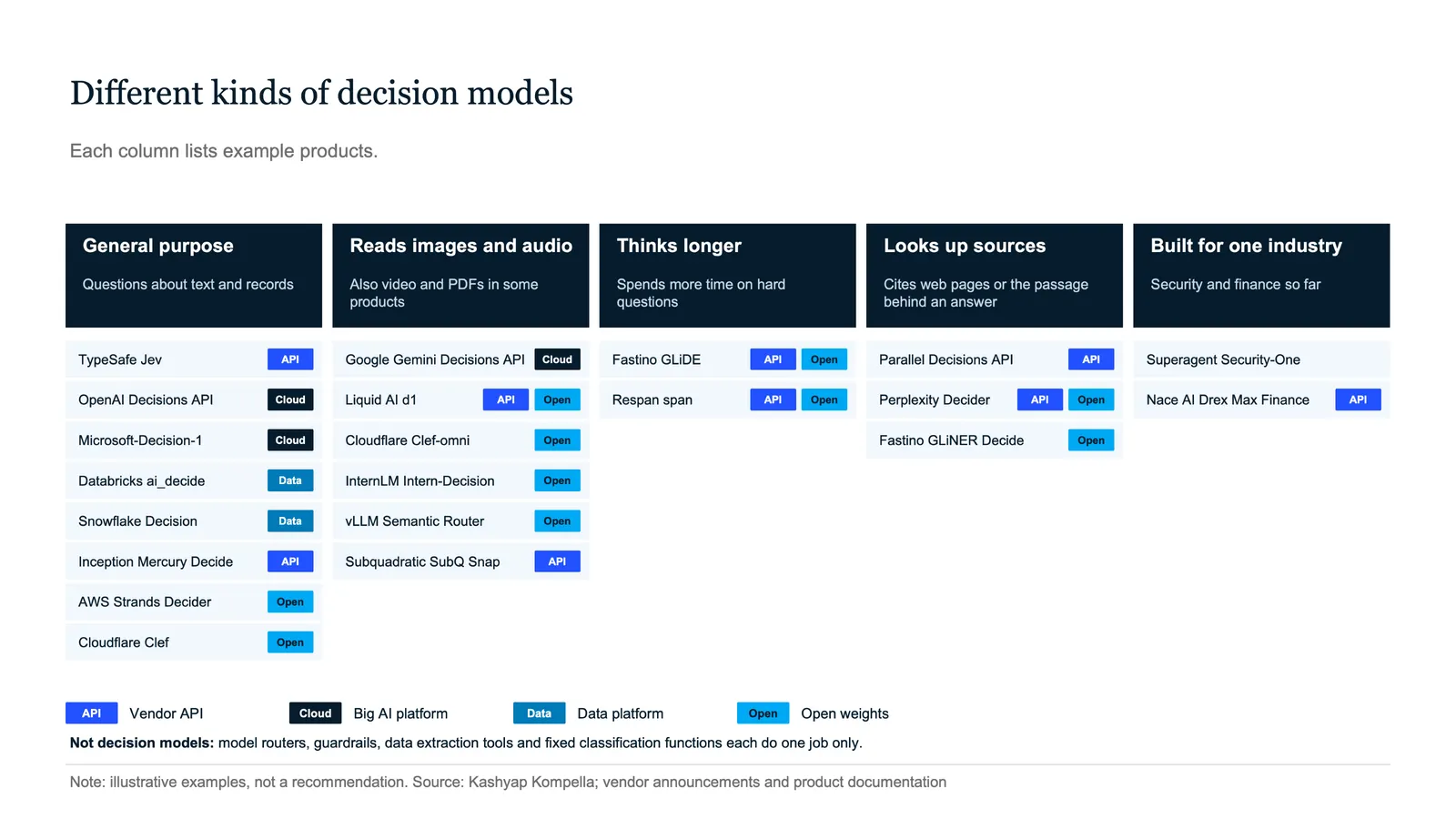
Categorization based on capability
- General-purpose models for text and records. TypeSafe Jev, OpenAI Decisions API and Microsoft-Decision-1.
- Models that read images, audio and video as well as text. Google Gemini Decisions API, Cloudflare Clef-omni and Liquid AI d1.
- Models that reason longer on difficult questions. Fastino GLiDE and Respan span.
- Models that consult sources and cite web pages or supporting passages. Parallel Decisions API and Perplexity Decider.
- Industry-specific models. Superagent Security-One and Nace AI Drex Max Finance.
Categorization based on delivery model
- Major AI platforms. OpenAI, Google and Microsoft.
- Data platforms. Databricks ai_decide and Snowflake Decision, accessible through SQL where enterprise data already resides.
- Open-weight, self-hosted models. Cloudflare Clef, AWS Strands Decider and others run through Ollama, vLLM or Hugging Face.
- Specialist vendor APIs. Offerings from smaller, AI-focused companies that specialize in speed, cost, advanced reasoning or industry-specific decisions. Examples include TypeSafe Jev, Fastino GLiDE, Parallel Decisions API and Superagent Security-One. These products are evolving rapidly and might be available on early-access terms, with varying levels of enterprise support and maturity.
Adjacent tools -- among them model routers, guardrails, data-extraction models and fixed classification functions -- perform a specific task. They are not a decision model.
Decision model use cases in the enterprise
Potential applications for decision models span many functions and industries:
- Customer service. Route tickets on arrival; flag angry or at-risk customers; and check draft replies against policy before sending.
- Finance and accounts payable. Match invoices to purchase orders; flag unusual payments; and identify suspected supplier fraud.
- Banking and payments. Hold payments when a customer appears to be coached by a scammer and triage fraud alerts.
- Insurance. Fast-track straightforward claims and refer suspicious claims to investigators.
- Security operations. Score alerts and decide whether to close, investigate further or escalate.
- IT and AI platforms. Route prompts to the least expensive model that can handle them.
- AI agents. Check each action before execution: Does it match the user's request? Did the instruction come from a document? Can the action be reversed?
- Procurement and supply chain. Scan supplier emails for signs of systemic delays and verify new carriers.
- Legal and compliance. Separate standard contracts from those requiring human review and flag marketing copy that violates style or regulatory rules.
- HR and recruiting. Route employee questions and check job advertisements for problematic language.
- Sales and marketing. Score inbound leads and classify customer feedback by theme.
- Healthcare administration. Identify claim denials worth appealing.
- Utilities and field service. Triage outage reports and maintenance requests by urgency.
Companies are increasingly using a decision model as an agent checkpoint. A check costing a fraction of a cent can precede each agent action, reinforcing permissions, spending limits and approval rules.
To identify business-process steps that could benefit from decision models, look for decisions that are frequent, narrow, data-heavy, governed and time-sensitive.
Instances where another approach might be a better fit
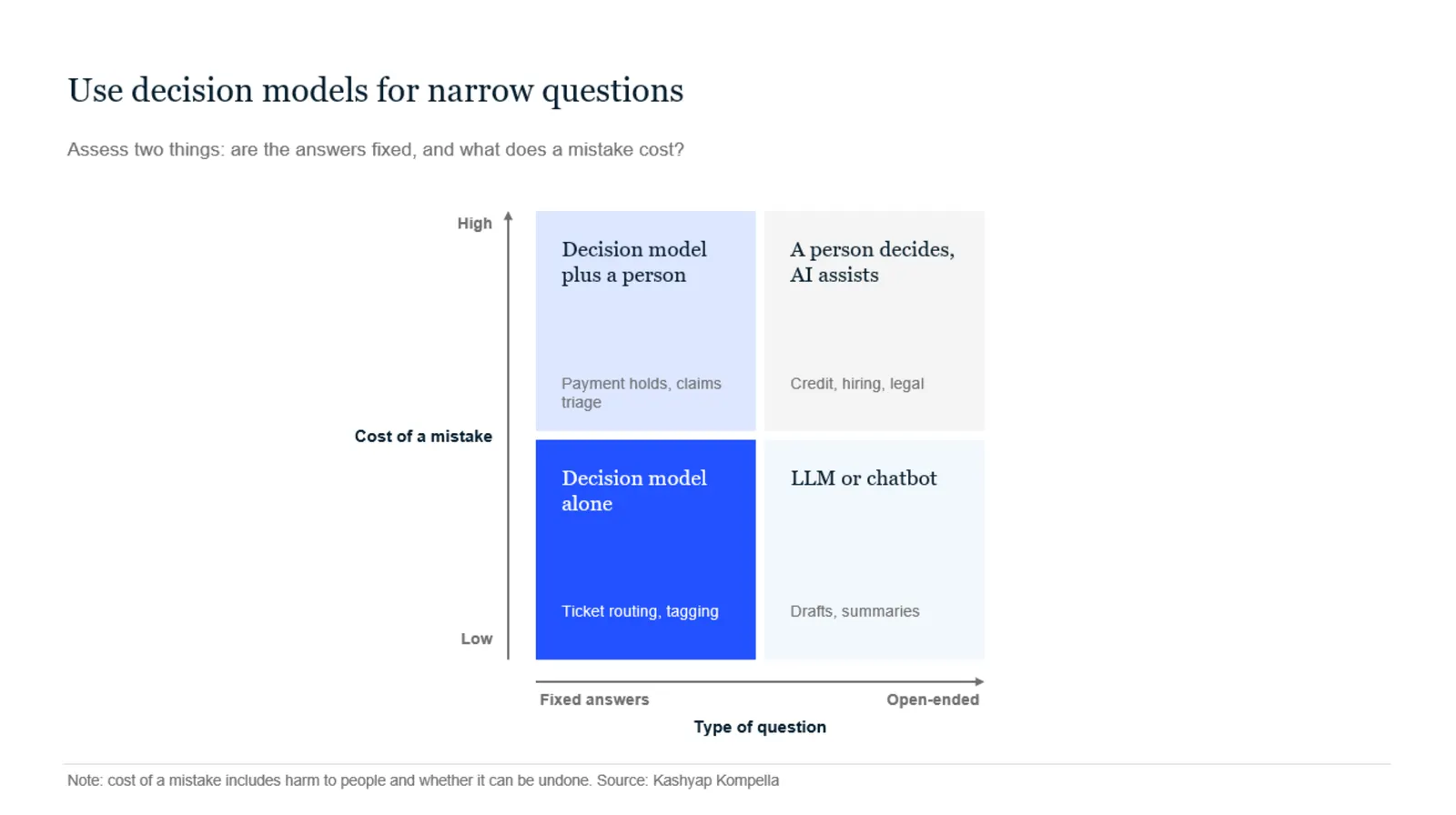
A generative model or agent is a better fit when the output is content for a person, the task requires multiple reasoning steps, the situation is unfamiliar or an explanation is needed. Large reasoning models might be better for complex problems while conventional rules engines suit exact, stable logic.
In practice, the right tool might combine several approaches. Image 6 provides a simple decision framework.
Decision model challenges and risks
Integration, scalability and support are common concerns across enterprise AI projects. Decision model deployments generate more specific risks, including the following:
- Accuracy and calibration vary by task. Calibration means the model's stated confidence aligns with observed accuracy: among predictions assigned 80% confidence, roughly 80% should be correct. Performance might differ across domains -- for example, finance and legal tasks. Test against your own labeled cases before setting thresholds.
- Low-cost errors accumulate. Even a well-calibrated model assigning 90% confidence will be wrong about one time in 10 on those predictions. At 1 million decisions per day, a 1% error rate means 10,000 mistakes.
- The model sees only the inputs provided. Missing records can lead to confident but incorrect answers. Handle dependencies between questions and calculations involving numbers or dates in code.
- High-stakes decisions require human oversight. Decision models should not be the sole decision-maker for credit, employment, housing, insurance, education, healthcare or legal rights. The EU AI Act requires human oversight, including the ability to override certain high-risk AI systems. Design appeals and overrides from the outset.
Are you ready for a decision model? Practical next steps
- Identify decisions suitable for decision models. List frequent, narrowly defined decisions in one or two business processes, identify who owns them and estimate the cost of an incorrect decision.
- Start with existing data platforms and contracts. Evaluate decision model offerings from your current data and AI providers first, using existing integrations and contractual relationships. Consider open-weight models for regulated or sensitive data.
- Avoid vendor lock-in. Integrate decision models through a common interface rather than embedding vendor-specific code into business processes. This makes it easier to switch providers as better, faster or cheaper models become available, without having to redesign your applications.
- Evaluate calibration before buying. Request vendor calibration results against human-labeled tasks similar to yours, along with their model-versioning policy. Test the model alongside your current process before allowing it to act.
- Validate and monitor thresholds. Treat thresholds as policy: version them, test them against historical cases, and check whether predictions with 80% confidence prove correct about 80% of the time.
Kashyap Kompella, founder of RPA2AI Research, is an AI industry analyst and advisor to leading companies across the U.S., Europe and the Asia-Pacific region. Kashyap is the co-author of three books, Practical Artificial Intelligence, Artificial Intelligence for Lawyers and AI Governance and Regulation.