
Getty Images
Adobe releases AI search product catalog optimization tool
Soon, if not already, the customer relationship begins by persuading AI agents that your brand is legit.

Many companies possess authoritative data that large language model-powered search engines love to crawl -- in their product catalogs. But they don't know how to show them to the LLMs.
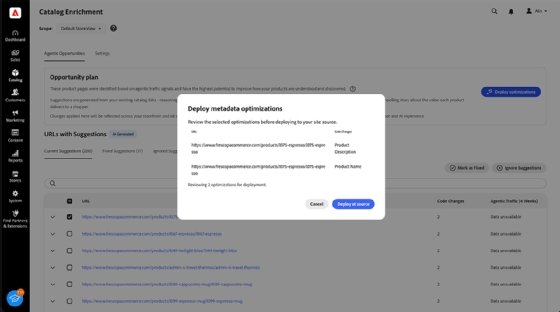
This week, Adobe released Catalog Agent, which analyzes and optimizes catalog data and web product pages. According to Adobe, it "influences the hidden layer crawled by LLM bots" without making visible changes to the human view. It is available to subscribers of Adobe Commerce, Adobe Commerce as a Cloud Service and Adobe Commerce Optimizer.
Catalog Agent works in combination with other recently released Adobe AI search optimization (AISO) tools, including LLM Optimizer and Brand Visibility. It incorporates technology and data from the Semrush acquisition. Other tech vendors working on similar tools include Shopify and SAP, as well as smaller competitors such as Yotpo and Fabric.
Digital catalogs are very authoritative to LLM search bots, said Liz Miller, analyst at Constellation Research, because they contain so many elements the bots crave.
"They are structured, so it's super easy and lightning fast for an algorithm to go and look at that [content]," Miller said. "It is constantly updated and -- if set up correctly -- it has a real-time, native integration to an ERP backend that lets you know all the details about the product, as well as all the supply chain details about that product: Is it available? Is there a backlog? If I order it today, what happens with the shipping? Commerce platforms are very, very good at pulling all of that information together."
'Zero-click' marketing
Making product catalog descriptions, pricing, images and video discoverable to AI search engines is just the beginning of what's to come for marketers, Miller continued.
By structuring catalog data now and connecting AISO tools to content and digital assets, Adobe and its competitors are laying the data foundation for how marketing technology will work in the not-too-distant future: "zero-click" search where the AI results page is the end, not the means, of information gathering, and AI search advertising becomes more readily available.
"No one's clicking things anymore," Miller said. "So how do you make sure that you're appearing in [the AI search results of] what the customer is asking for? Very quickly down the road, we will get to a point where we want to serve up images. Or, if I have an opportunity, how to sponsor it. All of that information is going to be there -- and is going to be made very available -- so I can personalize it."
The Semrush-Adobe Commerce combination now includes 300 million human-generated search prompts for analysis across its suite of integrated AISO tools.
Not every AISO vendor publishes how many prompts they have, but Ahrefs Brand Radar claims 243 million, and Writesonic and its partner, Dageneo, claim more than 120 million. Since AI search vendors don't share prompt data, some may incorporate synthetic data into their prompt research and analysis, a factor marketers should consider when evaluating and purchasing AISO tools.
Agentic relationship management
Brands have begun to think of the agentic component of the customer relationship, said Loni Stark, vice president of strategy and product at Adobe. A reality is setting in: Companies soon -- if not already -- must establish relationships with AI search and shopping agents as a first step in building customer loyalty.
Agents are a new kind of gatekeeper to the human customer's purchasing decision, and Adobe tools such as Brand Visibility and Catalog Agent were made with this environment in mind. Stark sees customers not only building their marketing operations to appeal to agents but also enhancing their storefront experiences for the humans who are actually spending the dollars.
"We [want] to drive brand preference, whether it's an agent or human," Stark said. "If the human has already told the agent, 'Look, I want a pair of Nike running shoes, not just any running shoes,' now it's finding the best deal on a pair of Nike running shoes."
Stark buys into the idea that the human side of shopping may never be fully replaced by agents -- echoing an idea expressed by experts earlier this year at the National Retail Federation's NRF '26: Retail's Big Show. At least some of the time, people won't want to give up the dopamine hit of buying things themselves.
"It's a form of entertainment, and it's not for everything. Like I don't browse across everything to buy milk, or things like that," Stark said. "But there are certain things I don't want to delegate to an agent -- because I actually enjoy buying it."
Don Fluckinger is a seasoned B2B technology journalist with more than 30 years of experience specializing in enterprise IT, digital experience and content management. As a senior news writer at Informa TechTarget, he delivers award-winning analysis that helps IT and business leaders navigate complex technologies to enhance customer and employee experiences. Got a tip? Email him.
Dig Deeper on Customer Experience
-
![]()
A buyer's guide to personalization software products
By: Griffin LaFleur
-
![]()
Adobe previews answer engine optimization, agentic AI creative tools
By: Don Fluckinger
-
![]()
AWS latest to introduce context layer for agentic AI
By: Eric Avidon
-
![]()
Adobe defines its AI-powered customer experience platform
By: Don Fluckinger