
Getty Images/iStockphoto
Adobe previews answer engine optimization, agentic AI creative tools
Semrush integration with LLM Optimizer is quickly productized; Creative Agent propagates Adobe app functionality and AI chat interfaces such as ChatGPT, Copilot and Claude.

Adobe previewed many marketing and creative tools this week ahead of next week's Cannes Lions International Festival in Cannes, France.
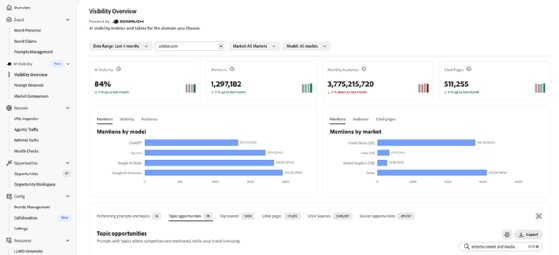
Marketers waiting to see details on how the Semrush acquisition would unfold at Adobe got their answer: Semrush will be integrated with Adobe's LLM Optimizer as a new product called Brand Visibility, coming soon. But it will also remain a standalone product for Semrush users who have built marketing workflows around it.
Brand Visibility sits in the Adobe stack alongside other apps such as Brand Concierge, Experience Manager and Sites Optimizer. It can suggest content to broaden a company's authority in LLM search and offers benchmarking tools to measure how adding or changing content affects AI search results.
While SEO and answer engine optimization are distinctly separate sciences -- or arts, depending on your perspective -- they dovetail and are necessary to the marketer's mix. Brand Visibility monitors and analyzes users' mentions across traditional and AI search to figure out how to make it all work together, said Loni Stark, vice president of strategy and product at Adobe.
"A lot still happens in SEO -- AI is one of the biggest users of search, as you see when you type into chat," Stark said. "Another is the question of what people are really typing into ChatGPT? What are people really asking? You know what you're asking, I know what I'm asking, but how do brands know what the collective is asking, and what are the blind spots?"
Brand Visibility was one of the fastest integrations of an Adobe acquisition ever, Stark said. Several factors made it happen, including the current state of cloud interoperability through APIs. Also, Adobe prioritized productizing Semrush to satisfy immediate user needs for more sophisticated answer engine optimization tools in a rapidly evolving market. Another factor was the use of new AI coding tools that sped up the typical development cycle.
Adobe customers have "held Adobe's feet to the fire" for how long it has taken for past acquisitions to be natively integrated into the company's marketing suite, said Liz Miller, analyst at Constellation Research. But Adobe Experience Platform's modern architecture and Adobe Experience Manager's headless architecture capabilities likely made this integration -- and will make future acquisitions -- faster.
Semrush adds outside data and competitive analysis from 28 billion keywords and 289 million prompts to a brand's own website traffic analysis in LLM Optimizer. Together, the two promise to paint a more complete picture to drive a user's marketing decisions.
"The breadth of Semrush analytics -- capable of delivering a view of how brand content and conversations appear across the entirety of marketing's paid, earned and owned landscape -- [is] now side-by-side with LLM Optimizer," Miller said. "The [user's] path from identifying insights, getting recommendations and then taking action is accelerated and, eventually, automated."
Creative AI, GenStudio tools to come
To act on all that fresh analysis from AI and traditional search, Adobe added AI tools to generate and deploy new content within GenStudio, its content supply chain management suite. Included among the new features is Simulated Audience, a synthetic-data tool for testing campaign ideas, in the vein of other marketing tools such as those from Qualtrics.
A new MCP integration in Adobe Workfront connects to LLMs, allowing marketers to assign tasks, check project status, and manage campaign activities using agent-based workflows. Firefly Graph for Enterprise combines Adobe and third-party AI models to automate content creation.
GenStudio for Performance Marketing adds Connected TV (CTV) as a new channel. Its AI analyzes marketing efforts across paid social media, email, display advertising and CTV. The Ad Recommendations feature provides suggestions on which ads to update, expand or optimize; another related feature, Next Best Creative, enables automatic generation of the next advertising or marketing asset based on those currently getting the best response.
Adobe also showed numerous updates to its tools on the Creative Cloud side in the run-up to Cannes.
Creative Agent, deployed in apps such as Photoshop, Illustrator, Frame.io, InDesign and others, automates complex workflows and can quickly perform tasks such as iterating and creating product reels, brand kits, storyboards and other collateral. The agent can work off standardized elements and within style guidelines to keep creatives and marketers from straying outside of brand rules.
Adobe will make Creative Cloud apps -- using Firefly and other models -- usable from prompts within AI tools such as Anthropic's Claude, Microsoft Copilot and OpenAI's ChatGPT, with Google Gemini to come. That is notable, as Anthropic emerged as a competitor earlier this year with a preview of Claude Design, an app that creates editable visual content from an AI prompt.
Don Fluckinger is a seasoned B2B technology journalist with more than 30 years of experience specializing in enterprise IT, digital experience and content management. As a senior news writer at Informa TechTarget, he delivers award-winning analysis that helps IT and business leaders navigate complex technologies to enhance customer and employee experiences. Got a tip? Email him.
Dig Deeper on Customer Experience
-
![]()
Adobe releases AI search product catalog optimization tool
By: Don Fluckinger
-
![]()
As Claude Design debuts, Adobe users -- and buyers -- shrug
By: Don Fluckinger
-
![]()
HubSpot builds answer engine optimization into its platform
By: Don Fluckinger
-
![]()
Adobe bolsters AI SEO with planned $1.9B Semrush acquisition
By: Don Fluckinger