Part of:HR’s role in compliance and tech that can help
Learn what to include on an HR compliance audit checklist
An HR compliance audit checklist can help HR teams review records, recruiting, pay, benefits, employee relations, workplace safety and handbook policies.
HR compliance requires more than keeping employee records in order. HR teams must also confirm that hiring, pay, benefits, leave, employee relations, workplace safety, employee data and handbook policies follow applicable federal, state, local and industry-specific requirements.
An internal HR compliance audit can help organizations identify missing records, outdated policies, inconsistent practices and system-access issues before they lead to fines, lawsuits or government scrutiny. The audit should also help HR, legal, payroll, benefits, IT and business leaders understand who owns each compliance responsibility.
An HR compliance audit checklist helps HR turn broad regulatory responsibilities into specific records, practices and controls that can be reviewed before a problem arises.
Learn more about what to include on an HR compliance audit checklist.
What is an HR compliance audit?
An HR compliance audit is a process that helps HR leaders confirm that their organization is following applicable employment laws, agency rules, internal policies and recordkeeping requirements.
Failure to comply can lead to financial penalties, lawsuits, employee complaints, reputational damage and operational disruption. Conducting an HR compliance audit is a best practice for companies of many sizes and is especially important for organizations with multiple locations, complex workforces, regulated operations or rapidly changing policies.
An HR team, or an internal audit team working with HR, legal, payroll, benefits and IT, can proactively carry out an HR compliance audit to identify HR compliance problems before they become larger issues.
An HR compliance audit checklist helps HR turn broad regulatory responsibilities into specific records, practices and controls that can be reviewed before a problem arises.
Why would the government conduct an audit?
An audit by a government agency may be routine, part of an enforcement initiative or triggered by a complaint, employee claim or suspected noncompliant practice.
For example, employers must maintain Form I-9 records that verify employment eligibility. Employers must retain each Form I-9 for either three years after the date of hire or one year after employment ends, whichever is later. Although separate storage is not required by law or regulation, USCIS suggests keeping original I-9 forms separate from employee personnel files so they can be produced more easily during an inspection.
Worker classification is another common source of HR compliance risk. Two common issues are classifying a nonexempt employee as exempt from overtime requirements and treating a worker as an independent contractor when the law would treat the person as an employee. HR should work with legal counsel and review applicable federal, state and local guidance when evaluating classification decisions.
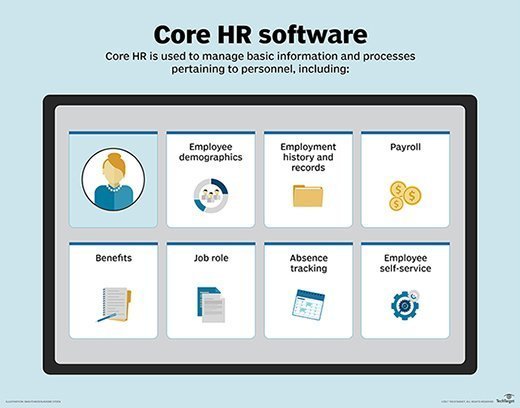
Core HR software stores many of the employee records, payroll, benefits and absence data that HR teams may need to review during a compliance audit.
HR compliance audit preparation checklist
Before starting an HR compliance audit, HR leaders should confirm who owns the audit, which laws and locations are in scope, which records must be reviewed, where employee data is stored, who has access to HR systems, which policies were updated recently and whether legal, IT, payroll or benefits teams need to participate.
6 items to include on an HR compliance audit checklist
HR leaders can help ensure their company is maintaining required records and following applicable practices by creating a checklist for the internal audit team. The checklist should reflect the organization's size, locations, industry, workforce model and HR software system.
Here are six items and practices to include.
1. Document retention
Document retention is one of the most important parts of an HR compliance audit checklist. HR should confirm that required employment records are complete, accurate, retained for the correct period and stored where authorized employees can retrieve them.
For I-9 forms, HR should confirm that forms are complete, accessible and retained for the required period. HR should also decide whether to store I-9 forms separately from personnel files, since USCIS suggests separate storage even though it is not required by law or regulation.
The audit should also review how the organization stores personnel files, payroll records, benefits records, leave documentation, investigation files, training records and HR data compliance documentation. Employees who access records should receive training on retention rules, privacy obligations and secure handling of employees' personal information. .
2. Recruitment
The internal audit team should review open and recent job postings to confirm that listings are free of discriminatory language and follow applicable equal employment opportunity, pay transparency, accessibility and accommodation requirements.
The audit should also review recruiting workflows, interview guides, applicant communications and hiring records. Interviewers should receive training on acceptable and unacceptable job interview questions, documentation expectations and consistent candidate evaluation practices.
If the organization uses recruiting software or AI-enabled hiring tools, HR should also review whether the tools, notices, data use and human oversight practices meet applicable legal and company requirements.
3. Compensation and benefits
Internal audit team members should confirm that compensation, payroll, leave and benefits practices comply with applicable federal, state and local requirements for each location where the company does business. These requirements may include wage and hour rules, pay transparency laws, payroll tax obligations, the Family and Medical Leave Act, COBRA, benefits notice requirements and employee benefits required by law.
The internal audit team should also review employee classifications, overtime eligibility, contractor status, payroll records and pay practices to confirm that the organization is applying policies consistently and paying required taxes.
The company should provide benefits uniformly across each employee category and apply the company's compensation structure consistently to reduce the risk of discrimination, pay equity, tax or benefits-administration problems.
4. Employee relations
As part of the compliance audit, the internal audit team should evaluate disciplinary processes, complaint handling, investigation practices and documentation for employees who violate company policies. The team should also confirm that managers receive training on how to handle conflicts, accommodation requests, retaliation risks and employee complaints.
The internal audit team should also review procedures for employee development, promotions, transfers and performance management to confirm that policies are applied consistently and documented appropriately.
Employee relations records can contain sensitive information, so HR should review who can access those records and how long the organization retains them.
5. Workplace safety
As part of the HR compliance audit, the internal audit team should confirm that Occupational Safety and Health Administration and workers' compensation notices are posted in visible places where required and that the organization is following applicable OSHA, state-plan and workplace safety requirements.
The audit should also review injury and illness records, safety training, incident reporting procedures, workers' compensation processes and documentation showing that required workplace safety training has occurred.
Training on sexual harassment, bullying and workplace conduct may also be part of the broader HR compliance audit, but those requirements should be reviewed based on applicable federal, state and local law and company policy rather than treated as OSHA-specific obligations.
6. Employee handbook
The internal audit team should evaluate the employee handbook to confirm that policies and procedures are current, legally reviewed and consistent with actual company practices. The team should pay particular attention to policies covering social media, harassment, discrimination, retaliation, workplace conduct, drug use, remote work, leave, benefits, pay practices, privacy, security and acceptable technology use.
HR should also confirm that employees can access the handbook, acknowledge receipt of updated policies and understand where to ask questions. If handbook policies differ from how managers actually apply them, the audit should identify those gaps for follow-up.
An HR compliance audit checklist should evolve as laws, company policies, workforce models and HR systems change. HR leaders should review the checklist regularly with legal, payroll, benefits, IT and business partners so the organization can identify compliance gaps before an employee complaint, system error or government audit exposes them.
Editor's note: This article was originally published in 2024 and was updated to clarify I-9 recordkeeping, worker classification, HR data compliance and workplace safety considerations.
Lynda Spiegel is a freelance writer and former global HR executive for financial services, telecommunications and SaaS companies.