Part of:HR’s role in compliance and tech that can help
4 examples of common HR compliance problems
Common HR compliance problems include discriminatory hiring practices, poor recordkeeping, worker misclassification, pay and benefits errors, and missing employee training.
HR compliance problems often start in everyday HR processes, not just during audits. Job postings, interview questions, employee records, payroll decisions, benefits practices and training programs can all create risk if HR teams are not following applicable requirements.
HR leaders should monitor federal, state and local changes and work closely with legal counsel to understand which rules apply to their organization. HR should also maintain documentation that can support the company during government audits, employee complaints, litigation or internal reviews.
Learn about some common HR compliance problems and how HR teams can reduce the risk that these issues occur.
1. Discriminatory recruitment language
HR leaders should work with hiring managers to avoid potentially discriminatory language in job postings, interview questions and candidate communications. Job requirements should be tied to the role and should not exclude candidates based on protected characteristics such as age, sex, race, religion, national origin, disability or other protected categories.
Employers should also be careful with citizenship language. In most cases, job postings should focus on whether applicants are legally authorized to work in the U.S. rather than requiring U.S. citizenship, unless a law, regulation, executive order or government contract requires a specific citizenship status.
Interviewers should avoid questions about candidates' personal lives, political affiliations, family status, medical history or anything unrelated to the role. If a candidate says they have a disability that requires a reasonable accommodation, HR and hiring managers should follow the organization's accommodation process and avoid removing the candidate from consideration because of the disability.
Background checks can create compliance problems if employers do not follow federal, state and local requirements. HR should review applicable background-check, ban-the-box, notice and authorization rules and consider whether to use an external vendor. In many cases, employers should wait until after a conditional offer of employment before ordering a background check.
Federal law also requires employers to report new and rehired employees to a designated state agency within 20 days of hire, and some states require faster reporting. Failure to report a new employee in a timely manner can trigger penalties.
If the organization uses recruiting software or AI-enabled hiring tools, HR should also review whether the tools, notices, data use and human oversight practices meet applicable legal and company requirements.
HR compliance problems often start in everyday HR processes, not just during audits.
2. Documentation issues
HR must securely store documents that contain employees' personal information, such as job applications, resumes, payroll forms, benefits records, leave documents and copies of Form W-4 and I-9 forms. Failure to secure confidential documents can lead to legal, privacy and employee trust problems.
Form I-9 records require particular attention because they verify employment eligibility and may be requested during a government inspection. Employers must retain each Form I-9 for either three years after the date of hire or one year after employment ends, whichever is later. Separate I-9 storage is not required by law or regulation, but USCIS suggests keeping I-9 forms separate from employee personnel files so they can be produced more easily during an inspection.
HR should also review access permissions, audit logs, retention schedules and HR data compliance practices across HR software, payroll systems, benefits systems, applicant tracking systems and shared files. Employees who access HR records should receive training on privacy obligations and secure handling of employees' personal information.
HR compliance problem areas to monitor
HR teams should pay close attention to job postings, interview questions, background checks, Form I-9 records, employee classifications, payroll practices, benefits eligibility, required notices, training records and access to employee data.
3. Compensation, benefits and taxes issues
Misclassifying workers can lead to serious penalties. HR, payroll, finance and legal teams should confirm whether workers are employees or independent contractors and whether employees are exempt or nonexempt under applicable wage and hour rules. The organization should also review state and local requirements, since classification rules can vary.
Pay practices can also create compliance problems. The federal Equal Pay Act addresses wage discrimination based on sex for substantially equal work, and many states and localities have additional pay equity, pay transparency and salary history rules. HR should review compensation practices for consistency and document the reasons for pay differences when appropriate.
Final-pay requirements can also vary by state. Some states require employers to issue a paycheck on the employee's last day of work, while others allow payment during the next regular pay cycle.
Benefits and payroll-tax compliance require similar attention. Employers must manage Social Security and Medicare payroll taxes, unemployment insurance, workers' compensation requirements and other federal, state and local obligations. Under the Affordable Care Act's employer shared responsibility provisions, applicable large employers -- generally those with at least 50 full-time employees, including full-time equivalents -- may need to offer affordable coverage that provides minimum value to full-time employees and their dependents.
HR should also ensure that managers are consistent when providing other types of benefits or perks, such as use of company cars, paid time off allowances, bonuses, flexible schedules and remote work arrangements.
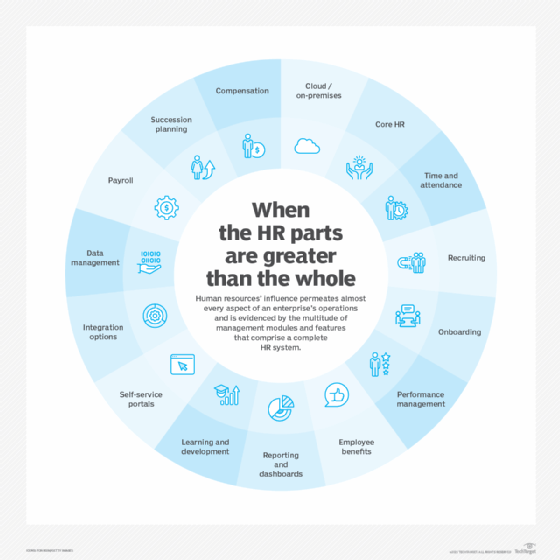
HR compliance problems can occur across recruiting, payroll, benefits, data management, training and other HR functions.
4. Lack of training
Training requirements vary by jurisdiction, industry, role and employer type. Depending on the organization, required or strongly recommended training may cover topics such as harassment prevention, workplace safety, data protection, privacy, cybersecurity, anti-money laundering, ethics, workplace conduct and anti-retaliation.
HR staff members are often responsible for assigning training, maintaining training records and confirming that employees complete required courses on time. HR should also confirm that managers receive training on topics such as interviewing, accommodations, employee complaints, performance documentation and wage and hour rules.
Companies that fail to administer required training, keep completion records or update training content when laws change may face penalties, lawsuits or employee relations problems.
HR compliance problems can change as laws, workforce models and HR systems evolve. HR leaders should review common risk areas regularly with legal, payroll, benefits, IT and business partners so the organization can correct small problems before they become audits, claims or penalties.
Editor's note: This article was originally published in 2024 and was updated to clarify recruitment compliance, I-9 recordkeeping, worker classification, benefits requirements and employee training considerations.
Lynda Spiegel is a freelance writer and former global HR executive for financial services, telecommunications and SaaS companies.