Mass automation: A vision for nearly automated companies
Nearly automated companies may sound like science fiction, but author Nick Pogrebnyakov argues business leaders should prepare now. Read an excerpt from his book Mass Automation.

AI agents have begun to automate end-to-end business processes. However, the next frontier could be fully or nearly automated companies.
In Mass Automation: Rethinking Companies for an AI Era When They Can Operate Autonomously, author Nick Pogrebnyakov presents what he calls a work of "biz-fi" -- the use of fictional scenarios to imagine how companies might operate in an AI-driven future. He argues the future of automation depends on three pillars: AI, robotics and sensing. While AI dominates much of today's conversation, he warns CIOs and business leaders not to overlook the other technologies required to enable large-scale automation.
"Everybody is asking [CIOs] how to create agents for this and that, but they mustn't forget about the other parts of automation," Pogrebnyakov said.
The following excerpt from Chapter 1 outlines Pogrebnyakov's vision for mass automation, explains why the three pillars must work together and explores what nearly automated companies could look like.
A vision of mass automation
This book is about a future that's probably nearer than you imagine: mass automation. There, most activities that humans engage in are automated, meaning these activities are run without constant human involvement or supervision.
What does mass automation look like? Consider the following scenario. If it sounds like science fiction, think about how much of this is already in place.
One day, as you're looking at a newly built steel-and-glass high rise, it sparks a memory of a toy you used to play with as a kid: a set of building blocks to make toy skyscrapers, with large, ready-made panels and connectors out of which you can quickly build skyscrapers and other buildings. You liked it a lot, but as an adult, you've never seen it being sold. So you decide to launch a line of skyscraper building blocks for children to enjoy.
You explain what those building blocks are to a central orchestrating system, which sits at the heart of your budding company and coordinates the activity of its automated "departments." This orchestrator passes your requirements to an automated design system, which outputs manufacturing specifications. A separate tool ensures that materials in those specifications are approved for children.
You tell the orchestrator that initially, you want to make a thousand sets a month and sell them in the country where you live. The orchestrator then finds and contracts a nearby manufacturing facility. An automated supply chain planner finds material suppliers and plans logistics. Meanwhile, the orchestrator issues and sells company stock to investors to cover operating expenses.
Since it's a child toy, your nearly automated company turns to digital government services to get the necessary permits.
Packaging is designed automatically, and after your approval, the facility that will make it is contracted, too.
One week before manufacturing starts, your nearly automated company launches a marketing campaign. It knows where parents and older children spend their time and targets advertising to these channels.
Contracts with sellers are automatically negotiated. Three months after the launch, you're happy to see that your toys are flying off the shelves like hotcakes.
Scenario 1. Launching a product in an automated company.
The book explores how companies and supply chains adapt to mass automation and how automation itself is shaped by them. My aim is to show a possible vision of the future to those who are impacted by the massive changes to the economy and society that this future entails. Business and technology leaders, engineers, researchers, and policymakers can then take steps to prepare for those changes.
An anticipated vision
AI is a popular subject these days, but this book aims to be different from most voices. Rather than extrapolating current trends, it establishes an anticipated vision -- mass automation -- and asks: what will companies look like in that world? This subtle change of perspective means that instead of looking ahead from today's perspective, we perch atop a possible future and survey its landscape. This allows probing deeper into possibilities and issues of automation, unshackled from the details of getting there. Divorced from those practicalities, which would have brought unnecessary detail and would look hopelessly outdated by the time they were implemented, the opportunities brought about by automation are clearer.
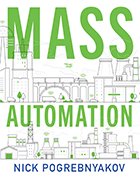 Click the cover image to
learn more about this book.
Much of what we do as humans -- certainly a lot of what we are paid to do -- revolves around our talents in one or more of three areas: making decisions, acting on objects in the physical world, and observing and interpreting the world around us. If you're a construction worker, you observe your environment and act upon it by pouring concrete or installing glass wall panels. If your job is an investment analyst, you collect and interpret multifaceted information about a company and its behavior to write investment recommendations. If you're a CEO, you make decisions based on information about your competitors, the market situation, and your experience.
Think of a company as a person in this sense. Just like people, companies make decisions concerning their operations (what I'm doing now) and strategy (why I'm doing this and what I should do next). Both manipulate objects in the physical world -- some companies more than others: think construction versus insurance. And both listen to and observe what is happening in the world.
Why mass automation becomes possible
Mass automation is made technologically possible by the maturity of three areas: AI, robotics, and sensing. They correspond to decision making (AI), acting in the physical world (robotics), and observing and understanding the environment around us (sensing). Today we have already achieved significant automation of these activities individually. Cars can park and, in many situations, drive themselves while being surrounded by human motorists -- who aren't always paragons of good driving. When OpenAI released ChatGPT in 2022, professionals across many industries were mesmerized by the quality with which it solved tasks in their profession, despite some occasional glitches. The effect of further, more nuanced, and capable automation is even more powerful, and combining these distinct automated activities together is more potent still.
Mass automation allows companies to make more products and provide more services faster, with fewer people, and in a more personalized way. These powerful new possibilities raise the question: with these technological developments, are nearly automated companies of tomorrow anything like companies of today? Does business in an automated world continue as usual -- in a very literal sense? The changes in societies and the economy that automation brings are profound and many, ranging from the individual (how people go about their daily lives) to society overall (what people expect from their governments). Here, we examine one slice of this pie and ask a more specific question: if most of what companies and supply chains do -- and by extension, most of what people who work at these companies were hired to do -- is capably done by machines, what does that mean for the ways companies and supply chains look and work?
 Nick Pogrebnyakov
When it becomes possible technologically
To put it simply: how will companies work when mass automation becomes a technological possibility?
First, let's call these companies nearly automated. We're not talking about full automation of companies and the economy at large. Why? Because some company activities remain under human control out of necessity or choice. For instance, sometimes companies need human involvement because of regulations. Products that put out medical diagnoses, for instance, may be required by law in some jurisdictions to involve a person with the final say.
Other things could not be automated because people do a better job than technology. For example, for a long time, robots did not have the dexterity necessary to take boxes off of shelves. That was a major reason why companies chose not to use robots more expansively in warehouses. It was only in the past few years that technological advances in control and hardware allowed them to do so.
And automated companies themselves have already been tried but were technologically deficient. An early attempt at an automated company was the decentralized autonomous organization, known then as the DAO. Created in 2016, it ran as smart contracts on a blockchain but was brought down by a hack that took a third of its assets.
Companies may have even more reasons for keeping people in the loop. Company owners may seek to make important strategic decisions or tweak processes that may be critical to the company's success. And, of course, people own these companies and make fundamental decisions, a basic example of which is whether the company should be closed down.
As a result, there are still people in those nearly automated companies. They are owners, decision-makers, researchers, or specialized workers.
Why we should care
Why do we need to care about the possibility of mass automation? After all, if it comes, it comes, and if it doesn't come, why bother?
One reason is to plan and prepare for this possibility so that business leaders and policymakers can prepare for this future instead of reacting to it when it arrives. New technologies often become a reality faster than society and the economy can adapt, leaving us scrambling to keep up.
For business leaders, this book may inspire thought about questions such as:
- What aspects of my business should I automate -- and when?
- What will my company look like when most of what it does can be automated?
- What becomes my company's competitive edge? What should we compete on?
- How do I structure an organization where strategy and execution are largely handled by machines?
- Should I centralize or decentralize decision-making in an automated enterprise?
Technology leaders may consider:
- Are we building the enabling blocks of automation, namely AI, robotics, and sensing in a balanced way?
- How can we prevent automation silos from forming in our tech stack?
- What should our orchestration architecture look like across functions?
- How can we ensure reliability and explainability in critical decisions that are automated?
Entrepreneurs could ask:
- What business ideas can I test in a world where these ideas can be effortlessly turned into a company?
- What types of companies become feasible when automation handles most operations?
- What startup opportunities exist in marketplaces for data or automated company functions?
Management and business scholars might wonder:
- How do firms coordinate, strategize, and compete when operations are autonomous?
- What theories need updating to account for AI-driven organizations?
- Can we really draw a boundary between strategy and operations in interdependent automated systems?
Nick Pogrebnyakov is an author and business school professor turned AI practitioner.
Tim Murphy is a site editor and writer for the IT Strategy team at TechTarget.
Dig Deeper on CIO Strategy
-
![]()
Fully automated companies: What CIOs need to know
By: Tim Murphy
-
![]()
SHRM CEO gives HR needed pep talk amid bad rap, AI challenges
By: David Essex
-
![]()
Mattel taps into Google Cloud to accelerate product innovation in response to customer feedback
By: Caroline Donnelly
-
![]()
The death of the piggy bank marks coming of age of a fintech
By: Karl Flinders