Fully automated companies might not be as futuristic as they seem. CIOs should consider how AI, robotics and sensing will work together to shape the future of automation.
Author Nick Pogrebnyakov shares his vision for mass automation and what it means for CIOs:
Think beyond AI. Build automation strategies that integrate AI, robotics and sensing rather than treating them as separate initiatives.
Avoid creating tomorrow's silos. Design AI agents and workflows to work together across the business instead of becoming isolated systems.
Prepare for more autonomous enterprises. As automation expands, CIOs will increasingly orchestrate automated systems rather than manage individual processes.
Use imagination to prepare for the future. Pogrebnyakov's "biz-fi" approach encourages leaders to envision how companies could operate in an AI-driven world before those changes arrive.
AI agents can automate individual tasks and processes, but the next frontier may be automating entire companies.
Science fiction has long imagined flying cars, autonomous robots and other futuristic technologies. Yet, it rarely explores the organizational details behind those technologies, such as who builds them, who markets them and what a company looks like when much of its work runs autonomously.
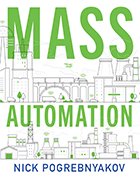
This gap inspired Nick Pogrebnyakov, author and former business school professor turned AI practitioner, to write Mass Automation: Rethinking Companies for an AI Era When They Can Operate Autonomously. He calls the book a work of "biz-fi" -- a blend of business strategy and speculative fiction designed to help business leaders imagine how AI, robotics and sensing could lead to nearly automated companies, or mass automation, in the near future.
Rather than focusing solely on AI, Pogrebnyakov argues that CIOs should think about how AI, robotics and sensing work together as part of a broader automation strategy. This requires avoiding technology silos, not letting AI overshadow investments in sensing and robotics, and preparing for a future in which humans increasingly orchestrate automated systems rather than run them directly.
In the following Q&A, Pogrebnyakov discusses the ideas behind Mass Automation and how CIOs can prepare their organizations for a more autonomous future.
Editor's note: The following transcript was edited for brevity and clarity.
What is your background?
Nick Pogrebnyakov: I have a PhD in Information Science and Technology, which is an interdisciplinary program that brings together people from machine learning (ML), computer science, anthropology and business. The idea is that if you unite people from different backgrounds to work on a problem, you get an interesting result.
After graduating, I worked for 13 years as an associate professor at Copenhagen Business School, where I researched and taught technology strategy, international business, how companies work, how companies move abroad and how they use technology. Then I moved to the industry side, where I started working as an AI researcher and ML engineer. I worked at several companies, including Thomson Reuters and Twitter, and I've headed an AI startup.
Click the cover image to
learn more about this book.
Why did you decide to write Mass Automation?
Pogrebnyakov: It started as an idea from reading science fiction. When you read sci-fi, you see all these interesting technologies, such as space travel and flying cars, which may or may not come to pass -- and some of them have already been implemented. The questions I've found lacking in sci-fi are "Who actually makes all of these flying cars?" and " Who finds customers to travel to distant stars?"
They're interesting questions because as we get increasingly used to AI being everywhere, we need to know how to bring it into our organizations. How do we restructure our companies for the AI age? This is a question that needs an answer.
How can reading sci-fi, or in the case of your book's genre -- "biz-fi" -- help business and tech leaders in their careers?
Pogrebnyakov: Biz-fi is my call to business leaders and the broader ecosystem that trains them to use more imagination.
Sci-fi provides us with ideas for products. Even before something can be implemented, such as a flying car, it's already been thought of 50 years ago. However, we don't have a similar blueprint for organizational forms, such as how we run processes and think about strategy in an AI world. For example, if you can have an agent that can formulate and implement a strategy for your company:
What permissions do you give it?
How does it work with internal systems within the company with other agents?
We know how AI agents work in specific workflows, such as software development, but what happens when they begin coordinating entire business functions?
Who is working inside these companies?
What are the jobs that humans do?
There are a lot of questions we don't have answers for, and if we put out some wild ideas, even though they might not come to pass, we at least stimulate some thinking about how we can restructure companies for the AI age.
Nick Pogrebnyakov
What are the three pillars of automation, and why are they important?
Pogrebnyakov: AI, robotics, and sensing. The reason I talk about them separately is twofold. First, this is how people behave. We perceive the world -- this is our sensing. This maps to organizations collecting and interpreting data. Then we decide what to do next -- this maps to AI decision-making. Then there's taking actions in the physical world, such as moving a box -- that's robotics. These pillars move at very different development speeds. For instance, AI is everywhere, whereas robotics, despite being very mature, gets much less coverage than it should.
Sensing is probably the least talked about of the three, even though it's foundational to both AI decision-making and robotics. A lot of the debate in the AI world right now is about how to provide models with organizational context so that an AI agent can make good decisions. It's the same for robotics. If you don't have a good perception of what's happening in the world, you will get poor outcomes. This is a reason to treat them separately.
At the same time, I want to bring the attention of leaders, such as CIOs, to the fact that all three are needed -- depending on which company you're at. Don't forget about them, because you need to integrate them. The power of an automated company comes from integration.
CIOs must avoid creating silos. That's why we need to talk about them together and look at what your company is doing today, where there is under-investment and where there is over-investment.
Why should CIOs, specifically, read this book?
Pogrebnyakov: So, they don't treat technologies in isolation. CIOs have a lot demanding their attention, and the strongest signal today is AI. Everybody is asking them how to create agents for this and that, but they mustn't forget about the other parts of automation. Are you underinvesting in sensing? The book aims to create a balanced perspective across the three pillars and envision what an automated company could be.
Everybody is asking [CIOs] how to create agents for this and that, but they mustn't forget about the other parts of automation.
You might have an automated marketing function that creates marketing campaigns, runs them and has a dashboard for a human to see. Then, you might have a manufacturing function that creates the physical products with a dashboard for how it's performing. There are already dark factories that operate with few humans -- automated manufacturing. But who oversees these functions? There should be an orchestrator of different functions, so manufacturing doesn't get ahead of sales. For instance, you don't want sales to sell 1,000 units if manufacturing can only make 100.
As CIOs build AI into the business, they must bring together the different pillars and ensure all company functions run at similar speeds. To do this, they can ask the following:
Are we building AI silos today in the way we create agents, codify processes and transform them into agentic workflows?
How do we ensure AI agents don't have competing goals?
How do we make processes explicit?
Do you believe that mass automation -- nearly automated companies -- is the direction that organizations and civilization should be heading?
Pogrebnyakov: I'm careful not to say that we should be doing this. The idea is that this might happen, and if it does, we had better prepare for it.
I'm careful not to say that we should be doing this. The idea is that this might happen, and if it does, we had better prepare for it.
If it happens, there are consequences for companies and the economy. For example, we might see the economy and companies split into two modes. One is maintenance, and the other is development. Maintenance is when a product just runs – it doesn't need many improvements.
Development is when you need to actively develop a new product or make significant refinements to an existing one. Many of the products currently in development mode might be moved to maintenance mode. Just let people consume that and redirect energy to creating new products and processes. We might also see AI tools, such as the orchestrator I mentioned, actively looking for new strategies. How do you make new products? How do you enter new markets with little human involvement aside from approval at the end?
When I was at a business school, I created an AI agent that developed a strategy in a simulated environment and showed it to about 1,000 students working in a similar simulation. They were all happy with the strategies that the agent discovered. There are several implications for where this might go, and I want us to be prepared for that.
What other advice do you have for CIOs?
Pogrebnyakov: As CIOs think about how to automate processes, they might consider monetizing the processes they automate. For instance, once you develop a well-functioning marketing pipeline for your industry, can you sell that capacity?
As CIOs think about how to automate processes, they might consider monetizing the processes they automate.
Another one is containerization. Many CIOs come from a tech background. They're familiar with Docker containers, which contain everything an application needs to run. You can think of companies themselves as Docker containers. You can package all that a company needs -- accounting, marketing, production -- into one piece of software and possibly hardware and sell it as a company.
If OS automation comes to pass, it unlocks a golden age for entrepreneurship, because we'll be able to pull together pre-built containerized companies or individual company functions and assemble them into a company easily. Then, we can implement whatever business idea we were dreaming about. In Silicon Valley, there is a bet right now on who's going to build the first one-person unicorn company, or when it will be built. That means a person who's running a billion-dollar company themselves.
Shapeshifting is another possibility. It's when you start in one industry and see an opportunity to move to another. With the automated discovery of possibilities and assembly of company components, you can do that more easily. For example, Nokia transformed from a pulp mill to a rubber boots company to a mobile phone manufacturer to a telecommunication company. Mass automation will enable this kind of shapeshifting on a much grander scale.
Tim Murphy is a site editor and writer for the IT Strategy team at TechTarget.

 Click the cover image to
 Nick Pogrebnyakov