LAS VEGAS -- AI dominates headlines, but what are the trends that have the greatest impact on organizations and IT leaders? IT leaders know emerging trends can change at any given moment. However, one concept remains clear -- technology decisions can be erratic.
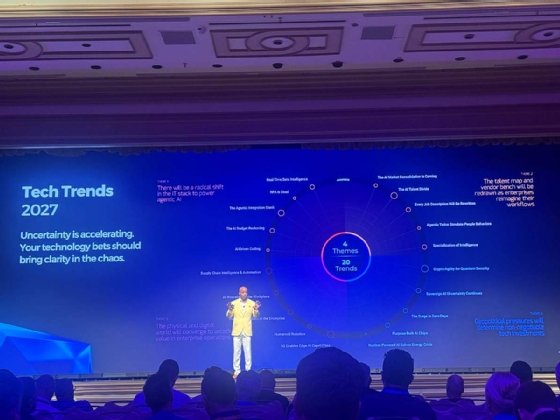
At the 2026 Info-Tech Research Group LIVE event June 8-11 in Las Vegas, Rob Meikle, executive counselor at Info-Tech Research Group, presented these trends.
Info-Tech determines these trends based on market signals, vendor strategies, venture capital investments, analyst conversations, new technology patents, and policy and regulatory shifts. Here were the top IT trends presented at Info-Tech LIVE.
Top themes for the IT trends
Before presenting the trends, Meikle said there were distinct themes for 2027, including the following:
There will be a radical shift in the IT stack. Decisions on budget and infrastructure today will determine how organizations shape their portfolio for the next decade. Examples of shifts include software development, data flows and how businesses serve customers. All of this centers on AI, so delivery and operating models must catch up.
Talent and jobs will be reimagined. There will be a talent divide between those who embrace AI and those who do not. AI is fundamentally changing how work is completed, not just automation of tasks, but reshaping operating models, customer interactions and the role of people in the organization. Organizations that adapt their workflows will have an advantage. Those who do not adapt will bear the cost of human effort, while machines could achieve greater efficiency.
The physical and digital world will converge. Technology is moving off the screens and into the world. It is powering robots on warehouse floors. The global supply chain is changing. Digital twins create environments in which the physical world is continuously monitored and modeled, and then acted on by intelligent systems.
Geopolitical pressures will determine tech investments.Geopolitical pressures will dictate which investments are mandatory and which are optional. The threat environment has expanded beyond cybersecurity into geopolitics. Data sovereignty, regulatory fragmentation and state-level risks are added to traditional security concerns for organizations. Energy and chip manufacturing will reshape the infrastructure underpinning AI technology, and regulations may determine how this is achieved.
Rob Meikle presenting top IT trends at the Info-Tech Research conference on June 10, 2026.
Agentic AI: The super trend
Agentic AI is a super trend. It is not new, but it is already redefining the landscape for 2027 and beyond. Info-Tech highlighted three trends for agentic AI:
AI is artificially inexpensive. The market will consolidate, and vendors will gain pricing power, leading to a cost shock. What was once free may no longer be. When this happens, organizations will need to reallocate AI funds from tools that are not mission-critical.
AI is not replacing jobs but changing them. AI literacy will cause a divide between employees who use it and those who do not. This may be a determining factor when making resourcing decisions.
Robotic process automation (RPA) is dead. All RPA implementations are about to become technical debt. As bots tied to old systems cannot be upgraded to the new AI systems, they will need to be rebuilt. "Traditionally, RPA has helped automate routine and repetitive tasks, but AI is pushing the boundaries on what can be automated and help automate messy processes that RPA bots could never handle," Meikle said. The RPA vendors are all repositioning, but organizations sitting on hundreds of legacy bots are facing a forced migration program that was not in the budget, he said.
The AI market will consolidate, and vendors will gain pricing power, leading to a cost shock. What was once free may no longer be.
Top IT trends presented at Info-Tech LIVE
These are the top trends IT leaders wanted to address at the conference:
The surge in zero-days
AI adoption leaves businesses more exposed. Implementing at a greater speed is forcing organizations to adopt AI faster than they can vet vendors, which can lead to accidental negligence.
Open source code is a big threat, but the problem is not open source code alone. The real problem is knowing where it is -- it's easy to lose track of it. If organizations don't know where the code is located, it can't be patched or updated, increasing vulnerability as attackers scan these public repositories. According to a report from Black Duck, 86% of commercial codebases have open source software vulnerabilities.
Meikle recommended that organizations ask these three questions to assess their open source security posture:
What are the company's open source implementation guidelines?
Does the organization have source composition analysis capabilities?
How quickly can the organization react when an issue is recognized?
Supply chain intelligence and automation
Supply chain and logistics are moving from human-driven operations to AI systems. Meikle said AI may help anticipate disruption versus being reactive. Most decisions in human-driven logistics are made by instinct, whereas AI reroutes inventory and automatically places orders. For IT leaders, embedding AI across ERP, logistics and procurement can position supply chain intelligence as an enterprise platform instead of an operations project. McKinsey estimates that around 2 trillion in annual value across supply chain manufacturing is not yet being accessed in the U.S., and Info-Tech Research believes AI is key to this.
Autonomous execution is another key area. This builds on AI's ability to act without intervention. Now, shipping and logistics are exploring autonomous delivery with driverless freight and drone delivery. Embedding AI into supply chain intelligence is established in this trend; however, what is next? Technology will become more advanced and deserves discussion within operations and integration. Autonomous logistics can be a market differentiator. IT leaders must ask:
Who owns the supply chain? Is it an enterprise-wide decision or IT-engineered?
How can a company get it? As an IT leader, the questions of build vs. buy must be addressed, as well as how the existing data infrastructure can manage the demand for intelligence and automation.
Sovereign AI
The regulatory environment is changing. However, an organization's preparation should not change.
Meinke said regulatory action is not an "if" but a "when" it will happen. A well-prepared organization separates the leaders in the industry, and this preparation is for the next regulatory action, not the current one.
Some regions are consolidating into unified frameworks while others are fracturing into jurisdictions that vary by state, sector or industry. Organizations cannot wait for regulatory certainty before building their governance infrastructure because there is none. Rules will continue to shift. Organizations need to prepare more quickly than regulatory changes require.
Two years ago, American models dominated AI downloads, making up 60% of the market. Now, Chinese models account for 17.1% of the global downloads, but 80% of American startups use Chinese open source models, according to the Center for European Policy Analysis. Chinese open source model licenses differ and may involve unforeseen circumstances -- countries in the EU are banning DeepSeek use because of this. The U.S. government is also removing DeepSeek from internal use, citing national security concerns.
There are three considerations for every IT leader:
Does the hyperscaler strategy create compliance exposure?
Is the AI governance strategy adaptable to regulatory change, or is it locked into today's rules?
Is the organization reliant on foreign AI capability?
These questions will point to two actions -- redesigning AI risk management to be adaptable and setting a benchmark for how much foreign AI the organization can rely on. Organizations need an AI board to review and stay on top of security and compliance trends.
Living with humanoid robotics
Venture capitalist investments are up 262% year over year in robotics alone, according to PitchBook. VC funding is fueled by industry demand and market growth. Technology will advance, and the use cases may increase as well. Humanoid robots may enter the household beyond automatic vacuums. These robots may find their way into various industries -- including logistics and manufacturing.
Even if there is no budget for physical AI, there are ways to prepare for this shift. Determining who owns the physical AI stack is the first step. This should go beyond a business decision, because this kind of technology requires infrastructure. Prepare the foundation now for faster adoption. Organizations with a strong foundation will see the greatest benefit in the future.
Amanda Hetler is a senior editor and writer for Informa TechTarget, covering IT strategy and CIO topics, including AI, security and risk management, and digital transformation.