Human skills become a competitive advantage. As AI automates more technical work, CIOs should prioritize skills such as critical thinking, adaptability and emotional intelligence.
Learning agility is now a business imperative. Organizations must hire for potential and embed continuous, AI-supported learning into daily work.
AI success depends on people and culture. CIOs need to build human-AI hybrid teams and foster adaptable, change-ready organizations.
LAS VEGAS – With AI increasingly involved in most business conversations and planning, IT leaders are being forced to rethink how they hire, develop and organize technology teams.
Info-Tech Research Group released its IT Talent Trends 2006 report at the LIVE event in June 2026, highlighting the shift IT the IT workforce driven by the rise of AI.
The theme of this report is that AI cannot replace humans, but it will create a new hybrid human-AI workforce, and leaders need to focus on the human skills AI cannot duplicate -- skills such as critical thinking, adaptability, emotional intelligence and teamwork.
Other key findings of the report include the following:
95% of IT professionals are aware of required skill changes to keep up with technology.
76% of IT managers have moderate or increasing stress levels.
42% of IT professionals are seeking jobs -- either actively or passively.
"Forward-looking CIOs prioritize the human element," said Isabelle Hertanto, associate vice president of research development at Info-Tech Research Group, during a presentation at the Info-Tech Research Live event.
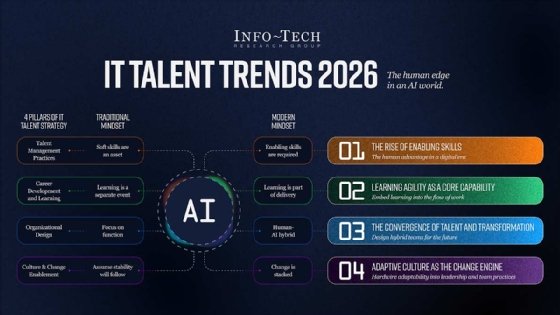
Here are the four IT talent trends highlighted in Hertanto's presentation and in the report.
These are the four IT talent trends presented by Info-Tech Research.
1. Enabling skills are the human advantage
With AI, technology has evolved, and having technological expertise is no longer a differentiator. However, AI cannot replicate human abilities such as emotional intelligence, problem solving, critical thinking and business acumen. These types of skills should be the focus of an organization. Hartanto told TechTarget that enabling skills are those that help employees use technology and navigate change, creating a framework in advance to be prepared. These objectives should be drilled down to the unit level for hiring.
"You want to hire and reward potential, not just credentials, recruit people who are curious and come from diverse backgrounds," said Hertanto. "Then reward your employees based on impact and behavior -- not just throughput -- especially those who use AI to learn, to innovate and to create, as well as elevate others in the organization." This reinforces employees' habits for lasting change.
She said the IT talent advantage is more than just being technologists; it's about solving problems, making decisions and teaching team members to embrace technology.
Info-Tech Research shows learning agility is becoming increasingly critical for career longevity in IT. For example, their research shows it takes three months to hire in IT -- five months for critical roles. To get full productivity from that hire, it takes about 12 months. The half-life of technical skills is less than three years. That means by the time a new hire is ready to go, the skills they were hired for are only a couple of years away from becoming outdated.
"So, hiring won't get you out of this new skills gap," Hertanto said.
There is a balance between hiring and training. Hertanto said to hire for aptitude and potential and then prepare to train for the rest.
Leaders need to focus on the human skills AI cannot duplicate.
2. Learning should be a core metric
According to Info-Tech Research, the key to success in 2026 is to create targeted, collaborative and highly iterative learning opportunities -- especially as the tech landscape changes. Organizations should focus development efforts on embedding learning into delivery and increasing agility across teams. When the environment changes so quickly and so often, the employees' ability to learn, unlearn and relearn will make the difference.
Hertanto pointed to these tactics to help CIOs embed learning into the flow of work:
Adopt learning as a core metric in hiring, developing and promoting within the organization. Evaluate employees on their ability to learn and adapt, not just on their performance in their current job.
Embed continuous learning into daily work. IT leaders should make learning a part of work -- not separate from it. Give employees time to learn every day and make it easy with short, on-demand, micro-learning opportunities.
Use AI to scale upskilling. An organization's AI strategy should prioritize upskilling and augmented learning. For example, one approach might be to build an AI tool that analyzes skill supply and demand and then personalizes learning plans for each employee.
An example would be embedded AI learning integrated into processes and tools. AI nudges leaders in real time, telling them this is a moment to coach -- without separate dashboards or extra steps … just learning.
3. Create human-AI hybrid teams
Successful transformation isn't about adding more tools; it's about intentionally rebuilding teams around the workflows and work that are constantly changing. Human-AI hybrid teams redefine roles to transform how employees learn, collaborate and execute jobs.
In the context of digital transformation, complacency isn't about ignoring AI; it's about over-trusting it without doing the work to ensure that humans remain in control.
"Remember, the goal of transformation today isn't about optimizing old processes that no longer serve us," Hertanto said. "It's about doing better work with greater impact and delivering higher value for the organization as a whole."
Info-Tech shows that successful transformation relies on human-AI hybrid teams, where AI isn't just a resource or tool to be consumed, but rather treated with the same consideration and oversight as a member of staff.
For the first time, tools can make decisions and provide advice. These tools are prone to undesirable human-like traits -- such as hallucinations and reasoning failures -- and their performance can be unreliable. This can create a complex relationship between technology and its users -- one that requires oversight.
However, rapid growth doesn't come without painful challenges, and so it's no surprise that most organizations expect some level of restructuring due to AI. For IT leaders to take control and build balanced hybrid IT teams, they must create new roles and career paths around emerging tech. The human workload side must be planned with intent, and the AI side must be built for efficiency using human judgment.
4. Instill an adaptive culture for change
Culture is often cited as a driver of resistance and resilience, but what that means in practice varies slightly. On one hand, some believe that stability in leadership is still extremely crucial for success; on the other hand, leadership is less about projecting certainty and more about creating environments where learning and reflection are valued. Now, Info-Tech emphasizes the critical role of leaders in creating adaptable, resilient and psychologically safe environments that help employees embrace change as a constant.
Only a small fraction of organizations is seeing tangible results from AI. The root cause appears to be unrelated to structural flaws or budget constraints. Transformation efforts fail because of human resistance, fatigue and failure to adapt. These are not technical failures -- they're people failures.
The adaptability quotient, or AQ, is emerging as a critical metric in IT. AQ predicts how effectively an individual or team navigates change and disruption. According to Info-Tech, people who lack adaptability experience higher levels of stress, stagnation and anxiety when confronted with change. Successful transformation relies on adaptive cultures that need to be nurtured at all levels of leadership.
Here are three tactics shared during the presentation to create adaptability in leadership practices.
Invest in leadership development programs that focus on empathy, change leadership and coaching. To promote a culture of change, it needs to be visible from the top.
Empower decision-making at all levels. Think about when a team member pushed a decision up a level that they probably could have solved on their own. Leaders need to think about how to set these employees up for success so they can make these kinds of decisions with greater confidence. This starts by trusting employees and putting decisions in the hands of those who are closest to the work.
Encourage continuous feedback and listening. Use AI to generate feedback at scale, detect sentiment shifts and surface emerging issues before they escalate. The result is a culture where people feel heard, they trust the process and they show up ready for change.
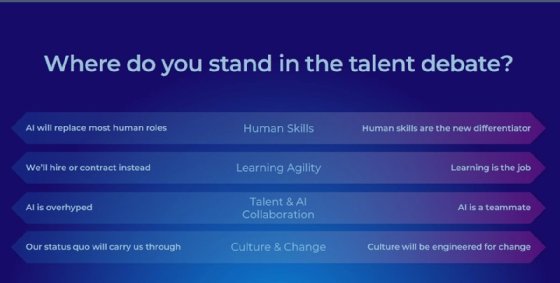
Organizations should determine where they stand on IT talent and AI to help plan learning strategies and AI adoption.
Info-Tech Research shared this slide for businesses to consider their stance on IT talent and AI.
Amanda Hetler is a senior editor and writer for Informa TechTarget, covering IT strategy and CIO topics, including AI, security and risk management, and digital transformation.